- Multi Channel Order Management
- TikTok Shop
- Amazon
- Temu
- About 4Seller
- Shopify
- Multi Channel Inventory Management
- Amazon MCF&FBA
- Seller Tips
- Listing Management
- Marketplace News
- Amazon Shipping
- DHL Express
- UPS
- Amazon MCF
- FedEx
- eBay
- Shein
- Creator Bulk Invite
- Inventory Sync
- GLS
- Multi-channel Store
- Walmart WFS
- Walmart
- Royal Mail
- Shipping Integration
- Kaufland
- DHL Parcel
- Seller Story
- Beginner Tutorial
- 3PL
- Walmart MCS
- Shipping Label
- Deutsche Post
- WooCommerce
- OTTO
- Platform Integration
- PayPal Tracking Sync
- UniUni
- Yodel
- ShipHero
- SPU Catalog
- Stripe Tracking Sync
- USPS
- GOFO
- CIRRO
- Correos
- Correos Express
- DPD
- Etsy
- Evri
- FBM
- Request Review
- Logistics Rule
- CaiNiao
- BRT
- Chronopost
- Poste Italiane
- Cdiscount
- AliExpress
- OMS
- DHL
- ShipBob
- WFS
- Price Sync
The 3PL Problem No One Warns Sellers About — How 4Seller Enhances Multi-Channel Inventory & Automatic Fulfillment?
 By Joline01 Dec,2025
For U.S. and European ecommerce brands, the 3PL you choose can make or break your operations. But what really determines efficiency and profitability is not the warehouse itself— it’s the system that connects your sales channels and your warehouse.

Inventory gaps, missing orders, reconciliation errors, delayed tracking uploads… They look like warehouse issues, but they’re actually system failures caused by data not flowing correctly.

And the truth is simple: Choosing the wrong 3PL software makes you lose money without even noticing.

1. The Typical Pain Points of Working With 3PLs

Why So Many Brands “Lose Money While Doing Nothing”?


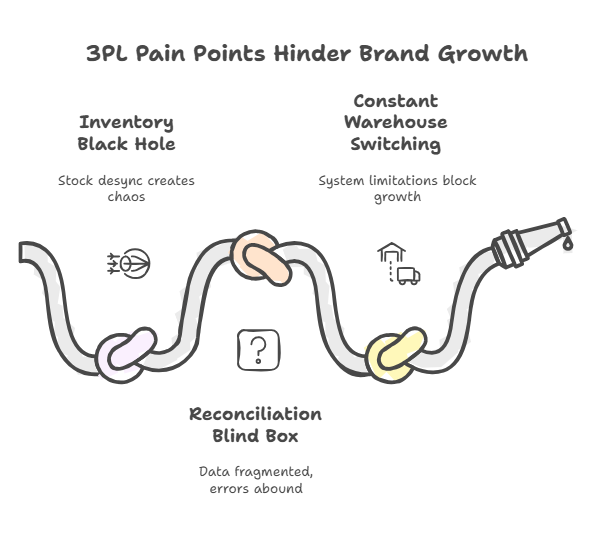
1) The Inventory Black Hole: Multi-Channel Stock Desync

When your sales happen across Amazon, Shopify, TikTok, Walmart, eBay, and other channels,

any delay or inconsistency in inventory syncing quickly creates chaos:

-
Platform inventory becomes inconsistent
-
Ads keep running while SKUs are actually out of stock
-
Low-stock alerts fail
-
Warehouse inventory and platform inventory never match
In short—you never know what your real inventory is.
The result?
Overselling, delayed shipments, canceled orders, platform penalties, wasted ad spend, and unhappy customers.
Traditional systems often sync slowly, or don’t sync at all. You end up manually adjusting stock—until something breaks.
2) Reconciliation Becomes a Monthly “Blind Box”
When your data is fragmented, you’re forced to cross-check:
-
Platform stock vs. 3PL stock
-
Order statuses vs. warehouse shipping logs
-
Listed quantities vs. actual outbound records
You spend hours trying to match numbers that never match. It feels less like accounting and more like a detective job—time-consuming, draining, and error-prone.
3) Constant Warehouse Switching:
System Limitations Create an Endless Loop**
As your brand grows, traditional 3PL systems often fail to keep up:
-
No multi-platform inventory linking
-
No automation rules
-
Limited routing capabilities
-
No unified tracking-number sync
Which means the moment your operations become more complex, you’re forced to switch warehouses or switch systems again and again. The warehouse should support your growth—not block it.
2. The Traditional “Manual Push” Workflow Is Fundamentally Broken
Many brands still operate like this:
Download order CSV → Reformat → Upload to 3PL → Wait → Manually copy tracking numbers → Update multiple platforms
On paper it looks simple. In reality:
-
You can’t keep up during high-volume periods
-
CSV templates change and break your process
-
Tracking numbers get lost or entered incorrectly
-
Missing orders go unnoticed
-
Multi-channel stock must be updated manually (causing inevitable errors)
This is not automation. This is manually feeding a system that was supposed to help you.
3. Connecting a 3PL via a Shopify App Isn’t Real Automation
Many Shopify sellers assume: “I just need to install my 3PL’s Shopify app. Problem solved.”
But Shopify connections only solve one very small part of the problem:
-
They work for Shopify only
-
They do NOT support Amazon / Walmart / TikTok / eBay
-
Inventory sync only covers Shopify, not your entire ecosystem
-
Tracking often doesn’t sync back to all channels
-
Routing is limited
-
Any multi-channel operation breaks the workflow immediately
This is why Shopify brands struggle the moment they expand beyond DTC. These plugins provide surface-level automation, not the backend stability a growing brand needs.
4. 4Seller: A True Automation System Built for Multi-Channel Brands
4Seller is not a plugin—it’s a centralized ecommerce operations platform designed to unify your sales channels and your warehouses.
4Seller alre ady supports leading 3PLs and fulfillment services: Walmart WFS, Amazon FBA, ShipBob (with ongoing expansion).
Real-Time, Multi-Store Inventory Sync & Automatic Deduction (No More Overselling)
This is where 4Seller becomes a game-changer.
4Seller automatically monitors your inventory across all platforms and, whenever an order comes in—on ANY channel—it:
-
Deducts inventory across ALL stores instantly
-
Prevents overselling
-
Eliminates the need for manual adjustments
-
Removes the risk of inconsistent stock levels
-
Keeps your entire system accurate and aligned
For multi-channel brands, this is not a “feature”—it’s a lifeline.
5. How 4Seller Creates True End-to-End 3PL Automation
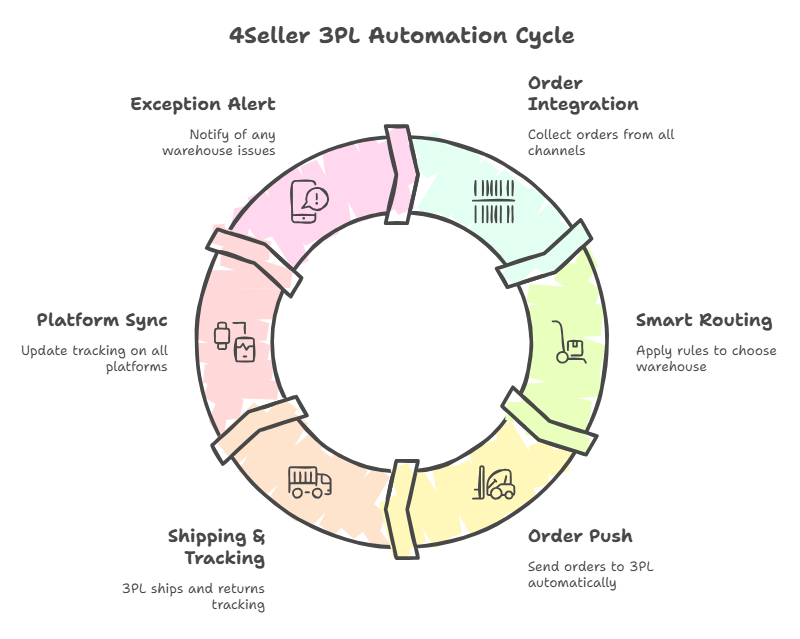
Here’s what the workflow looks like in reality:
-
All channel orders flow automatically into 4Seller
Shopify, Amazon, Walmart, TikTok, eBay, Etsy—everything in one place. -
4Seller applies smart routing rules
Choose the cheapest warehouse, nearest location, or SKU-specific warehouse automatically. -
Orders auto-push to the correct 3PL (no manual steps)
-
3PL ships → tracking auto-returns to 4Seller
-
Tracking auto-syncs to every platform instantly
-
Any warehouse exception triggers an automatic alert
No more silent failures.
It’s fully automated from start to finish—faster, more accurate, more scalable, and dramatically more reliable.
Helping article: How to Fulfill Orders Via Shopify 3PF Warehouse?
6. Why 4Seller Is Especially Critical for U.S. & European Brands
Because Western ecommerce has unique operational demands:
-
Multi-channel sales are the norm
-
Warehouses are spread across multiple states or regions
-
Sudden order spikes (sales events, seasonality)
-
High ad costs mean inventory mistakes = burned cash
-
Customers expect fast updates and fast fulfillment
-
Large SKU catalogs, frequent restocking
-
Teams rely on shared, accurate data
This means:
You don’t need a plugin.
You need a system that can truly run your fulfillment operations.
4Seller gives you:
-
More accurate inventory
-
Lower labor cost
-
Fewer errors
-
Faster fulfillment
-
Full multi-channel automation
-
Zero overselling
-
Intelligent routing
-
Seamless tracking sync
-
A stable, scalable operational backbone
Exactly what modern brands require to grow.
Conclusion:
3PL Software Isn’t a Tool—It’s Your Brand’s Operational Foundation**
No matter your current model:
-
Multi-channel + multi-warehouse
-
DTC + Amazon + Walmart
-
Shopify + FBA + ShipBob
-
High SKU count
-
High-volume sales
-
Multi-team collaboration
4Seller provides:
-
Real-time inventory sync across all stores
-
Automatic stock deduction (no overselling)
-
Zero manual inventory updates
-
Fully automated fulfillment
-
Automated routing to the correct 3PL
-
Automatic tracking sync to all channels
-
Exception alerts
-
A truly unified operational command center
This is the infrastructure modern ecommerce brands actually need.
Not just a plugin.
Not a temporary workaround.
But a long-term foundation for scale and stability.
- Multi Channel Order Management
- TikTok Shop
- Amazon
- Temu
- About 4Seller
- Shopify
- Multi Channel Inventory Management
- Amazon MCF&FBA
- Seller Tips
- Listing Management
- Marketplace News
- Amazon Shipping
- DHL Express
- UPS
- Amazon MCF
- FedEx
- eBay
- Shein
- Creator Bulk Invite
- Inventory Sync
- GLS
- Multi-channel Store
- Walmart WFS
- Walmart
- Royal Mail
- Shipping Integration
- Kaufland
- DHL Parcel
- Seller Story
- Beginner Tutorial
- 3PL
- Walmart MCS
- Shipping Label
- Deutsche Post
- WooCommerce
- OTTO
- Platform Integration
- PayPal Tracking Sync
- UniUni
- Yodel
- ShipHero
- SPU Catalog
- Stripe Tracking Sync
- USPS
- GOFO
- CIRRO
- Correos
- Correos Express
- DPD
- Etsy
- Evri
- FBM
- Request Review
- Logistics Rule
- CaiNiao
- BRT
- Chronopost
- Poste Italiane
- Cdiscount
- AliExpress
- OMS
- DHL
- ShipBob
- WFS
- Price Sync
 17 Dec,2024
- 17 Dec,2024