- Multi Channel Order Management
- TikTok Shop
- Amazon
- Temu
- About 4Seller
- Shopify
- Multi Channel Inventory Management
- Amazon MCF&FBA
- Seller Tips
- Listing Management
- Marketplace News
- eBay
- Amazon Shipping
- Amazon MCF
- DHL Express
- FedEx
- UPS
- Shein
- Creator Bulk Invite
- Multi-channel Store
- Inventory Sync
- GLS
- Beginner Tutorial
- Walmart
- Walmart WFS
- Shipping Integration
- Seller Story
- Kaufland
- Royal Mail
- 3PL
- Platform Integration
- Shipping Label
- OTTO
- WooCommerce
- Deutsche Post
- Walmart MCS
- GOFO
- DHL Parcel
- Yodel
- SPU Catalog
- PayPal Tracking Sync
- ShipHero
- USPS
- Stripe Tracking Sync
- AliExpress
- UniUni
- CIRRO
- Correos
- Poste Italiane
- Chronopost
- BRT
- CaiNiao
- Logistics Rule
- Request Review
- FBM
- Evri
- Etsy
- DPD
- Correos Express
- Cdiscount
- WFS
- DHL
- OMS
- Price Sync
- ShipBob
Walmart Fulfillment Services (WFS): The Complete Guide for Sellers and How 4Seller Automates Multi-Channel Fulfillment?
 By Joline02 Dec,2025
Running a successful online business on Walmart Marketplace requires efficient order fulfillment, fast shipping, and seamless inventory management. Walmart Fulfillment Services (WFS) offers a powerful solution, providing sellers with access to Walmart’s nationwide fulfillment centers, 2-day shipping, and streamlined returns. With WFS, sellers can focus on growth while Walmart handles the logistics.
However, managing multi-channel sales and syncing inventory across platforms can still be challenging. This is where 4Seller ERP comes in. As an Approved Walmart Marketplace Solution Provider, 4Seller fully integrates with Walmart WFS, automating order processing, inventory management, and fulfillment across multiple channels.
In this guide, we’ll explain everything you need to know about Walmart Fulfillment Services, including eligibility, pricing, benefits, and how to efficiently automate multi-channel fulfillment with 4Seller. By the end, you’ll understand why combining WFS with 4Seller is the ultimate strategy for scaling your Walmart Marketplace business.
1. What Are Walmart Fulfillment Services (WFS)?
1.1 Definition and Purpose of WFS
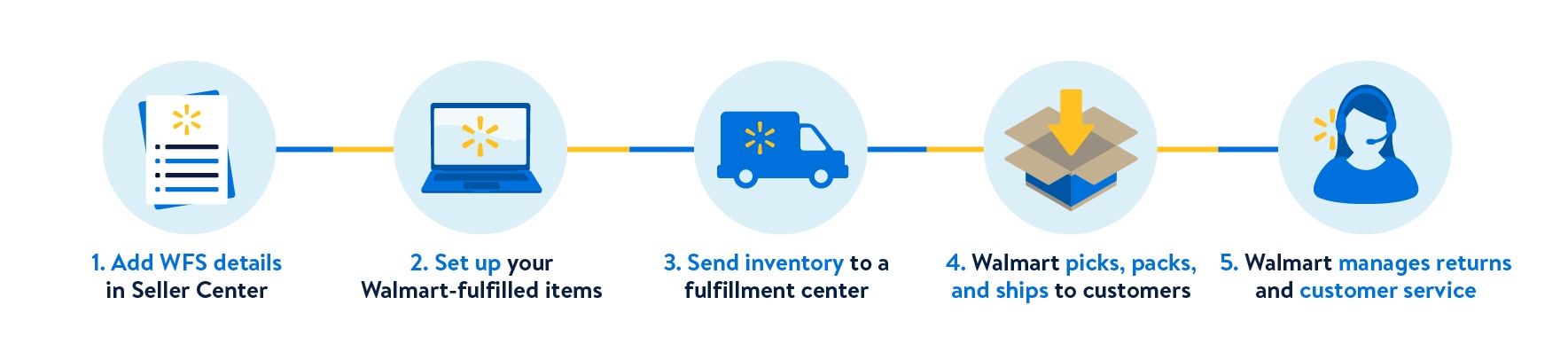
Walmart Fulfillment Services (WFS) is Walmart’s official in-house fulfillment program for Marketplace sellers. Walmart marketplace fulfillment refers to the process of handling orders placed on Walmart Marketplace, either through Walmart’s own warehouses or approved third-party logistics providers. WFS enables sellers to store inventory in Walmart fulfillment centers and have Walmart manage picking, packing, shipping, customer support, and returns. This allows sellers to focus on growing their business while Walmart ensures fast delivery and high service quality.
1.2 Eligibility Requirements
Not all products are eligible for WFS. To qualify, items must ship to Walmart fulfillment centers from within the United States, cannot be perishable or regulated, have a maximum weight of 30 lbs, and dimensions no larger than 25″ x 20″ x 14″. Sellers need to meet these requirements to benefit from the program’s efficiency, cost savings, and enhanced visibility on Walmart Marketplace.
1.3 4Seller ERP Integration
4Seller is an Approved Walmart Marketplace Solution Provider that fully integrates with WFS. With 4Seller, sellers can automatically push multi-channel orders to Walmart fulfillment centers, sync inventory across multiple marketplaces, and receive real-time shipment status updates. This integration streamlines multi-channel fulfillment and reduces manual workload.
2. Key Advantages of Walmart Fulfillment Services (WFS)
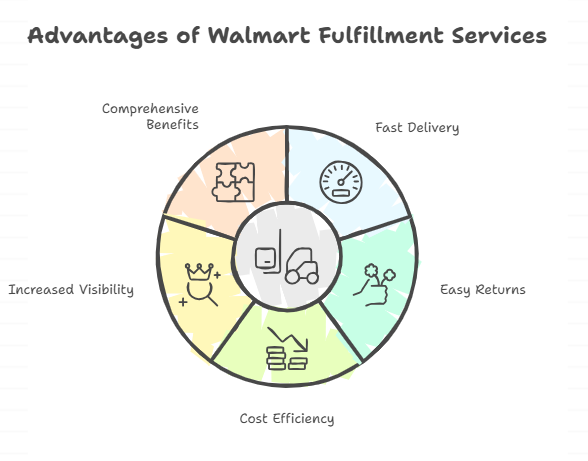
2.1 Fast Delivery and Free 2-Day Shipping
One of the most attractive benefits of WFS is the guaranteed free 2-day shipping on orders over $35, with no membership required. This fast delivery not only enhances customer satisfaction but also provides a competitive alternative to Amazon Prime, attracting a wider audience of Walmart shoppers. Sellers can leverage this advantage to increase conversions and improve buyer trust in their products.
2.2 Easy Returns and Customer Satisfaction
WFS also simplifies the returns process, making it fast and convenient for customers. The United States hosts more than 20 Walmart fulfillment centers and 4,700 stores, with 90% of Americans living within 15 minutes of a Walmart location. This extensive network ensures that returns are handled efficiently, helping sellers maintain high customer satisfaction and loyalty. Combined with Walmart’s reliable customer service, WFS creates a seamless post-purchase experience for buyers.
2.3 Cost Efficiency for Sellers
From a seller’s perspective, WFS provides cost-effective storage and fulfillment. Compared to Amazon FBA, WFS generally charges 1–2% less for storage and order fulfillment. Products are stored separately, avoiding commingling with other sellers’ inventory, which reduces the risk of fraud, mislabeling, or being held responsible for defective items from other merchants. This feature not only protects brand integrity but also makes WFS an affordable and secure solution for scaling eCommerce operations.
2.4 Increased Visibility and Brand Exposure
WFS significantly boosts a seller’s visibility on Walmart Marketplace. With roughly 30,000 active sellers—far fewer than Amazon’s 3 million—products fulfilled by Walmart gain enhanced exposure. Listings with “TwoDay” and “Fulfilled by Walmart” tags enjoy higher search rankings, increased conversion rates, and greater Buy Box prominence. With access to Walmart’s 116 million unique monthly visitors, sellers can effectively expand their reach and grow their brand presence.
2.5 Comprehensive Benefits for Sellers
Beyond individual advantages, WFS offers a holistic set of benefits for sellers. It enables an exceptional customer experience through fast delivery, easy returns, and quality support. Sellers gain full transparency to track inventory, orders, and shipments with easy-to-read reports, ensuring operational control. WFS also supports multichannel sales, allowing sellers to centralize inventory and fulfill orders from other platforms while optimizing returns with the omnichannel Free & Easy Returns program. With no restrictions on minimum or maximum inventory, sellers can scale their business flexibly, and WFS’s end-to-end supply chain support—from freight imports to preferred carriers—ensures a seamless eCommerce operation.
3. How Walmart WFS Works
3.1 Account Setup and Product Listing
Sellers must create or update their Walmart Marketplace Seller Center account. Within the WFS section, sellers provide contact information, billing details, and return preferences. Products must be converted into Walmart-fulfilled listings, including additional attributes required by WFS.
3.2 Shipping Inventory to Walmart Fulfillment Centers
Once products are ready, sellers create a shipping plan indicating which items will go to assigned Walmart fulfillment centers. Walmart provides warehouse location guidance, and sellers can optimize costs using the Inventory Transfer Service or Walmart Preferred Carrier Program.
3.3 Receiving and Tracking Inventory
After shipments arrive, Walmart typically processes inventory within two business days. Sellers can track shipments and inventory status through Seller Center, ensuring that products are ready for sale and accurately updated across Walmart.com and connected channels.
3.4 End-to-End Business Growth
WFS handles storage, picking, packing, delivery, returns, and customer support. Sellers can focus on growth using Walmart’s analytics, reporting tools, and inventory insights, making it easier to scale operations while maintaining high customer satisfaction.
4. Walmart WFS Pricing and Fees
4.1 Overview of WFS Fees
WFS fees are generally 15% lower than most competitors, with no signup or monthly subscription fees. The cost structure includes storage fees based on item dimensions and weight, and fulfillment fees based on the same criteria. This transparent pricing makes it easier for sellers to plan and control costs.
4.2 Additional Costs for Special Items
Certain product categories, such as apparel, hazardous materials, oversized items, or low-price items, may incur additional fees. During peak seasons, slow-moving inventory may also result in higher storage charges. Sellers can use Walmart’s Cost Estimator or WFS fees page to calculate exact costs for their products.
5. What Products Are Eligible for Walmart WFS?
5.1 Basic Requirements
Eligible products must weigh up to 500 lbs, including packaging, and have dimensions no larger than 120” x 105” x 93”. Products must not require temperature control and must be permitted under Walmart’s WFS program.
5.2 Compliance and Restrictions
Prohibited items include regulated products, perishable goods, and items that require special handling. Products must be shipped from the U.S. or cleared through customs before reaching a Walmart fulfillment center, ensuring compliance with WFS regulations.
6. How to Automate Multi-Channel Fulfillment Through WFS with 4Seller ERP
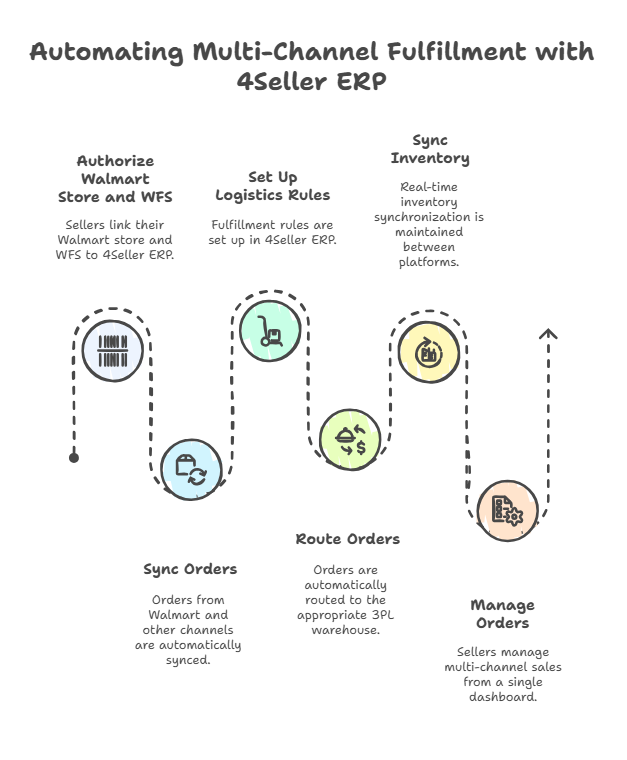
6.1 Authorize Walmart Store and WFS Inventory in 4Seller
Sellers can link their Walmart Marketplace store and WFS warehouses to 4Seller ERP. Orders from Walmart and other channels are automatically synced into 4Seller.
Helping article: How to Authorize Walmart Shop to 4Seller?6.2 Automated Logistics Rules
By setting up fulfillment rules in 4Seller, orders that match predefined criteria are automatically routed to the appropriate 3PL warehouse, carrier, and shipment service. This ensures fast, accurate, and automated multi-channel fulfillment.
Helping article: How to Set the Logistics Rules?6.3 Multi-Channel Inventory Sync
4Seller ERP maintains real-time inventory synchronization between Walmart WFS and other sales platforms, avoiding overselling or stockouts and optimizing multichannel operations.
Helping article: How to Enable Inventory Sync (Inventory Linkage)?6.4 Efficient Order Management
Through 4Seller integration, sellers can manage multi-channel sales from a single dashboard, leveraging Walmart WFS for fulfillment while keeping control over inventory, shipping, and reporting.
Conclusion: Why WFS + 4Seller Is the Best Multi-Channel Fulfillment Strategy
Combining Walmart Fulfillment Services (WFS) with 4Seller ERP creates the ultimate multi-channel fulfillment strategy. Sellers benefit from Walmart’s fast 2-day shipping, nationwide fulfillment network, and high brand visibility, while 4Seller provides automation for inventory management, cross-platform order fulfillment, and real-time shipping updates. Together, WFS and 4Seller ERP allow sellers to reduce costs, improve operational efficiency, and scale their eCommerce business across multiple channels with minimal effort.
This combination is ideal for Walmart Marketplace sellers seeking a seamless, cost-effective, and high-performance fulfillment solution.
- Multi Channel Order Management
- TikTok Shop
- Amazon
- Temu
- About 4Seller
- Shopify
- Multi Channel Inventory Management
- Amazon MCF&FBA
- Seller Tips
- Listing Management
- Marketplace News
- eBay
- Amazon Shipping
- Amazon MCF
- DHL Express
- FedEx
- UPS
- Shein
- Creator Bulk Invite
- Multi-channel Store
- Inventory Sync
- GLS
- Beginner Tutorial
- Walmart
- Walmart WFS
- Shipping Integration
- Seller Story
- Kaufland
- Royal Mail
- 3PL
- Platform Integration
- Shipping Label
- OTTO
- WooCommerce
- Deutsche Post
- Walmart MCS
- GOFO
- DHL Parcel
- Yodel
- SPU Catalog
- PayPal Tracking Sync
- ShipHero
- USPS
- Stripe Tracking Sync
- AliExpress
- UniUni
- CIRRO
- Correos
- Poste Italiane
- Chronopost
- BRT
- CaiNiao
- Logistics Rule
- Request Review
- FBM
- Evri
- Etsy
- DPD
- Correos Express
- Cdiscount
- WFS
- DHL
- OMS
- Price Sync
- ShipBob

 17 Dec,2024
- 17 Dec,2024