- Order Management
- TikTok Shop
- Temu
- Amazon
- About 4Seller
- Shopify
- Inventory Management
- Amazon MCF&FBA
- Seller Tips
- Marketplace News
- Listing Management
- Amazon Shipping
- UPS
- FedEx
- DHL Express
- Creator Bulk Invite
- eBay
- GLS
- Amazon MCF
- Shein
- Inventory Sync
- Multi-channel Store
- Walmart
- Royal Mail
- Walmart WFS
- WooCommerce
- Shipping Integration
- Beginner Tutorial
- Poste Italiane
- Platform Integration
- BRT
- PayPal Tracking Sync
- ShipHero
- Shipping Label
- Stripe Tracking Sync
- UniUni
- USPS
- Yodel
- FBM
- CIRRO
- Correos
- Correos Express
- Deutsche Post
- DHL Parcel
- Etsy
- Evri
- OTTO
- GOFO
- Kaufland
- 3PL
- Logistics Rule
- CaiNiao
- Chronopost
- Cdiscount
- ShipBob
- SPU Catalog
- AliExpress
- DPD
- DHL
- Request Review
- Price Sync
- OMS
Amazon’s next-gen AI assistant for shopping is now even smarter, more capable, and more helpful — How 4Seller Supercharges Your Listings via Rufus
 By Joline03 Dec,2025
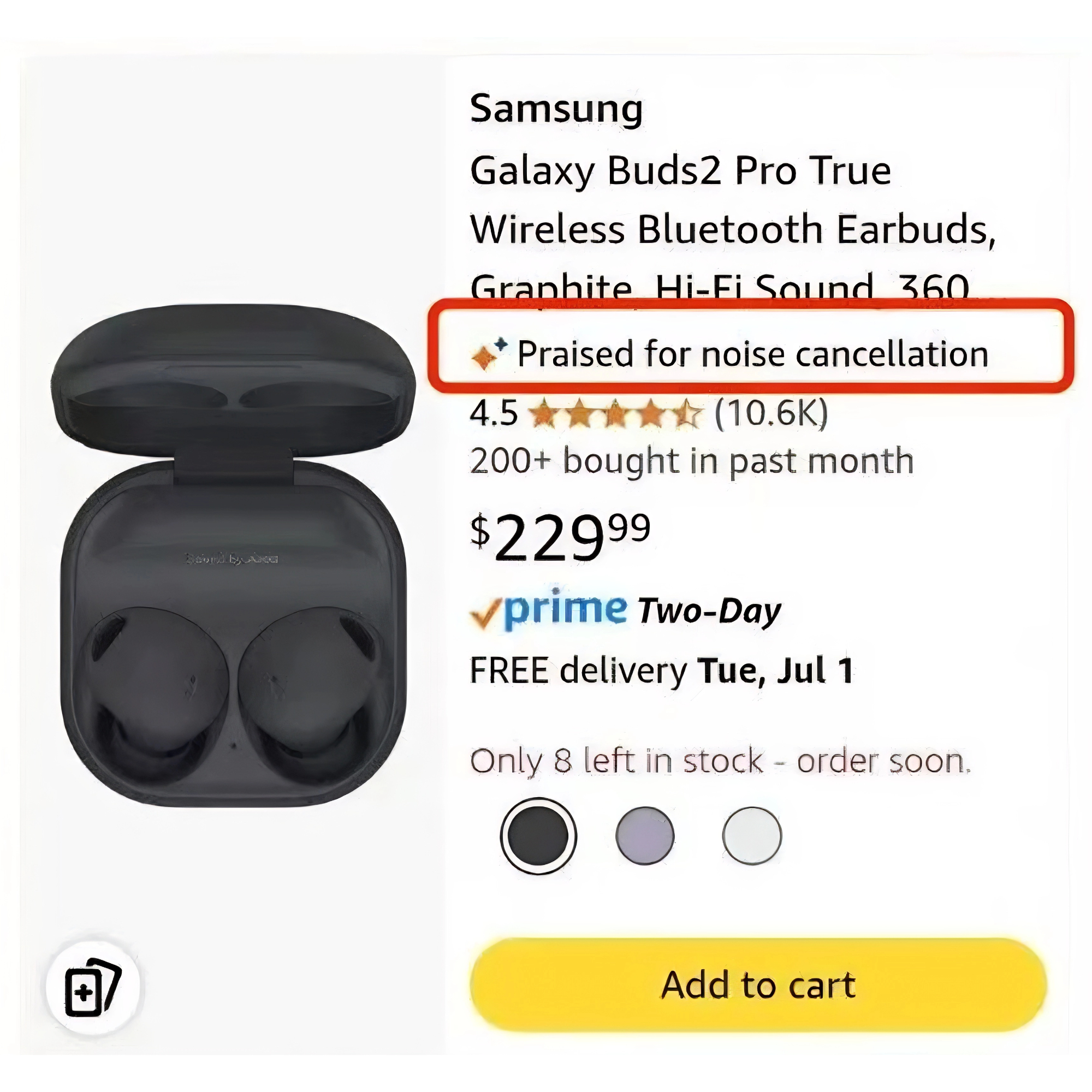
If you open the Amazon app today, you may notice a new line of bold, eye-catching text above certain product ratings—phrases like “Highly rated for noise cancellation,” “Lightweight and comfortable for long wear,” or “Trusted by users for long battery life.”
These are not seller-written slogans. They are AI-generated “super conversion labels” created by Amazon’s algorithm Rufus.
Last week, Amazon quietly began testing this small but potentially game-changing feature.
The key lies in its placement: these labels appear in the prime real estate of search results, right between the product title and the product ratings—an area with enormous impact on click-through rate (CTR) and conversion rate (CVR).
From a buyer’s standpoint:
They may not fully trust your title.
They may be skeptical of your images.
But a Rufus-generated label—created automatically and with no seller interference—naturally earns a higher level of trust.
It summarizes exactly what shoppers care about, at the moment they are making a decision.What Are Rufus Labels and Why Do They Matter?
This new micro-label appears directly between the product title and rating, positioned in a golden visual zone that requires zero scrolling. The content of the label responds directly to the buyer’s core concerns—often reducing the entire buying journey from:
“Click product → enter detail page → browse → think → buy”
to
“See key benefit → click → buy.”Products with Rufus labels may experience:

-
Higher click-through rates
-
Higher buyer trust
-
Improved conversion rates
-
Additional organic visibility
-
Preferential search placement
-
Stronger competitive differentiation
On desktop, the Rufus highlight also appears prominently beneath the main images—signaling Amazon’s serious investment in this feature.
If Rufus extracts and recognizes a compelling product benefit, your listing may earn priority placement, effectively becoming an algorithmic traffic bonus.
How Can a Product Be Recognized by Rufus?
Many sellers assume the label is simply extracted from reviews, but the reality is far more complex.
The most important underlying data used by Rufus is your structured listing content:
-
Title
-
Bullet points
-
A+ content (text + images + semantic signals)
-
Backend search terms
If your listing is not strategically designed to highlight the signals Rufus looks for—or if the structure prevents AI from understanding your product—you will be ignored by Rufus and will miss out on this new traffic advantage.
How Does Rufus Extract These AI Labels?
Rufus generates labels through a multi-dimensional evaluation, synthesizing three major data sources:
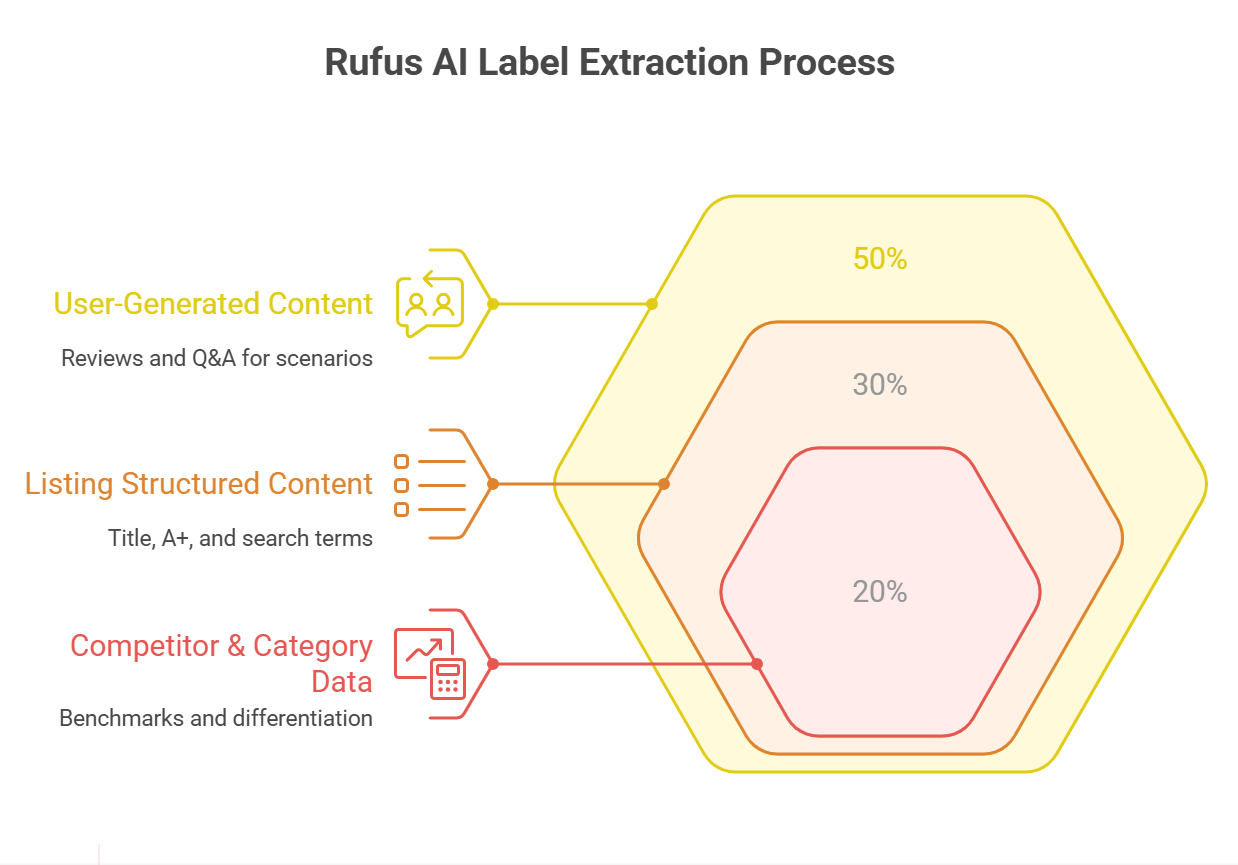
1. User-Generated Content (Highest weight – approx. 50%)
-
Reviews: Extracting high-frequency scenarios and emotionally strong descriptions
-
Q&A: Prioritizing answers addressing buyer pain points
2. Listing Structured Content (Approx. 30%)
-
Title & bullet points: Clarity of benefits, scenario definition, core advantages
-
A+ content: Visual and textual signals identifying use-cases
-
Backend Search Terms: Intent words influence AI product understanding
3. Competitor & Category Data (Approx. 20%)
-
Industry benchmarks
-
Competitive differentiation
-
Unique selling points in the category
Which Products Receive Rufus Labels First? Why Do “High-Review” Listings Get Tagged More Often?
At first glance, sellers believe:
“More reviews = more likely to get a Rufus label.”
It looks true. But the real logic is deeper.
Rufus label appearance is driven by two forces:
1. The Testing Pool (Visibility Layer)
Amazon is still testing Rufus label placement and logic.
So:
-
Not every ASIN enters the test pool
-
Not every user can see the labels
-
Different regions / app versions show different results
This explains why some listings have labels while similar products do not.
2. Benefit Concentration (Algorithm Layer)
Once an ASIN is in the test pool, Rufus evaluates:
-
Title clarity
-
Bullet point structure
-
Main image text
-
A+ semantic signals
-
Review keyword density
-
Scenario consistency
-
Competitive differences
Rufus essentially asks:
“Does this product have ONE clear, repeatedly mentioned, easily summarized core benefit?”
If the “benefit signal” is strong and consistent, Rufus confidently generates a highlight.
This is why:
✔ Listings with only a few reviews but highly consistent themes can get a label
✘ Listings with thousands of reviews but scattered, conflicting themes may not
Why do high-review listings appear more often?
Not because of quantity—but because:
-
Repeated reviews = stronger consensus
-
Stronger consensus = clearer signal
-
Clearer signal = easier for AI to summarize
The actual determining factor is:
⭐ Benefit Concentration: Consistent. Repeated. Stable. Unified. — not review count.
Summary of Amazon’s Logic
-
Test pool determines visibility
-
Benefit concentration determines label generation
This is why you may see:
-
Low-review listings with labels
-
High-review listings without labels
Rufus + COSMO: Amazon’s New “Intent Understanding + Content Extraction” Engine
Since 2024, Amazon’s COSMO algorithm and Rufus AI shopper assistant form a closed-loop system.
COSMO = Search Intent Brain
Not just matching keywords—understanding what the buyer actually wants to solve.
Rufus = AI Buying Assistant
Extracts key information from your listing
Responds to buyer questions
Generates highlight tags directly on search pages
Thus, Amazon has officially shifted from:
“Keyword Era” → “User Intent + AI Semantic Era.”
Listings today are written not only for humans—but also for AI.
Sellers still using old practices like:
-
stuffing titles with keywords
-
listing every feature in bullet points
-
ignoring structured data
will be left behind.
How to Rewrite Listings to Make Rufus Generate the Labels You Want?
Starting April 2024, the COSMO + Rufus combination has fundamentally reshaped listing optimization.
Below is how each listing section must evolve.
1. Title Optimization: From Keyword Stuffing to Intent Expression
Previously, sellers stuffed as many keywords as possible.
Now you must communicate intent + scenario.
Example:
Instead of “Wireless Earbuds,”
use “Noise-Canceling Earbuds for Meetings”
→ Immediately tells COSMO the use-case and target audience.
2. Bullet Points: From Feature List to Question-Answer Structure
Under Rufus logic, bullet points act as:
“Answer sources for buyer questions.”
For example:
Buyer asks: “Are these earbuds good for travel?”
Rufus scans bullet points.
If it cannot find an answer,
it may recommend a competitor listing instead.
Therefore, bullets should be structured around:
✔ Buyer concerns
✔ Real questions
✔ Benefit explanations
✔ Scenario clarity
—not generic parameter lists.
3. A+ Content: The AI’s Scenario & Use-Case Recognition Hub
A+ is no longer just a branding space.
AI now:
-
reads all text
-
interprets all images
-
analyzes scenes
-
understands user profiles
Example:
Buyer asks: “Is this backpack good for family camping or pro hiking?”
Rufus reads your A+ images and text to decide.
Thus, your A+ should include:
-
Real usage scenarios
-
Environment visualization
-
Target user personas
4. Images & Videos: Fully AI-Readable Assets
Amazon’s AI now performs visual semantic analysis.
AI recognizes:
-
On-image text
-
Scenarios
-
People
-
Environments
-
Product usage
Use images to explicitly tell COSMO:
-
Who uses the product
-
Where it is used
-
What problem it solves
Do not forget to add image keywords, a crucial AI signal.
5. Backend Search Terms: Feed COSMO “Intent Words”
COSMO doesn’t just look for:
“What the product is.”
It looks for:
“Why buyers purchase it.”
Add search terms like:
-
“gift for remote workers”
-
“backpack for weekend travel”
-
“earbuds for Zoom meetings”
These help AI understand motivation and intent.
Common Mistakes Sellers Must Avoid
❌ 1. Generic AI-Generated Copy
Unedited AI copy lacks scenario and emotional depth.
❌ 2. Weak Bullet Points
Listing specs without answering buyer questions = missed Rufus matches.
❌ 3. Ignoring Reviews & Q&A
If users repeatedly mention missing features, update listings accordingly.
❌ 4. Incomplete Backend Attributes
Amazon heavily relies on attribute data for semantic matching.
Fill in:
-
materials
-
use-cases
-
application scenarios
-
target users
-
synonyms
The more complete, the better for Rufus.
Think of Your Listing as a “Product Résumé” for Rufus
To optimize:
Title → Insert scenario keywords
Example: “Conference Noise-Canceling Headset”
Bullets → Use Q&A style
Answer concerns before they’re asked.
A+ Content → Add scene-based visuals
Show product use in real environments.
Backend Attributes → Fill everything
Feed COSMO the data it needs.
Reviews → Encourage scenario-based language
Guide reviewers to mention usage context and specific advantages.
Why Rufus AI Matters So Much?
Rufus highlights sit in a premium, non-ad placement, carrying enormous competitive value.
Though still in grayscale testing, sellers must prepare early.
Optimizing listing structure and guiding reviews now ensures:
-
Better AI recognition
-
Higher chance of earning labels
-
Stronger organic traffic
-
Lower dependence on ads
Rufus will become a major conversion lever in the coming year.
Amazon Has Officially Transitioned Into the “AI Semantic + User Intent” Era
Many sellers think Rufus labels are just “a small extra tag.”
In reality, they represent a major shift in Amazon’s ranking logic:
**From keyword-matching → to intent understanding
From manual optimization → to AI-driven semantic evaluation
From stuffing listings → to structured content engineering**
Those who adapt fastest will:
-
reduce advertising costs
-
unlock new organic traffic
-
gain advantage in increasingly competitive categories
-
build long-term defensible listing strength
The era of “AI-readable listings” has arrived.
Whoever masters this new system will own the next wave of Amazon growth.
ChatGPT/Deepseek Embedding-Powered Multilingual Titles & Descriptions — 4Seller’s Edge

4Seller leverages ChatGPT embedding technology to automatically generate and localize product titles and detail-page descriptions across multiple languages—turning raw product data, reviews, and category signals into AI-readable, intent-focused listing copy. By converting listing elements and user-generated content into semantic embeddings, 4Seller identifies the strongest benefit signals and crafts concise titles and bullet-point answers that align with Amazon’s COSMO intent model and Rufus extraction logic.
The result: high-quality, localized copy that preserves benefit concentration (the single, repeatable selling point Rufus needs), improves semantic match with buyer search intent, and scales rapidly across marketplaces and locales. Sellers get consistent messaging, faster A/B iterations, and automated translation + cultural localization that retains SEO-rich keywords and intent phrases—so your listings not only read well to shoppers, they read correctly to Amazon’s AI, boosting the likelihood of earning Rufus highlights and better organic visibility.
- Order Management
- TikTok Shop
- Temu
- Amazon
- About 4Seller
- Shopify
- Inventory Management
- Amazon MCF&FBA
- Seller Tips
- Marketplace News
- Listing Management
- Amazon Shipping
- UPS
- FedEx
- DHL Express
- Creator Bulk Invite
- eBay
- GLS
- Amazon MCF
- Shein
- Inventory Sync
- Multi-channel Store
- Walmart
- Royal Mail
- Walmart WFS
- WooCommerce
- Shipping Integration
- Beginner Tutorial
- Poste Italiane
- Platform Integration
- BRT
- PayPal Tracking Sync
- ShipHero
- Shipping Label
- Stripe Tracking Sync
- UniUni
- USPS
- Yodel
- FBM
- CIRRO
- Correos
- Correos Express
- Deutsche Post
- DHL Parcel
- Etsy
- Evri
- OTTO
- GOFO
- Kaufland
- 3PL
- Logistics Rule
- CaiNiao
- Chronopost
- Cdiscount
- ShipBob
- SPU Catalog
- AliExpress
- DPD
- DHL
- Request Review
- Price Sync
- OMS
 17 Dec,2024

- 17 Dec,2024