- Multi Channel Order Management
- TikTok Shop
- Amazon
- Temu
- About 4Seller
- Shopify
- Multi Channel Inventory Management
- Amazon MCF&FBA
- Seller Tips
- Listing Management
- Marketplace News
- FedEx
- UPS
- Amazon MCF
- DHL Express
- Amazon Shipping
- eBay
- Shein
- Creator Bulk Invite
- Inventory Sync
- GLS
- Multi-channel Store
- Walmart
- Walmart WFS
- Shipping Integration
- Kaufland
- Royal Mail
- Seller Story
- Beginner Tutorial
- 3PL
- WooCommerce
- DHL Parcel
- Walmart MCS
- Shipping Label
- OTTO
- Deutsche Post
- Platform Integration
- PayPal Tracking Sync
- AliExpress
- Yodel
- ShipHero
- SPU Catalog
- Stripe Tracking Sync
- USPS
- UniUni
- GOFO
- CIRRO
- Correos
- Correos Express
- DPD
- Etsy
- Evri
- FBM
- Request Review
- Logistics Rule
- CaiNiao
- BRT
- Chronopost
- Poste Italiane
- Cdiscount
- OMS
- DHL
- WFS
- ShipBob
- Price Sync
Stop Overselling and Manual Repricing: How 4Seller SPU Catalog Keeps Inventory and Prices in Sync
 By Joline22 Dec,2025
If you sell the same products across multiple marketplaces, you already know the pain. Inventory looks fine on Shopify, but Amazon oversells. A promotion ends, but one store still shows the old price. None of this feels like a “growth problem”, yet it quietly eats margins, time, and platform trust.

Still Updating Inventory and Prices One Store at a Time? 4Seller SPU Catalog Solves the Two Biggest Multi-Channel Seller Problems.

4Seller SPU catalog was built specifically to solve these two issues at the product level: inventory accuracy and price consistency, across all major sales channels.

What Is an SPU catalog and Why Multi-Channel Sellers Rely on It?

An SPU (Standard Product Unit) represents a product as a whole, not as separate listings scattered across platforms.


Instead of managing inventory and prices individually for Amazon, Shopify, TikTok Shop, Walmart, or eBay, sellers manage one SPU. Every connected listing follows that single source of truth.

For sellers operating in the US, UK, or EU, this becomes essential the moment sales volume increases or multiple warehouses are involved.

The Two Core Problems SPU catalog Is Designed to Solve

Most sellers don’t struggle because they lack tools. They struggle because their tools are fragmented.

The same product exists in multiple places, with:

-
Inventory changing in different warehouses
-
Prices adjusted manually on different platforms
-
No single place that reflects reality
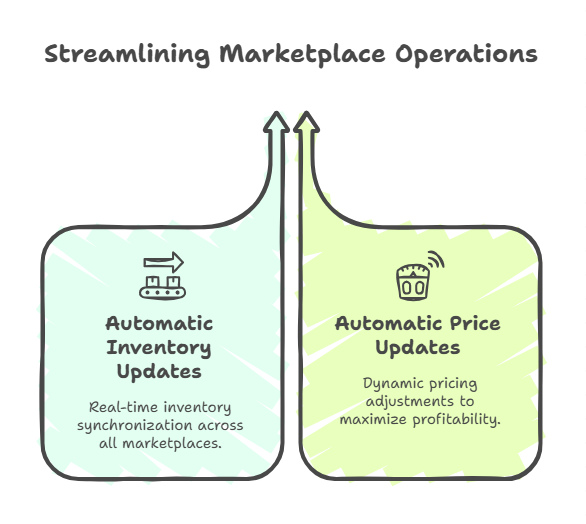
4Seller SPU catalog addresses this with two tightly connected capabilities:
-
Automatic inventory updates to marketplaces
-
Automatic price updates to marketplaces
Core Feature 1: Automatically Sync Inventory to Marketplaces
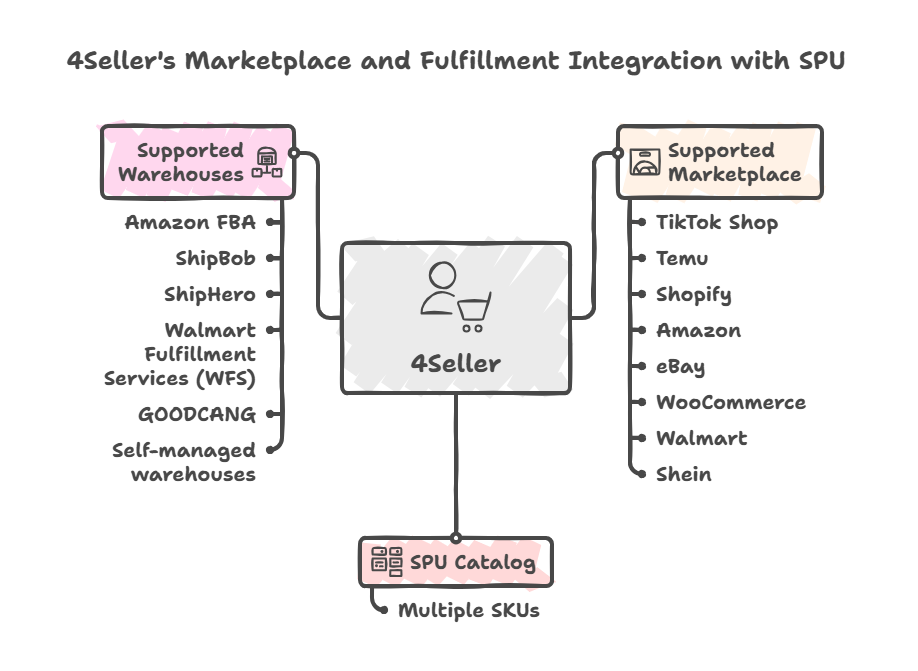
Supported platforms: TikTok Shop, Temu, Shopify, Amazon, eBay, WooCommerce, Walmart, Shein
When Overselling Isn’t a “What If”, but a Tuesday Morning
Imagine a seller sitting at their desk in Chicago. They sell a popular SKU across Shopify, Amazon, and TikTok Shop. Inventory is split between Amazon FBA and ShipBob, with a small buffer in their own warehouse.
A TikTok video performs better than expected. Orders spike within minutes. Shopify sells through first. Amazon keeps selling because FBA stock hasn’t updated yet. By the time the seller notices, customer service tickets are already coming in.
This isn’t a rare edge case. It’s what happens when inventory updates lag behind real warehouse data.
How SPU Inventory Sync Works in Practice?
In 4Seller, each SPU catalog contains multiple SKUs. Each SKU can be bound directly to a warehouse or 3PL product, including:
-
Amazon FBA
-
ShipBob
-
ShipHero
-
Walmart Fulfillment Services (WFS)
- GOODCANG
- LVK
-
Self-managed warehouses
When inventory changes in any of these locations, the update flows automatically into the SPU, and from there to every connected marketplace listing.
No manual exports. No delayed syncs. No guessing which store is “correct”.
Inventory Rules That Match Real Business Decisions
Not all sellers want to sync inventory the same way, and SPU catalog reflects that reality.
Some sellers choose to sync available inventory, accounting for reservations and pending orders. Others prefer syncing on-hand inventory to stay conservative. SPU catalog supports both approaches.
Many sellers also need to protect themselves from last-unit overselling. With SPU catalog, when available inventory drops below a defined threshold, the system can automatically push the store inventory to zero. The product switches to sold out before mistakes happen.
There are also cases where inventory should never be synced at all. A SKU might be reserved for wholesale partners, retail stores, or influencer campaigns. SPU allows sellers to exclude specific SKUs from inventory push rules entirely, so changes never reach marketplace listings.
Finally, experienced sellers often control how inventory appears publicly. SPU catalog allows setting maximum and minimum pushed quantities. This keeps listings active, avoids sudden out-of-stock status, and maintains sales momentum without constant manual adjustments.
Helping article: How to Enable Inventory Sync (Inventory Linkage)?
Core Feature 2: Automatically Sync Prices Across All Stores
The Slow, Error-Prone Reality of Manual Repricing
A seller in the UK runs a seasonal promotion. Prices are adjusted on Shopify first. Amazon comes next. Walmart and TikTok Shop are updated later in the afternoon.
One store is missed.
Customers notice different prices for the same product. Support tickets increase. Marketplace price parity warnings appear. None of this improves sales, yet it consumes hours.
This is the hidden cost of manual price management.
One SPU Price, Every Store Updated Automatically
With 4Seller SPU catalog, sellers maintain pricing at the SPU level. When the price changes, every connected listing updates automatically.
This means:
-
Promotions start and end on time everywhere
-
Cost-based price changes apply consistently
-
No store is forgotten
For sellers operating in regulated or highly competitive markets like the US and EU, this consistency is not optional. It protects margins and brand trust.
Helping article: In 4Seller How to Automatically Update the Price to Platform Stores?
Why Centralized Pricing Matters for Sellers?
Local sellers often operate with tighter margins, higher fulfillment costs, and stricter marketplace rules. Price inconsistencies can trigger platform penalties or customer complaints faster than expected.
SPU pricing sync allows sellers to make decisions once and execute them everywhere, without logging into multiple dashboards or spreadsheets.
Why SPU catalog Is Different from Traditional Inventory and Pricing Tools?
Many tools promise inventory sync or price automation, but often operate at the listing level. Warehouses are treated separately. Prices require platform-specific rules.
SPU catalog works at the product level. Inventory and pricing share the same logic and the same source of truth. That is why accuracy improves as sales scale, instead of falling apart.
Who 4Seller SPU catalog Is Built For?
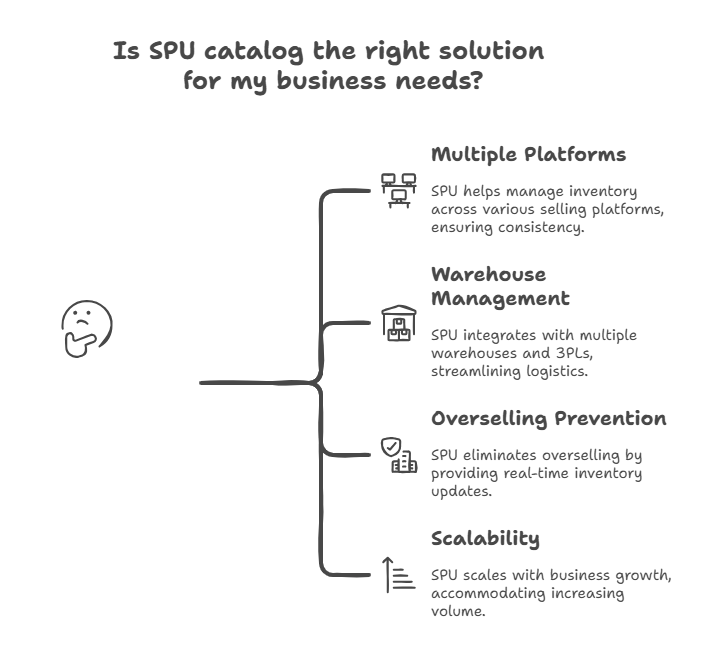
SPU catalog is designed for sellers who:
-
Sell the same products on multiple platforms
-
Use more than one warehouse or 3PL
-
Want to eliminate overselling and manual repricing
-
Need a reliable system that scales with volume
If inventory checks and price updates are still manual tasks, SPU catalog replaces that complexity with clarity.
Final Thoughts
Inventory mistakes and pricing inconsistencies don’t stay small. They compound as sales grow.
4Seller SPU catalog gives sellers a single, reliable source of truth for both inventory and pricing, ensuring every connected store reflects reality in real time.
For multi-channel sellers, this isn’t just efficiency.
It’s control.
- Multi Channel Order Management
- TikTok Shop
- Amazon
- Temu
- About 4Seller
- Shopify
- Multi Channel Inventory Management
- Amazon MCF&FBA
- Seller Tips
- Listing Management
- Marketplace News
- FedEx
- UPS
- Amazon MCF
- DHL Express
- Amazon Shipping
- eBay
- Shein
- Creator Bulk Invite
- Inventory Sync
- GLS
- Multi-channel Store
- Walmart
- Walmart WFS
- Shipping Integration
- Kaufland
- Royal Mail
- Seller Story
- Beginner Tutorial
- 3PL
- WooCommerce
- DHL Parcel
- Walmart MCS
- Shipping Label
- OTTO
- Deutsche Post
- Platform Integration
- PayPal Tracking Sync
- AliExpress
- Yodel
- ShipHero
- SPU Catalog
- Stripe Tracking Sync
- USPS
- UniUni
- GOFO
- CIRRO
- Correos
- Correos Express
- DPD
- Etsy
- Evri
- FBM
- Request Review
- Logistics Rule
- CaiNiao
- BRT
- Chronopost
- Poste Italiane
- Cdiscount
- OMS
- DHL
- WFS
- ShipBob
- Price Sync
 17 Dec,2024
- 17 Dec,2024