- Multi Channel Order Management
- TikTok Shop
- Amazon
- Temu
- About 4Seller
- Shopify
- Multi Channel Inventory Management
- Amazon MCF&FBA
- Seller Tips
- Listing Management
- Marketplace News
- eBay
- Amazon Shipping
- DHL Express
- Amazon MCF
- UPS
- FedEx
- Shein
- Creator Bulk Invite
- Multi-channel Store
- Inventory Sync
- GLS
- Beginner Tutorial
- Walmart WFS
- Walmart
- Seller Story
- Royal Mail
- Kaufland
- Shipping Integration
- DHL Parcel
- 3PL
- WooCommerce
- Walmart MCS
- Deutsche Post
- Shipping Label
- OTTO
- Platform Integration
- PayPal Tracking Sync
- UniUni
- Yodel
- ShipHero
- SPU Catalog
- Stripe Tracking Sync
- USPS
- AliExpress
- GOFO
- CIRRO
- Correos
- Correos Express
- DPD
- Etsy
- Evri
- FBM
- Request Review
- Logistics Rule
- CaiNiao
- BRT
- Chronopost
- Poste Italiane
- Cdiscount
- OMS
- DHL
- WFS
- ShipBob
- Price Sync
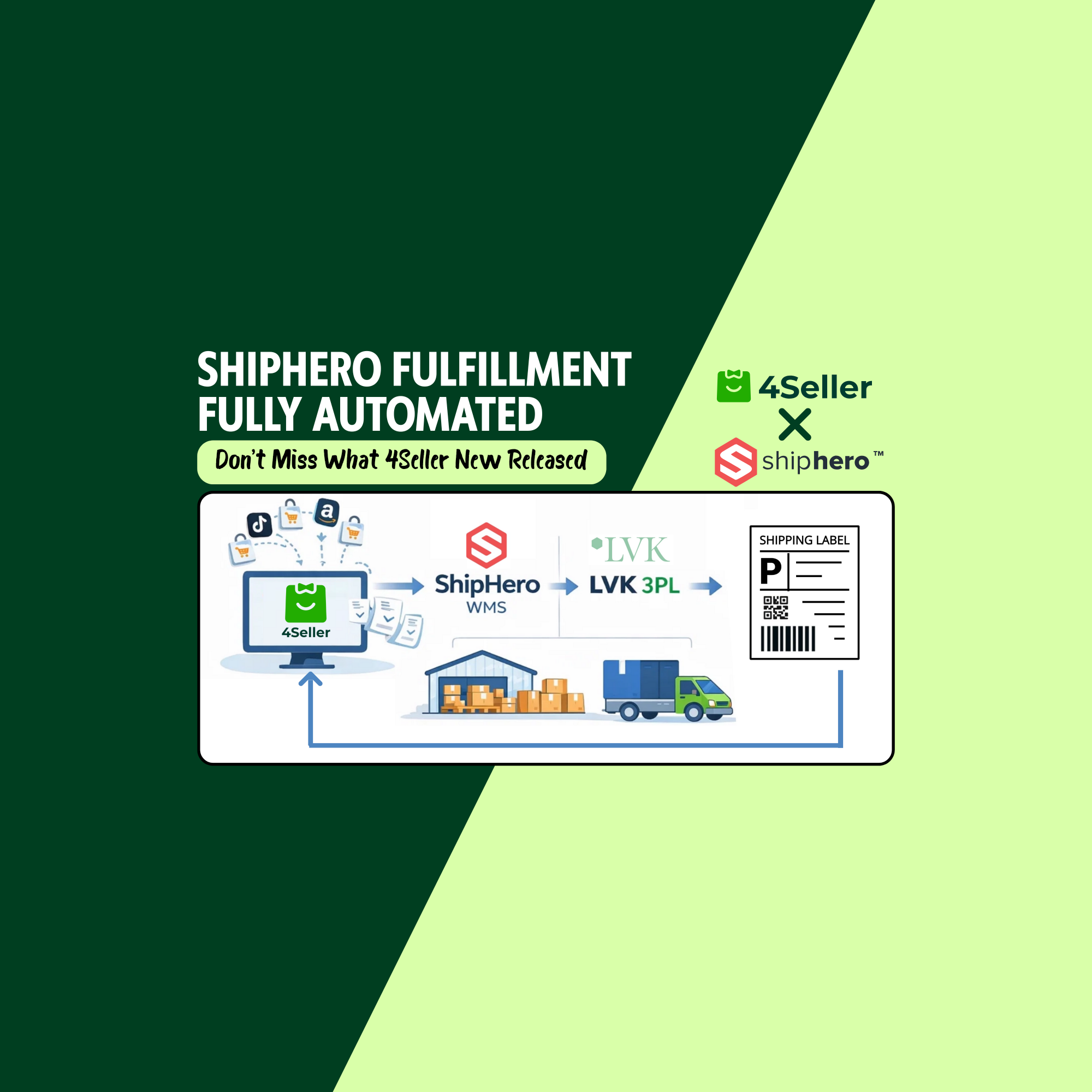
ShipHero Partners with 4Seller to Enable Automated Multi-Channel Fulfillment and Shipping
 By Joline25 Dec,2025
Selling across multiple ecommerce platforms is no longer a growth experiment. For most established brands in the US, UK, and EU, it is the default operating model.

Amazon FBM, Shopify DTC, Walmart Marketplace, TikTok Shop, and regional platforms often coexist within the same business. While revenue scales through channel diversification, operational complexity increases at a faster pace. Industry benchmarks show that sellers operating on three or more sales channels experience inventory discrepancies at more than twice the rate of single-channel sellers, with fulfillment errors ranking among the leading causes of order cancellations and negative marketplace performance metrics.

This growing operational gap is precisely what 4Seller’s LVK integration is designed to address.

What Is ShipHero and How Is It Related to LVK Fulfillment?

ShipHero is a well-established warehouse management system (WMS) widely used across North American ecommerce logistics. It provides the software layer that powers inventory control, picking workflows, shipping logic, and operational visibility inside warehouses.

LVK originated as ShipHero Fulfillment and later evolved into an independent, full-service third-party logistics (3PL) brand. While ShipHero continues to focus on building warehouse software, LVK operates the physical fulfillment network using ShipHero’s WMS as its core technology foundation.

Today, LVK functions as the execution arm, while ShipHero provides the system intelligence behind warehouse operations. This separation allows LVK to specialize in fulfillment quality and service while benefiting from enterprise-grade warehouse technology.

Why Use ShipHero-Based LVK Fulfillment for Ecommerce Shipping?

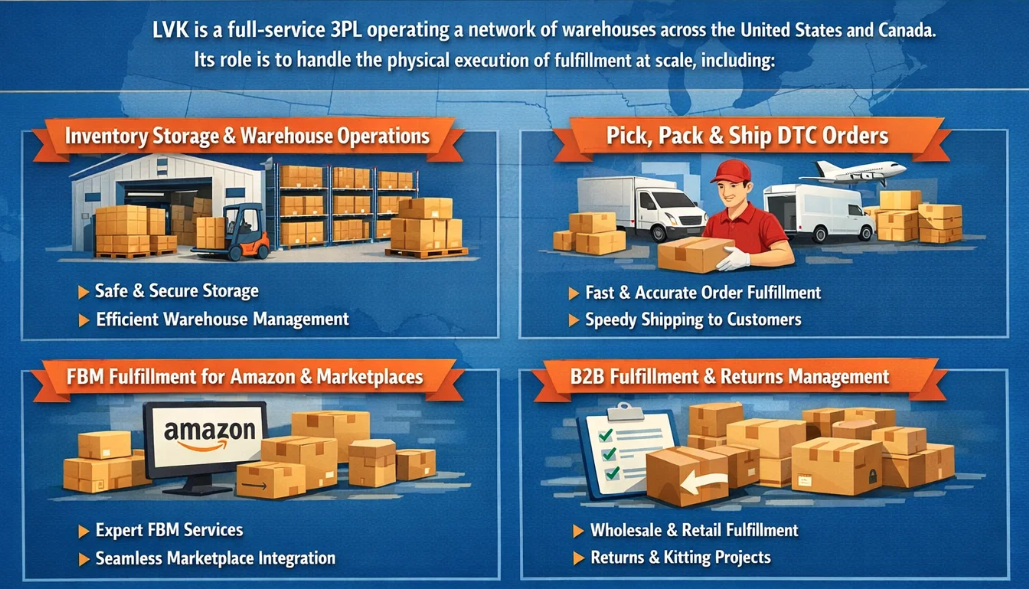
LVK is a full-service 3PL operating a network of warehouses across the United States and Canada. Its role is to handle the physical execution of fulfillment at scale, including:
-
Inventory storage and warehouse operations
-
Pick, pack, and ship for direct-to-consumer orders
-
FBM fulfillment for Amazon and other marketplaces
-
B2B fulfillment, returns processing, and kitting projects
For mid-market and enterprise sellers, LVK often replaces in-house warehouses while maintaining the service levels required by platforms such as Amazon, Walmart, and TikTok Shop.
However, even a high-performing 3PL cannot fully eliminate fulfillment risk if order routing, inventory allocation, and shipping logic remain fragmented across multiple sales systems. Without centralized orchestration, operational inefficiencies persist upstream.
Where Does Multi-Channel Fulfillment Typically Break Down?
For most sellers, the challenge is not a lack of tools, but an excess of disconnected systems.
A typical non-automated workflow often includes:
-
Orders downloaded separately from Amazon, Shopify, and other platforms
-
Inventory updated manually or on delayed synchronization cycles
-
Tracking numbers pushed back to each platform one by one
-
Shipping rules managed inconsistently across channels
-
Peak sales days requiring hands-on intervention to avoid backlogs
Operational data across ecommerce fulfillment shows that manual workflows can increase fulfillment error rates by 15–30% during peak periods, directly impacting late shipment rates, valid tracking rates, and order defect metrics on major marketplaces.
What Role Does 4Seller Play in the Fulfillment Process?
4Seller is neither a warehouse nor a carrier.
Its role is orchestration.
By connecting sales channels and fulfillment partners like LVK into a single system, 4Seller becomes the decision layer that governs how orders flow, how inventory is allocated, and how fulfillment status is synchronized back to each platform.
Once connected, 4Seller continuously manages three critical processes in parallel:
-
Order routing
-
Shipping execution
-
Inventory synchronization
All actions are triggered automatically based on predefined rules rather than manual operations.
How Does 4Seller Enable Automated Fulfillment Across Multiple Sales Channels?
After authorization, 4Seller automatically pulls orders from supported platforms including Amazon, Shopify, Walmart, eBay, TikTok Shop, Temu, WooCommerce, Etsy, Shein, OTTO, Kaufland, Miravia, AliExpress, and Cdiscount.
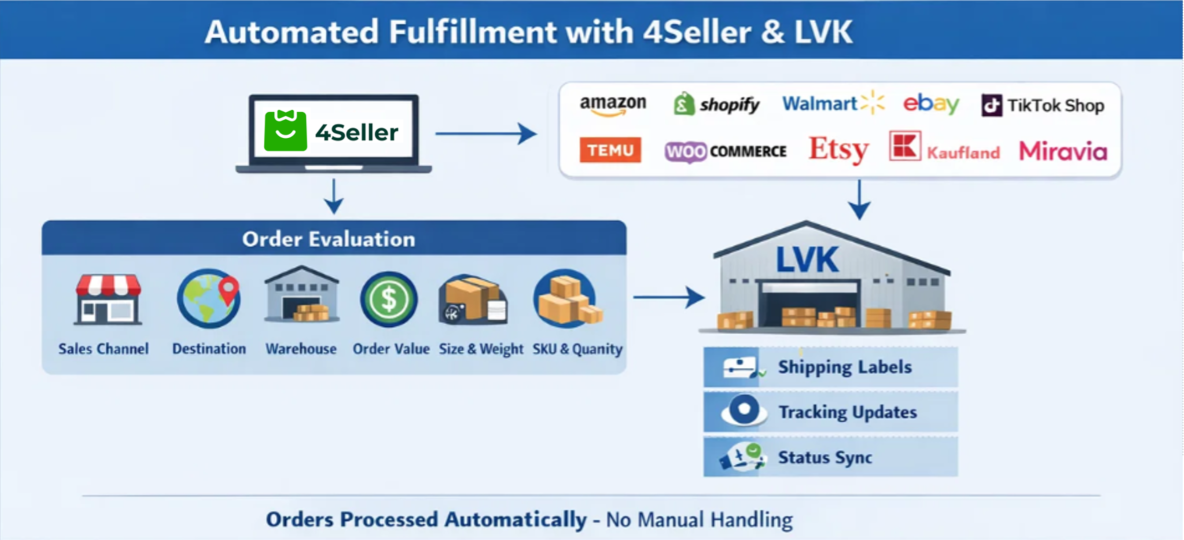
Each order is evaluated in real time against seller-defined fulfillment rules that can account for factors such as:
-
Sales channel
-
Shipping destination
-
Warehouse availability
-
Order value thresholds
-
Product dimensions and weight
-
Quantity and SKU combinations
If an order meets the defined criteria, it is automatically pushed to LVK for fulfillment. Shipping labels are generated, tracking numbers are retrieved, and order status updates are synchronized back to the originating platform without manual intervention.
This eliminates CSV uploads, manual label purchases, and platform-by-platform order handling.
Helping Article Reference: How to Set the Logistics Rules?
How Does Real-Time Inventory Sync Prevent Overselling?
Inventory accuracy is one of the most underestimated operational risks in multi-channel selling.
Delayed or partial inventory updates are a primary cause of overselling, which often leads to forced cancellations and marketplace performance penalties. Studies across ecommerce operations indicate that real-time inventory synchronization can reduce overselling incidents by up to 80% compared to manual or scheduled sync methods.
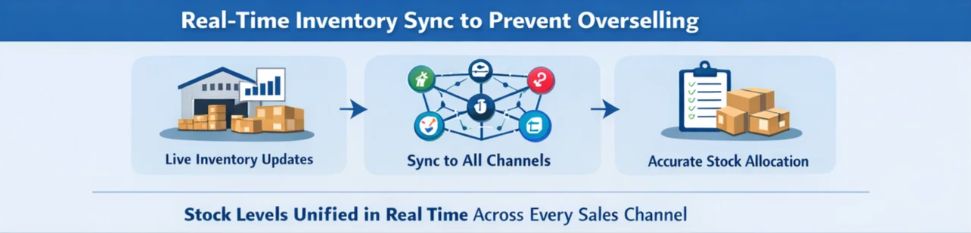
With 4Seller and LVK working together:
-
Inventory levels are pulled directly from LVK warehouses
-
Stock changes are reflected across all connected sales channels in near real time
-
SKU mappings ensure the correct physical inventory is allocated regardless of where the order originates
This capability is especially critical during promotions, seasonal demand spikes, or influencer-driven traffic surges, when inventory velocity exceeds the limits of manual control.
Helping Article Reference: How to Enable Inventory Sync (Inventory Linkage)?
What Is the Operational Impact for US, UK, and EU Sellers?
For local sellers, the value of fulfillment automation is reflected in daily operations rather than abstract efficiency metrics.
Automated order fulfillment and inventory synchronization help sellers:
-
Maintain marketplace compliance without constant monitoring
-
Reduce fulfillment-related customer support inquiries
-
Scale order volume without increasing operational headcount
-
Minimize revenue loss caused by cancellations and stockouts
Instead of reacting to fulfillment issues, teams can redirect focus toward demand planning, merchandising strategy, and long-term growth.
Who Is This Solution Designed For?
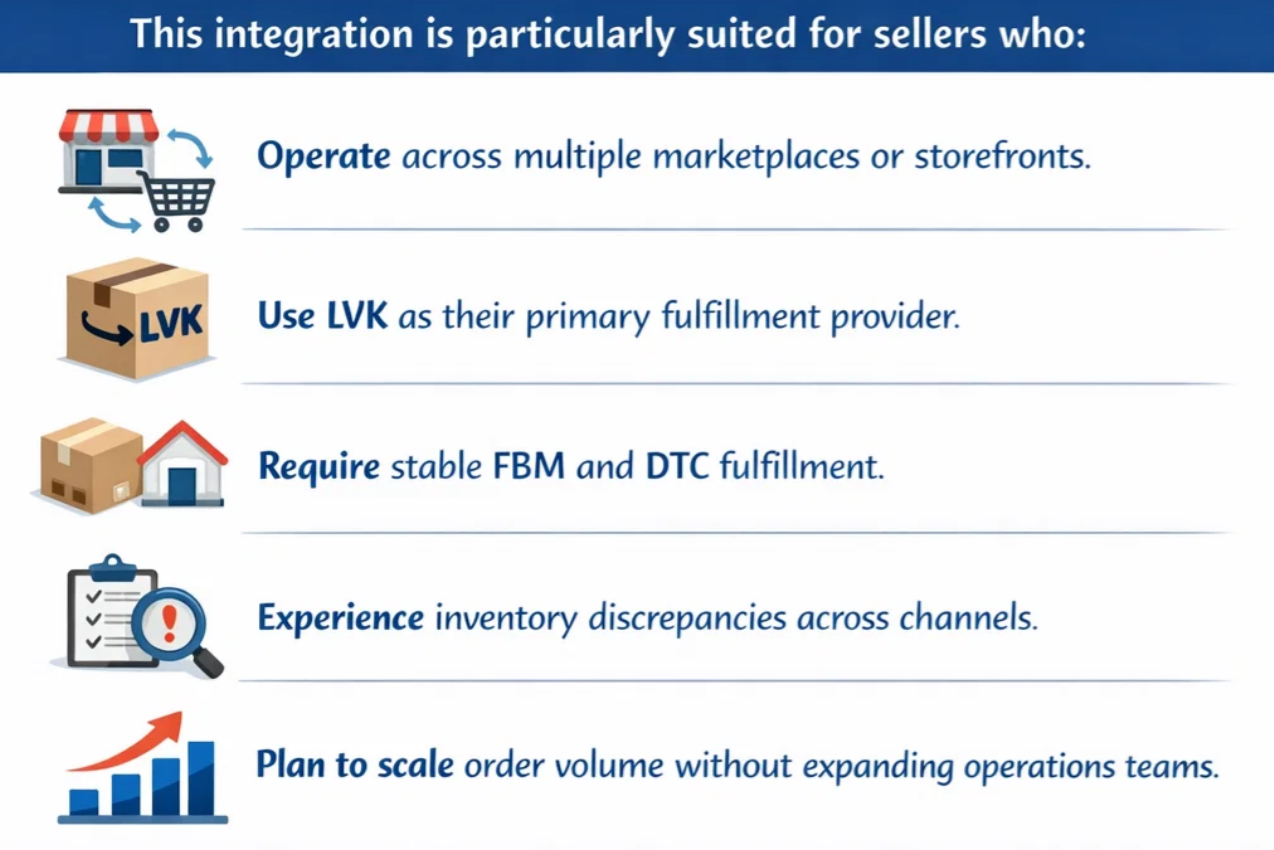
This integration is particularly suited for sellers who:
-
Operate across multiple marketplaces or storefronts
-
Use LVK as their primary fulfillment provider
-
Require stable FBM and DTC fulfillment
-
Experience inventory discrepancies across channels
-
Plan to scale order volume without expanding operations teams
For these businesses, fulfillment automation is no longer a competitive advantage. It is foundational infrastructure.
In Summary, Why Connect ShipHero-Based LVK Fulfillment with 4Seller?
By connecting multi-channel sales platforms with LVK fulfillment, 4Seller enables sellers to automate order routing, shipping execution, and inventory synchronization within a single system. The result is fewer errors, stronger operational reliability, and a fulfillment workflow that scales alongside the business instead of becoming a bottleneck.
- Multi Channel Order Management
- TikTok Shop
- Amazon
- Temu
- About 4Seller
- Shopify
- Multi Channel Inventory Management
- Amazon MCF&FBA
- Seller Tips
- Listing Management
- Marketplace News
- eBay
- Amazon Shipping
- DHL Express
- Amazon MCF
- UPS
- FedEx
- Shein
- Creator Bulk Invite
- Multi-channel Store
- Inventory Sync
- GLS
- Beginner Tutorial
- Walmart WFS
- Walmart
- Seller Story
- Royal Mail
- Kaufland
- Shipping Integration
- DHL Parcel
- 3PL
- WooCommerce
- Walmart MCS
- Deutsche Post
- Shipping Label
- OTTO
- Platform Integration
- PayPal Tracking Sync
- UniUni
- Yodel
- ShipHero
- SPU Catalog
- Stripe Tracking Sync
- USPS
- AliExpress
- GOFO
- CIRRO
- Correos
- Correos Express
- DPD
- Etsy
- Evri
- FBM
- Request Review
- Logistics Rule
- CaiNiao
- BRT
- Chronopost
- Poste Italiane
- Cdiscount
- OMS
- DHL
- WFS
- ShipBob
- Price Sync
 17 Dec,2024
- 17 Dec,2024