Popular Posts
- Multi Channel Order Management
- TikTok Shop
- Amazon
- Temu
- About 4Seller
- Shopify
- Multi Channel Inventory Management
- Amazon MCF&FBA
- Seller Tips
- Listing Management
- Marketplace News
- Amazon Shipping
- DHL Express
- UPS
- Amazon MCF
- FedEx
- eBay
- Shein
- Creator Bulk Invite
- Inventory Sync
- GLS
- Multi-channel Store
- Walmart WFS
- Walmart
- Royal Mail
- Shipping Integration
- Kaufland
- DHL Parcel
- Seller Story
- Beginner Tutorial
- 3PL
- Walmart MCS
- Shipping Label
- Deutsche Post
- WooCommerce
- OTTO
- Platform Integration
- PayPal Tracking Sync
- UniUni
- Yodel
- ShipHero
- SPU Catalog
- Stripe Tracking Sync
- USPS
- GOFO
- CIRRO
- Correos
- Correos Express
- DPD
- Etsy
- Evri
- FBM
- Request Review
- Logistics Rule
- CaiNiao
- BRT
- Chronopost
- Poste Italiane
- Cdiscount
- AliExpress
- OMS
- DHL
- ShipBob
- WFS
- Price Sync
How to Manage MultiChannel Inventory by Stock Threshold, SKU Exclusion, Min & Max Limits, and Smart Predictable Sync?
 By Joline29 Dec,2025
Every inventory tool on the market promises the same thing: multi-channel inventory sync. On paper, that sounds exactly what modern sellers need. But once you actually run a business across Amazon, Shopify, TikTok Shop, Walmart, and eBay, that promise starts to feel dangerously incomplete.
Inventory syncing answers only one question: can numbers move between platforms? What it doesn’t answer is whether those numbers should move, where they should appear, and how much of your real stock each platform is allowed to see.
This gap between “syncing” and “controlling” inventory is where most operational issues begin. Overselling, unexpected order spikes, forced cancellations, and platform penalties are rarely caused by inventory not syncing. They happen because inventory sync is too rigid to match real-world selling scenarios.
That is exactly the problem 4Seller’s inventory linkage upgrade is designed to solve.Why Do “Basic Inventory Sync” Tools Break Down in Real Seller Operations?
Basic inventory sync tools assume a single rule: if inventory changes, push the update everywhere. That assumption might work for single-channel sellers, but it breaks almost immediately in multi-platform operations.As soon as you introduce different fulfillment methods, different platform rules, or different sales purposes for the same SKU, the “sync everything” logic starts creating friction. A warehouse deduction meant for one channel suddenly affects another channel that was never meant to sell that inventory in the first place.
Sellers end up spending more time correcting the system than benefiting from automation. The tool technically works, but operationally it creates risk.
4Seller’s upgraded inventory linkage adds a layer that most tools skip entirely: decision-making logic that mirrors how sellers actually operate.What is 4Seller’s Inventory Linkage Upgrade?
4Seller’s upgraded inventory linkage allows sellers to exclude SKUs from specific platforms, cap maximum inventory visibility, and enforce minimum stock levels. This prevents overselling, algorithm penalties, and stock exposure issues across Amazon, Shopify, TikTok Shop, Walmart, eBay, Temu, and Shein while syncing inventory from FBA, WFS, and leading 3PLs.When a SKU Must Never Be Touched: SKU-Level Inventory Sync Exclusion Rules
Have you ever been in this situation?
You manage the same SKU across multiple sales channels within one system: Amazon FBM is selling normally, your Shopify store is running paid ads, and eBay has a special-purpose listing that might be reserved for B2B clients, used for negotiated offline deals, fulfilled manually outside your main warehouse, only opened during specific time windows, or backed by a completely separate inventory pool. On paper, everything seems under control, but in reality, problems start the moment inventory moves.Where does traditional inventory sync go wrong?
Most inventory tools follow simple logic: inventory changes → sync everywhere.
So when your main warehouse stock changes:


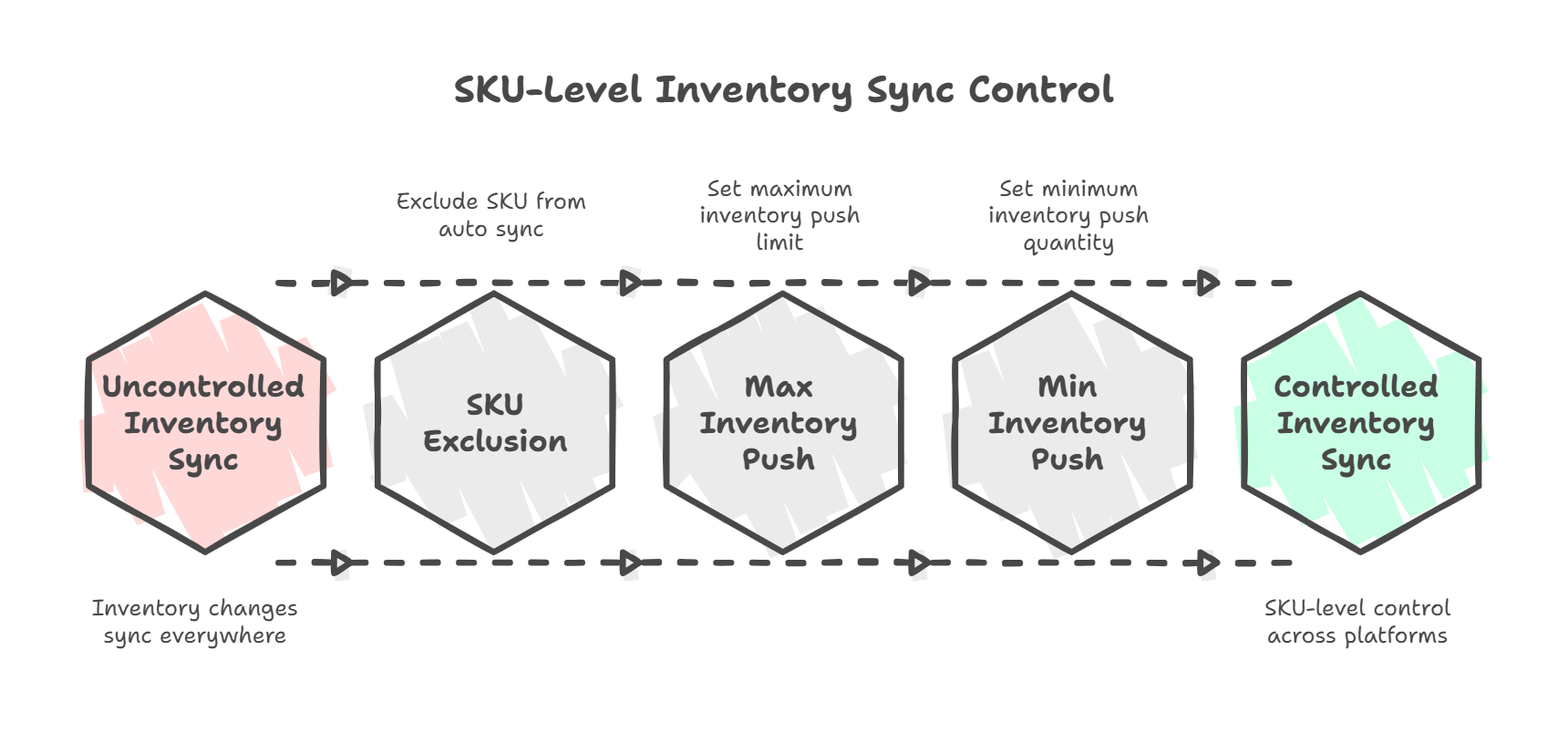
- Inventory decreases
- The system automatically syncs
- eBay inventory gets updated
- Orders are triggered
- You scramble to cancel orders or source emergency stock
How 4Seller solves this problem?
Inventory Sync Upgrade Feature #1: 4Seller allows you to exclude a specific SKU from automatic inventory sync to selected platform stores.Once this rule is applied:
- Inventory changes for that SKU
- Will never be pushed to the selected store
- Whether inventory increases or decreases
- The platform listing is permanently excluded from sync rules
Who benefits most from this feature?
This functionality is especially valuable for sellers who:- Use the same SKU for different business purposes across platforms
- Operate channels that require manual intervention
- Need to reserve or lock inventory for specific platforms
- Sell across Amazon FBM, Shopify, and eBay simultaneously
- Work with 3PLs such as ShipBob, ShipHero, GoodCang, Amazon FBA or Walmart WFS
Too Much Inventory Can Be a Risk: Maximum Inventory Push Control
Many sellers overlook a critical truth: Not every platform should see your real inventory numbers.A very real scenario
Imagine you have 2,000 units in Amazon FBA while simultaneously selling on Walmart Marketplace, TikTok Shop, and Shopify. If you push all 2,000 units to every platform, it might initially seem fine—platforms see ample stock, traffic increases, and orders pick up. But problems quickly emerge: FBA inbound shipments can be delayed, inventory transfers may get stuck, one platform can sell faster than expected, and other platforms instantly oversell. What seems like growth at first is actually a cascading chain reaction of inventory failures.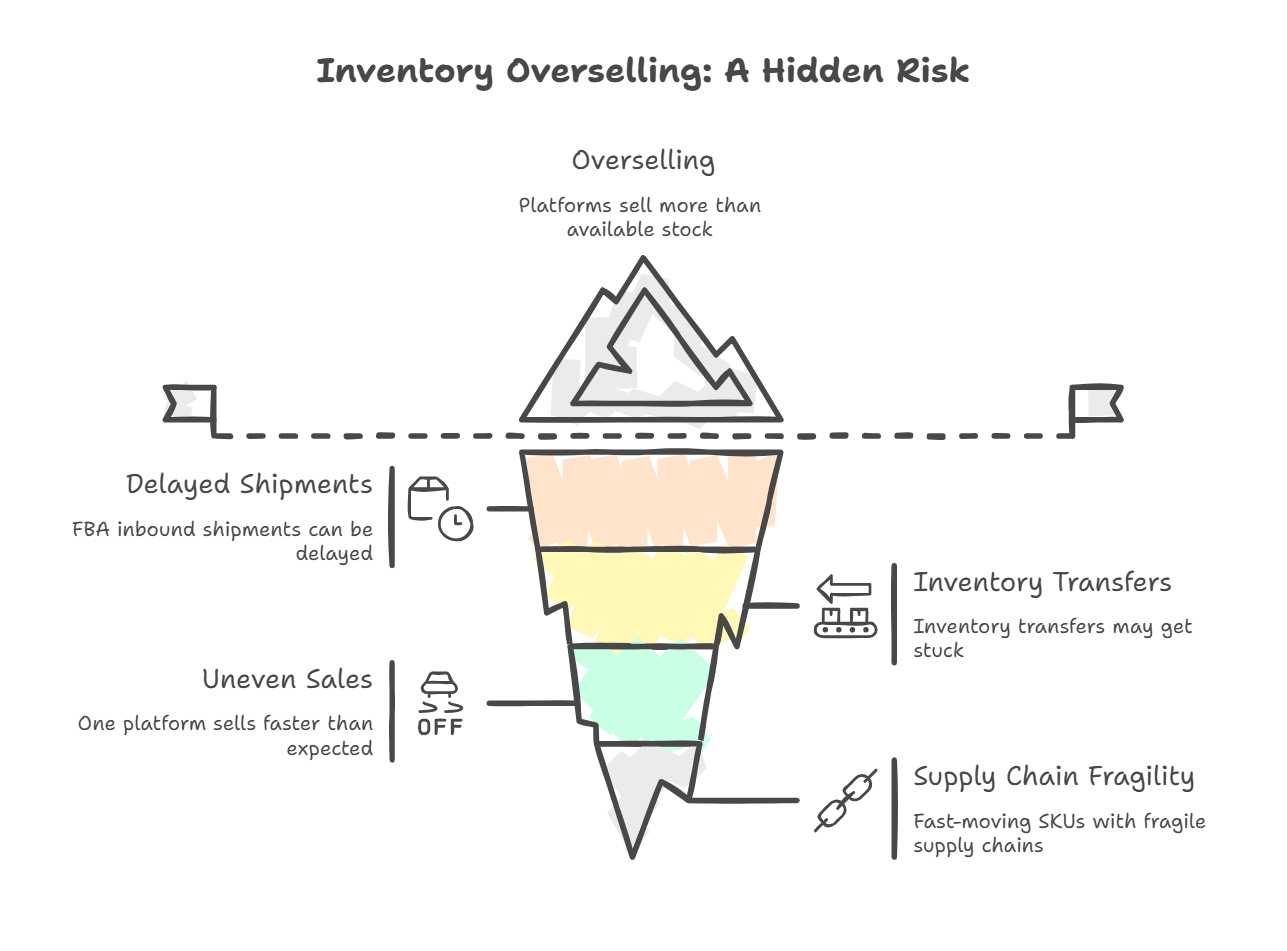
How 4Seller solves this problem?
Inventory Sync Upgrade Feature #2: 4Seller supports setting a maximum inventory push limit.The logic is simple and transparent:
- When actual inventory is lower than the max limit → Push actual inventory to the platform
- When actual inventory is higher than the max limit → Only push the maximum limit to the platform
What problems does this actually solve?
This feature directly reduces inventory exposure risk:- Prevents one platform from consuming all available stock
- Creates safety buffers for FBA, WFS, or 3PL fulfillment
- Avoids system-level overselling during promotions
- Keeps multi-channel sales pace under control
- Combine Amazon FBA with multi-channel FBM
- Use Walmart WFS alongside ShipHero or other 3PLs
- Have fast-moving SKUs but fragile supply chains
Low Inventory Can Kill Traffic: The Hidden Value of Minimum Inventory Push
Many sellers assume: “If inventory is low, just show less stock.” Platforms do not always think the same way.A common but rarely discussed scenario
You are selling well on TikTok Shop or SHEIN, but one day your warehouse stock drops to just two units. The platform detects extremely low inventory and interprets it as a high risk of fulfillment failure. As a result, traffic is throttled, exposure is reduced, and listing momentum collapses—sometimes even before you actually sell out—despite knowing that replenishment is arriving the very next day.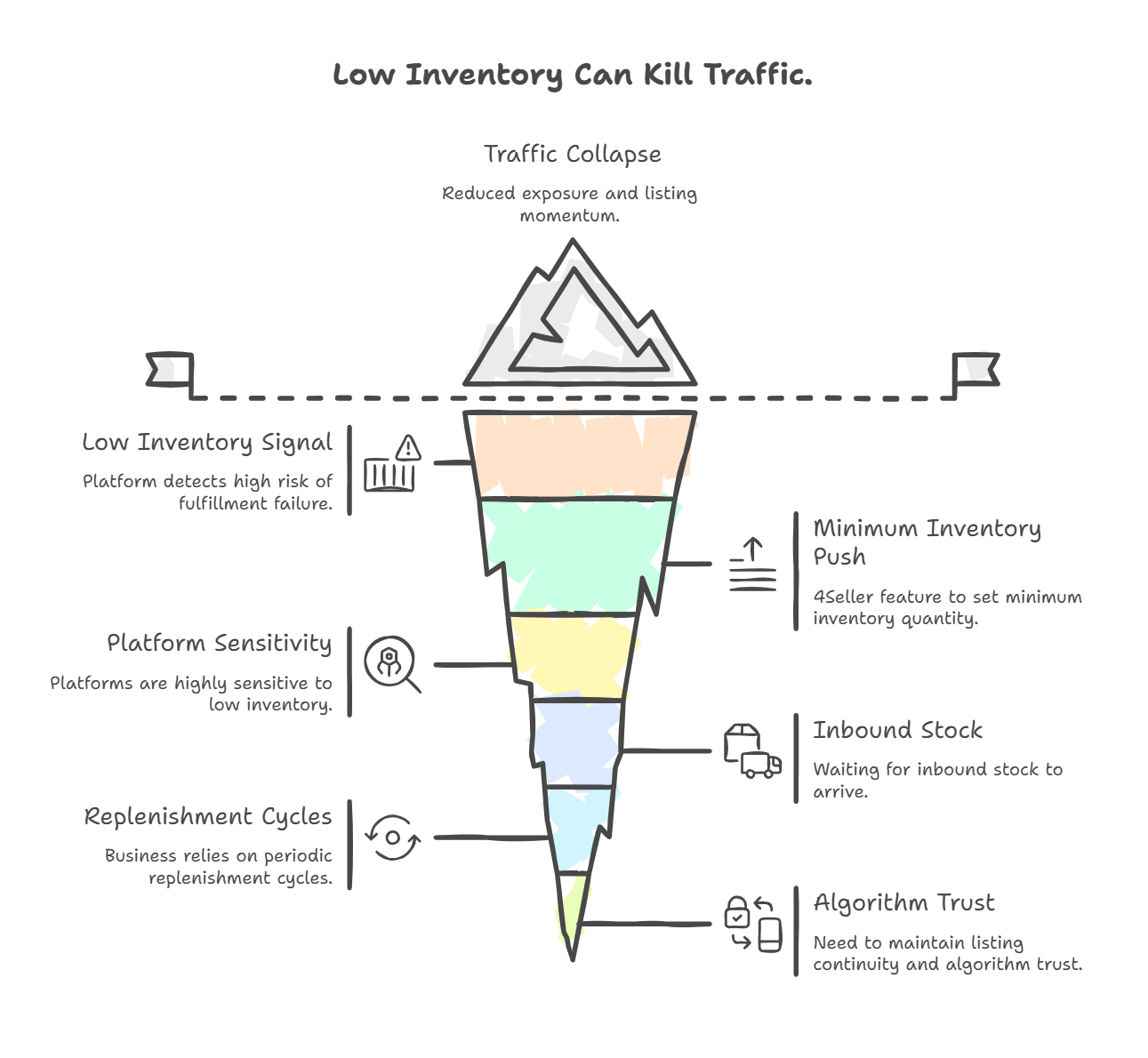
How 4Seller solves this problem?
Inventory Sync Upgrade Feature #3: 4Seller allows you to set a minimum inventory push quantity.The logic works like this:
- When actual inventory is lower than the minimum limit → Push the minimum quantity to the platform
- When actual inventory is higher than the minimum limit → Push actual inventory
When is this feature critical?
This feature becomes essential when:- Platforms are highly sensitive to low inventory signals (TikTok, SHEIN)
- You are waiting for inbound stock and want to avoid early traffic loss
- Your business relies on periodic replenishment cycles
- You need to maintain listing continuity and algorithm trust
Multiple Rules Can Coexist Without Conflict: Priority Logic in Inventory Sync
When SKU exclusion, maximum push, and minimum push rules are all active at the same time, a critical question arises: which rule takes precedence? Without a clear priority system, rules can override each other, leading to unpredictable outcomes and leaving sellers unsure of what will actually happen.4Seller addresses this by providing a rule sorting feature, allowing sellers to set the execution order of their inventory sync rules. The most important SKU exclusion rule can be placed at the top, ensuring that any inventory changes do not affect excluded listings. Next comes the maximum push rule, controlling how much inventory is exposed to platforms. Finally, the minimum push rule maintains the perceived stock for platform algorithms. Each rule is evaluated in order, without interfering with the others, creating a top-down, layered protection logic.
With this system, inventory sync is no longer a black-box process—it becomes a controllable, explainable, and predictable operational strategy.
Which Platforms and Warehouses Does 4Seller Inventory Linkage Support?
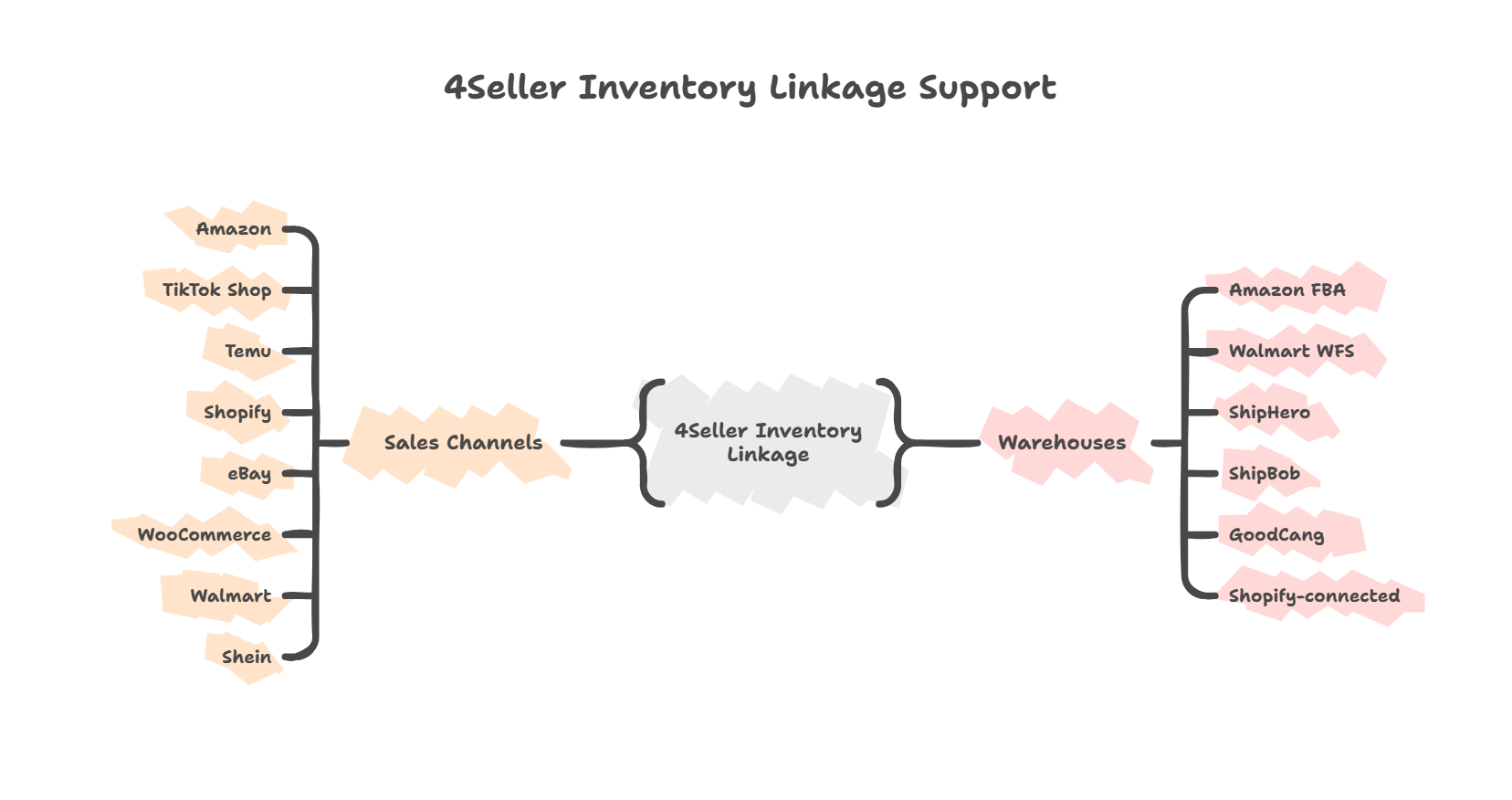
The goal isn’t just broad compatibility. It’s to ensure that inventory logic follows the product across platforms and fulfillment partners, instead of being constrained by them.
Helping article pls refer: How to Enable Inventory Sync (Inventory Linkage)?
Why This Upgrade Matters for Established Sellers?
Inventory sync should reduce risk, not introduce it. As operations grow more complex, sellers need tools that respect nuance instead of forcing one-size-fits-all automation.4Seller’s inventory linkage upgrade shifts inventory sync from a mechanical process to an operational strategy. It gives sellers control over where inventory moves, how much is exposed, and when automation should step aside.
For multi-platform sellers, that control is no longer optional. It’s foundational.
All Topics
- Multi Channel Order Management
- TikTok Shop
- Amazon
- Temu
- About 4Seller
- Shopify
- Multi Channel Inventory Management
- Amazon MCF&FBA
- Seller Tips
- Listing Management
- Marketplace News
- Amazon Shipping
- DHL Express
- UPS
- Amazon MCF
- FedEx
- eBay
- Shein
- Creator Bulk Invite
- Inventory Sync
- GLS
- Multi-channel Store
- Walmart WFS
- Walmart
- Royal Mail
- Shipping Integration
- Kaufland
- DHL Parcel
- Seller Story
- Beginner Tutorial
- 3PL
- Walmart MCS
- Shipping Label
- Deutsche Post
- WooCommerce
- OTTO
- Platform Integration
- PayPal Tracking Sync
- UniUni
- Yodel
- ShipHero
- SPU Catalog
- Stripe Tracking Sync
- USPS
- GOFO
- CIRRO
- Correos
- Correos Express
- DPD
- Etsy
- Evri
- FBM
- Request Review
- Logistics Rule
- CaiNiao
- BRT
- Chronopost
- Poste Italiane
- Cdiscount
- AliExpress
- OMS
- DHL
- ShipBob
- WFS
- Price Sync
Popular Posts
 17 Dec,2024
Table of Content
Popular Posts
- 17 Dec,2024

Back to top