- Multi Channel Order Management
- TikTok Shop
- Amazon
- Temu
- About 4Seller
- Shopify
- Multi Channel Inventory Management
- Amazon MCF&FBA
- Seller Tips
- Listing Management
- Marketplace News
- FedEx
- UPS
- Amazon MCF
- DHL Express
- Amazon Shipping
- eBay
- Shein
- Creator Bulk Invite
- Inventory Sync
- GLS
- Multi-channel Store
- Walmart
- Walmart WFS
- Shipping Integration
- Kaufland
- Royal Mail
- Seller Story
- Beginner Tutorial
- 3PL
- WooCommerce
- DHL Parcel
- Walmart MCS
- Shipping Label
- OTTO
- Deutsche Post
- Platform Integration
- PayPal Tracking Sync
- AliExpress
- Yodel
- ShipHero
- SPU Catalog
- Stripe Tracking Sync
- USPS
- UniUni
- GOFO
- CIRRO
- Correos
- Correos Express
- DPD
- Etsy
- Evri
- FBM
- Request Review
- Logistics Rule
- CaiNiao
- BRT
- Chronopost
- Poste Italiane
- Cdiscount
- OMS
- DHL
- WFS
- ShipBob
- Price Sync
How to Import Shopify, Amazon, TikTok, eBay, Etsy, WooCommerce & Shein Products to Temu? A New 4-Step Migration Process
 By Joline04 Jan,2026
For many US, UK, and EU-based sellers, Temu is no longer a side experiment. If you already run stable sales on Amazon, Shopify, eBay, Etsy, or TikTok Shop, moving products to a new marketplace should feel operational, not existential. In theory, it should be a matter of copying listings, adjusting a few fields, and publishing.

In reality, Temu exposes a deeper problem that most listing tools never address. Products copy successfully. But publishing fails. Drafts pile up. Errors feel vague. And sellers are left wondering what they missed.

The uncomfortable truth is this: Temu listing failures are rarely caused by seller mistakes. They are caused by tools that treat Temu like every other marketplace.

Why “Product Migration” Breaks Down on Temu?

Most listing migration tools were built around one assumption: If a product is already live on Amazon or Shopify, it is structurally complete.

That assumption works across many platforms. It breaks on Temu. Temu does not evaluate listings as “products that already sell.” It evaluates them as data structures that must pass strict validation before they are allowed to exist.
- Category accuracy determines attribute requirements.
- Logistics settings define eligibility.
- Weight, dimensions, and variant images are not enhancements. They are gatekeepers.
When tools copy listings without restructuring them for Temu’s logic, they do not save time. They simply postpone failure.
This is why so many sellers experience the same loop:
- They migrate first.
- They fix errors later.
- They repeat the process SKU by SKU.
The issue is not that Temu is difficult. The issue is that most tools push sellers forward before the listing is actually ready to move forward.
Why “Copy First, Fix Later” Creates More Manual Work, Not Less?
A common promise across listing tools sounds reassuring: “Import your products now. You can optimize them later.”
On Temu, this approach is a trap. Once a product is imported with the wrong category, every attribute that follows becomes unstable. Sellers end up filling fields that are not required, missing fields that are mandatory, and correcting mistakes only after the platform rejects the listing. At that point, the seller is no longer saving time. They are debugging a system they were never meant to understand.
This is where most migration workflows quietly fail. They treat publishing as the end of the process, rather than the result of correct preparation.
Why 4Seller Rebuilt the Temu Migration Flow from the Ground Up?
4Seller did not add “more Temu features.” It rebuilt the logic behind how products move to Temu.
The goal was simple: move error handling before publishing, not after it.
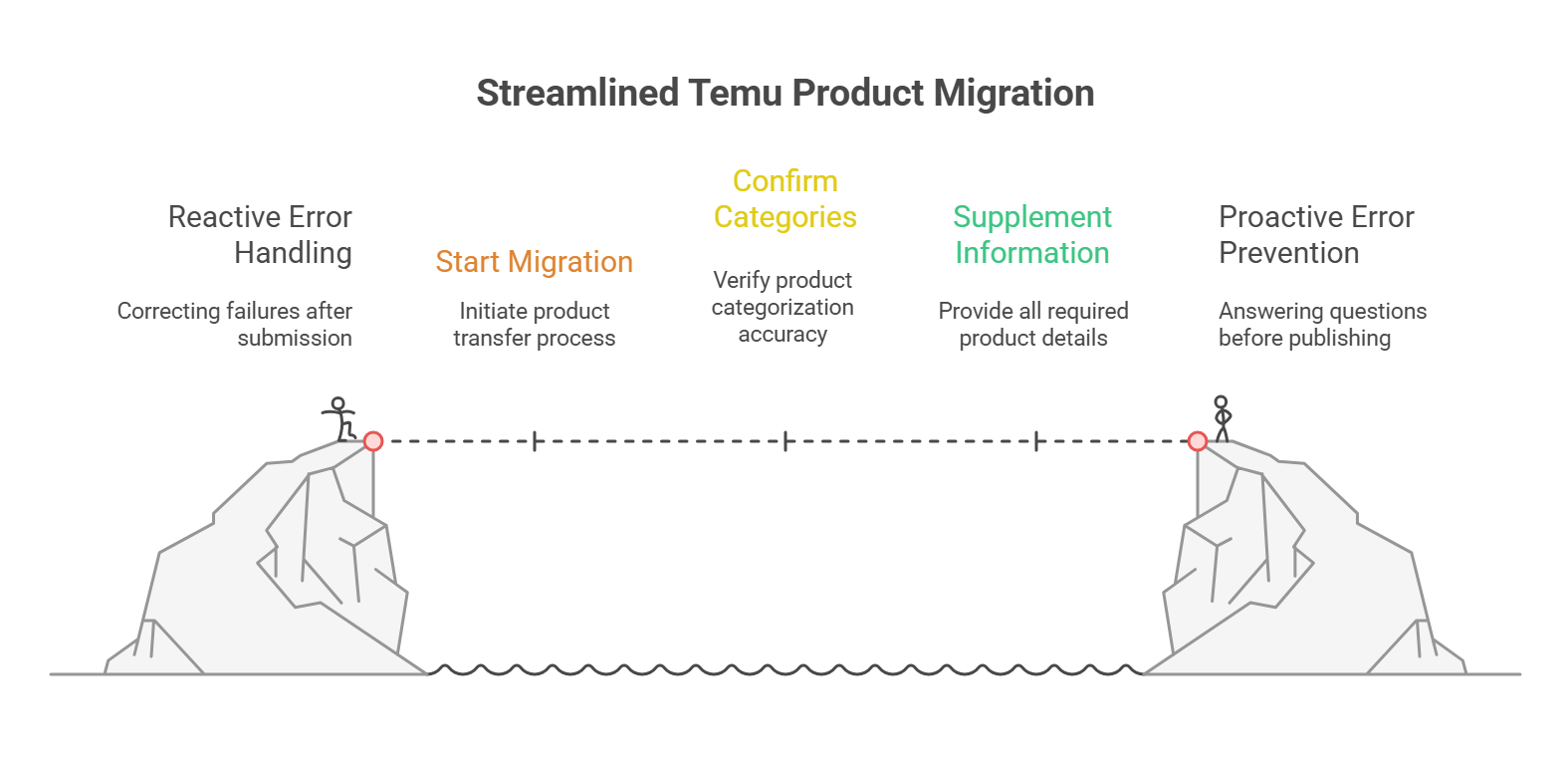
Instead of allowing sellers to rush toward submission, 4Seller redesigned the workflow into four enforced stages:
- Start Migration
- Confirm Categories
- Supplement Information
- Publish Products
Each stage exists to answer a question Temu will eventually ask anyway.
Helping article pls refer: How to Sync Listings from Shopify 、Amazon、TikTok、eBay、Etsy、WooCommerce、Shein store to TikTok , Amazon, Temu, eBay or Shopify Store?
By answering those questions early, sellers stop wasting time correcting preventable failures.
Why Shipping and Fulfillment Must Be Defined Before Anything Else?
In most tools, shipping settings are an afterthought. In Temu’s system, they are foundational.
4Seller now requires sellers to define shipping time and logistics templates at the start of the migration process, not at the end. This prevents a common failure scenario where dozens of products fail simply because they inherited incorrect or default fulfillment rules. For sellers running local US or EU warehouses, this step eliminates silent mismatches between inventory reality and Temu’s fulfillment expectations. The product does not move forward until the logistics logic makes sense.
Why Category Confirmation Is the Most Critical Step Sellers Usually Skip?
Category selection is not cosmetic on Temu. It determines which attributes exist, which are mandatory, and which combinations are allowed.
Most tools auto-match categories and move on. 4Seller stops and makes category matching visible. Sellers can clearly see which products are correctly matched, which are not, and which should be removed entirely from the migration. This is not about slowing sellers down. It is about preventing them from building on top of a flawed foundation.
Once categories are correct, everything downstream becomes predictable.
Why Bulk Supplementation Is the Difference Between Automation and Illusion?
One of the most frustrating parts of Temu onboarding is supplementing missing information at scale.
Weight and dimensions are often missing across variants. Attributes differ by category. Images may exist but are not structured correctly for variants. 4Seller addresses this by grouping missing information logically and allowing sellers to supplement data by category rather than by SKU. Instead of editing the same fields dozens of times, sellers resolve structural gaps once and apply them consistently.
This is where automation becomes real. Not by skipping steps, but by resolving repetition.
Why Publishing Should Explain Outcomes, Not Hide Them?
When publishing begins, sellers need clarity, not optimism.
4Seller’s publishing stage clearly separates products that publish successfully, products that remain in draft due to optimization requirements, and products that fail for system reasons and can be retried later. There is no guessing. There is no silent failure. Every outcome is traceable.
For sellers managing hundreds or thousands of SKUs, this visibility is not a convenience. It is operational control.
What Actually Changed Compared to Older Tools and Older Versions?
This Temu migration upgrade is not about speed alone. It is about shifting where mistakes are handled.
Instead of fixing errors after submission, sellers now resolve them before publishing. Instead of managing chaos in drafts, sellers control structure upstream.
Compared to other listing tools, 4Seller no longer treats Temu as “just another channel.” Compared to its own previous versions, it no longer prioritizes copying speed over publishing success.
How to Sync Listings from Shopify 、Amazon、TikTok、eBay、Etsy、WooCommerce、Shein store to Temu Store?
Helping article pls refer: How to Sync Listings from Shopify 、Amazon、TikTok、eBay、Etsy、WooCommerce、Shein store to TikTok , Amazon, Temu, eBay or Shopify Store?The Real Outcome for Sellers
For US, UK, and EU sellers who already understand ecommerce operations, this rebuild delivers something more valuable than bulk actions.
It delivers predictability. Listings move forward because they are structurally ready. Failures are reduced because requirements are surfaced early. Manual rework shrinks because repetition is eliminated.
Temu becomes a channel you can scale deliberately, not one you tiptoe around.
Final Thought
Temu listing has never been about copying products. It has always been about respecting structure.
4Seller’s Temu migration rebuild acknowledges that reality and designs around it. Not by asking sellers to work harder, but by making the system finally work in the right order.
- Multi Channel Order Management
- TikTok Shop
- Amazon
- Temu
- About 4Seller
- Shopify
- Multi Channel Inventory Management
- Amazon MCF&FBA
- Seller Tips
- Listing Management
- Marketplace News
- FedEx
- UPS
- Amazon MCF
- DHL Express
- Amazon Shipping
- eBay
- Shein
- Creator Bulk Invite
- Inventory Sync
- GLS
- Multi-channel Store
- Walmart
- Walmart WFS
- Shipping Integration
- Kaufland
- Royal Mail
- Seller Story
- Beginner Tutorial
- 3PL
- WooCommerce
- DHL Parcel
- Walmart MCS
- Shipping Label
- OTTO
- Deutsche Post
- Platform Integration
- PayPal Tracking Sync
- AliExpress
- Yodel
- ShipHero
- SPU Catalog
- Stripe Tracking Sync
- USPS
- UniUni
- GOFO
- CIRRO
- Correos
- Correos Express
- DPD
- Etsy
- Evri
- FBM
- Request Review
- Logistics Rule
- CaiNiao
- BRT
- Chronopost
- Poste Italiane
- Cdiscount
- OMS
- DHL
- WFS
- ShipBob
- Price Sync
 17 Dec,2024
- 17 Dec,2024