Popular Posts
- Multi Channel Order Management
- TikTok Shop
- Amazon
- Temu
- About 4Seller
- Shopify
- Multi Channel Inventory Management
- Amazon MCF&FBA
- Seller Tips
- Listing Management
- Marketplace News
- Amazon Shipping
- DHL Express
- UPS
- Amazon MCF
- FedEx
- eBay
- Shein
- Creator Bulk Invite
- Inventory Sync
- GLS
- Multi-channel Store
- Walmart WFS
- Walmart
- Royal Mail
- Shipping Integration
- Kaufland
- DHL Parcel
- Seller Story
- Beginner Tutorial
- 3PL
- Walmart MCS
- Shipping Label
- Deutsche Post
- WooCommerce
- OTTO
- Platform Integration
- PayPal Tracking Sync
- UniUni
- Yodel
- ShipHero
- SPU Catalog
- Stripe Tracking Sync
- USPS
- GOFO
- CIRRO
- Correos
- Correos Express
- DPD
- Etsy
- Evri
- FBM
- Request Review
- Logistics Rule
- CaiNiao
- BRT
- Chronopost
- Poste Italiane
- Cdiscount
- AliExpress
- OMS
- DHL
- ShipBob
- WFS
- Price Sync
All You Need to Know About Shopify Inventory Sync Bidirectionally for Multi-Channel Selling
 By Joline07 Jan,2026
- Shopify does not natively support true multi-channel inventory synchronization. To enable automated, bidirectional inventory coordination across self-fulfilled warehouses and 3PL networks, sellers must rely on a third-party, all-in-one inventory management solution such as 4Seller.
- When inventory data is not synchronized, businesses face stock shortages, excess inventory, unreliable demand forecasts, and expensive cross-channel allocation errors.
- Inventory synchronization tools offer a single, consolidated inventory view across major sales channels including TikTok, Temu, Shopify, Amazon, eBay, WooCommerce, Walmart, and Shein, allowing faster fulfillment and more strategic stock redistribution.
- 4Seller automates inventory updates, supports safety stock thresholds, and enables configurable minimum and maximum stock exposure rules to reduce manual work and minimize inventory-related mistakes.
This guide explains the main approaches to multi-channel inventory synchronization and how solutions like 4Seller support scalable inventory operations.
What Is Bidirectional Shopify Inventory Sync?
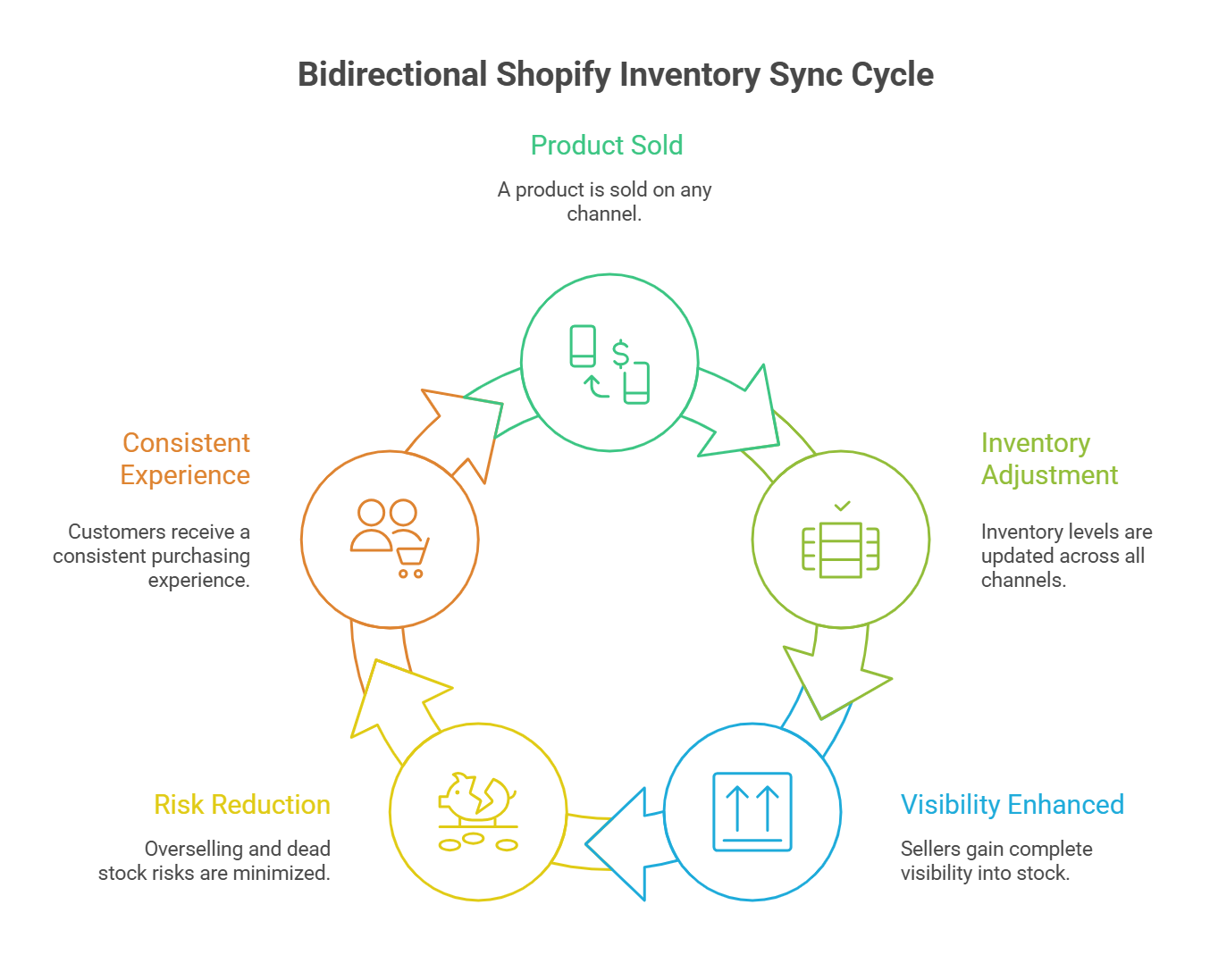
By connecting Shopify inventory with external marketplaces and offline locations, sellers gain complete visibility into available stock, reduce the risk of overselling or dead stock, and deliver a consistent purchasing experience no matter where customers place their orders.
What are the Hidden Costs of Unsynced Inventory in Multi-Channel Ecommerce?
Managing inventory as separate pools across sales channels quietly drains efficiency and profitability. What looks like a manageable setup on the surface often hides a series of operational risks that compound over time.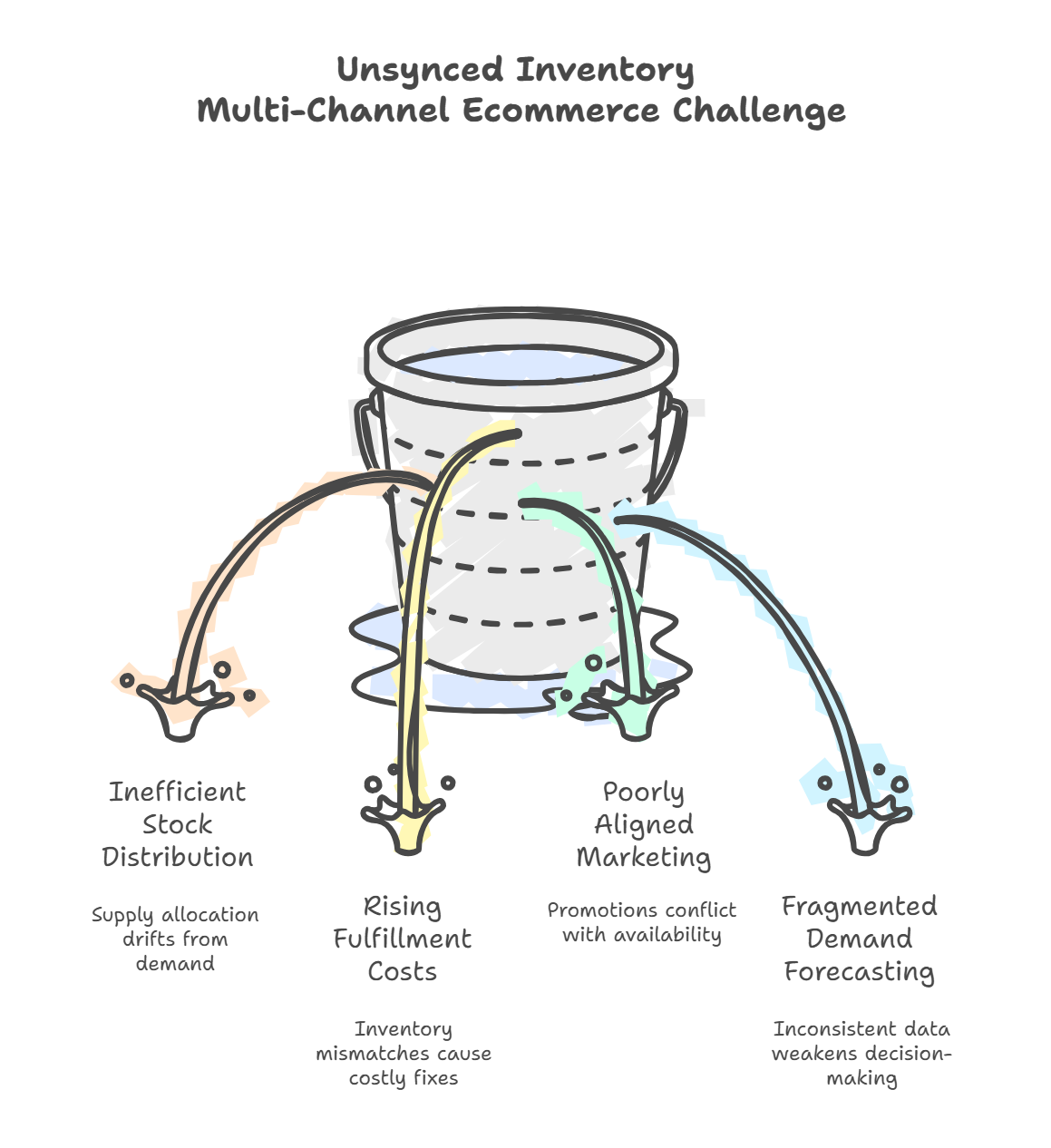
-
Inefficient Stock Distribution
A fast-selling running shoe, for instance, might show as out of stock on a Shopify store while excess units sit idle in a brick-and-mortar location. This imbalance is not caused by demand shifts, but by the absence of shared inventory visibility. The result is missed online sales alongside unnecessary overstock elsewhere.
By centralizing inventory data across platforms, solutions like 4Seller enable sellers to place inventory where customers are actively buying.
-
Rising Fulfillment Costs
These include urgent inter-warehouse transfers or frequent low-volume replenishment orders, both of which increase per-unit costs and compress margins.
A typical scenario might involve shipping a laptop from a distant warehouse even though local stock is available, simply because systems are not aligned. Over time, these inefficiencies quietly inflate operating expenses.
-
Poorly Aligned Marketing Decisions
A product that moves slowly online but sells rapidly in physical stores may be aggressively promoted on digital channels, unintentionally draining in-store inventory and reducing overall profitability. Without a unified view of stock levels, promotions can conflict with real availability, leading to wasted ad budgets and damaged customer confidence.
-
Fragmented Demand Forecasting
Sellers may overinvest in products that perform well on only one platform or underestimate demand because sales data from other channels is missing.
For example, a toy seller analyzing Shopify performance alone might ignore strong offline sales signals, resulting in delayed restocking and lost revenue. Fragmented inventory data ultimately weakens decision-making across purchasing, marketing, and sales.
Does Shopify Support Cross-Channel Bidirectional Inventory Sync?
No. Shopify does not include built-in functionality to automatically synchronize inventory levels across external sales channels. If products are sold on platforms such as Amazon, eBay, or in physical retail locations, inventory updates must be handled separately.Although Shopify supports product management, bulk inventory edits, and limited inventory history reporting, these features apply only to the Shopify store itself. As a result, Shopify functions best as a single-channel inventory system.
To achieve automated inventory coordination and optimization across channels, sellers must integrate third-party inventory management tools like 4Seller.
How to Sync Inventory with Shopify Bidirectionally?
Shopify inventory can be aligned with other sales channels in bidirectionals: manual updates or automated synchronization.Method 1: Manual Inventory Updates
Manual synchronization typically involves the following steps:- Access the Shopify admin panel and navigate to Products > Inventory.
- Update inventory quantities for each product or variant based on sales from other channels.
- Repeat the process every time an order is placed outside Shopify.
Method 2: Use an Automatic Bidirectional Inventory Sync Tool - 4Seller
Automated inventory sync tools like 4Seller offer a more scalable and reliable solution while extending Shopify’s native capabilities.Implementation generally includes:
- Installing 4Seller app from the Shopify App Store and connecting sales channels such as TikTok, Temu, Amazon, eBay, WooCommerce, Walmart, and Shein.
- Inventory levels update automatically based on predefined rules. When a sale occurs on one channel, stock quantities are instantly adjusted every marketplace.(TikTok shop、Temu、Shopify、Amazon、eBay、WooCommerce、Walmart、Shein).
- This approach significantly reduces manual effort while preventing both stockouts and overstock.
What is the 4Seller Bidirectional Inventory Sync Tool?
A Shopify inventory sync tool is a third-party application designed to automatically coordinate stock levels across multiple sales channels. These tools integrate directly with Shopify and provide a centralized interface for managing inventory across platforms, warehouses, and even multiple Shopify stores.By using a solution like 4Seller, sellers remove the need for constant manual updates, as inventory adjustments occur automatically in real time. Additional advantages include:
- Faster fulfillment enabled by a unified inventory overview
- Flexible inventory control with SKU-level sync exclusions
- Smart stock exposure through minimum and maximum quantity rules
- Safety Stock Alerts for more accurate replenishment planning
- Fewer stockouts and reduced customer dissatisfaction
- Lower risk of emergency restocking and excess inventory
- Easier redistribution of inventory between locations
- Improved forecasting accuracy through complete inventory visibility
What are Key Features of 4Seller Inventory Sync Tools?
Real-Time Inventory Control and Sync
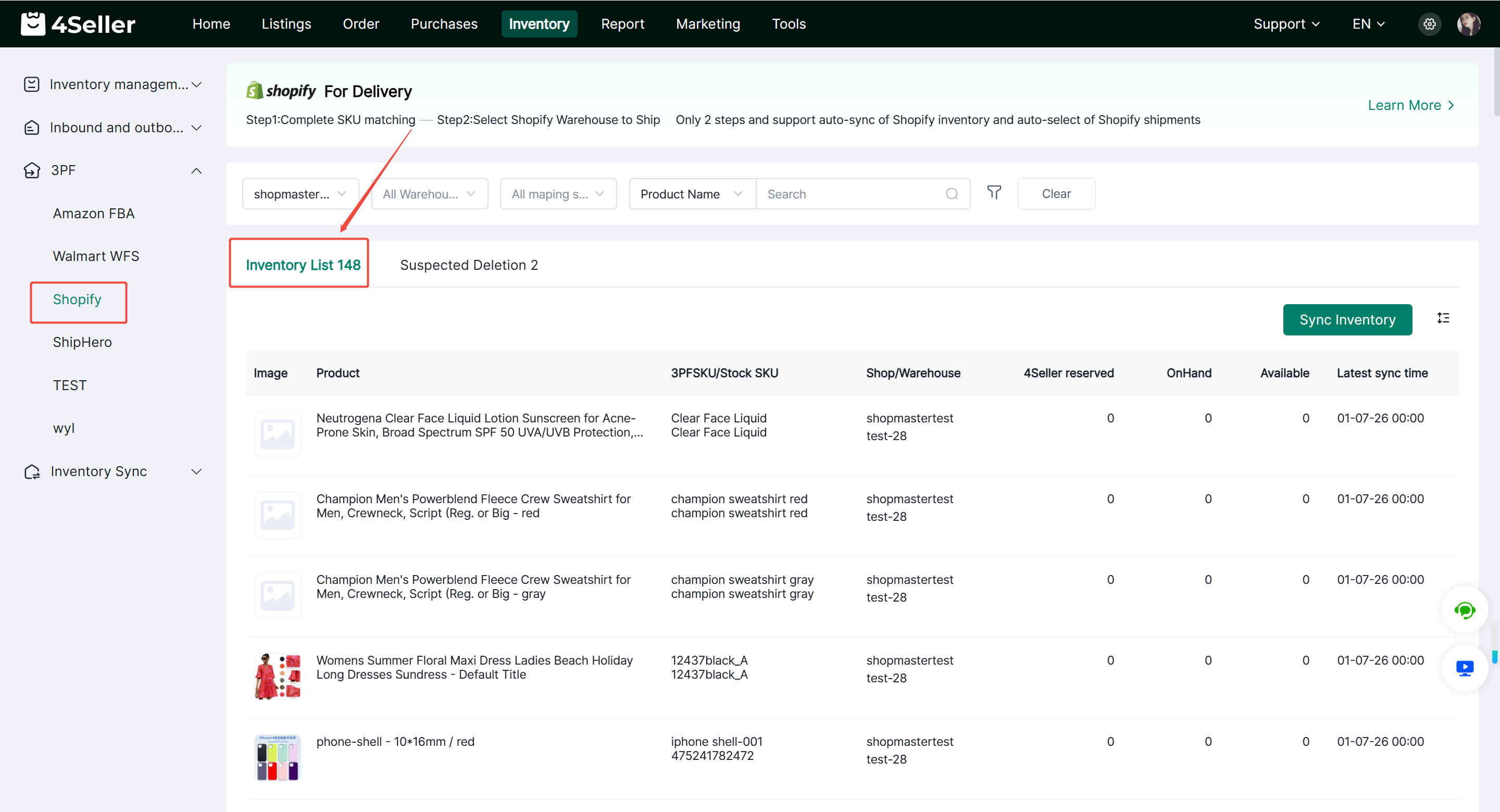
Real-time synchronization ensures that every sale, return, or adjustment is reflected across platforms automatically. Inventory rules eliminate delays and inaccuracies, allowing sellers to react quickly to changes in demand.
4Seller consolidates sales and inventory data into a single platform that supports multi-store, multi-warehouse, bundled products, and subscription models. Custom performance metrics provide deeper operational insights across channels.
Safety Stock Alerts
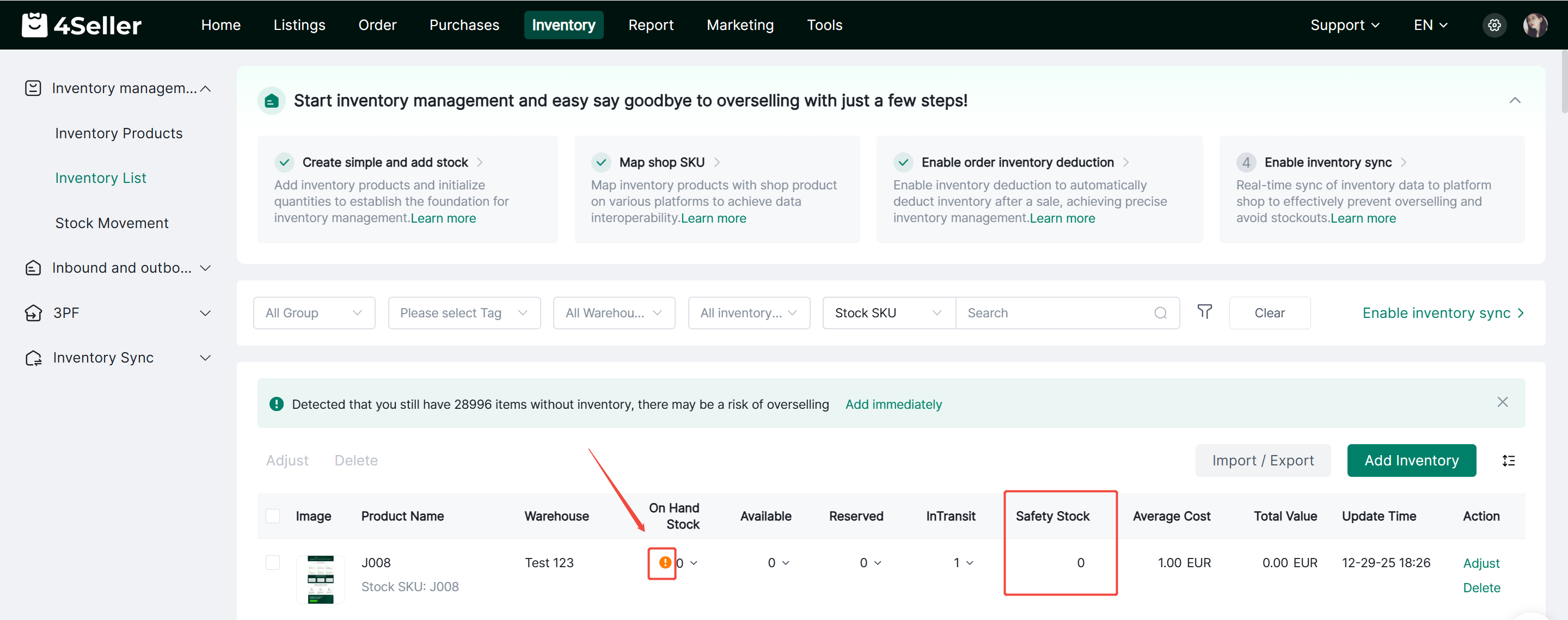
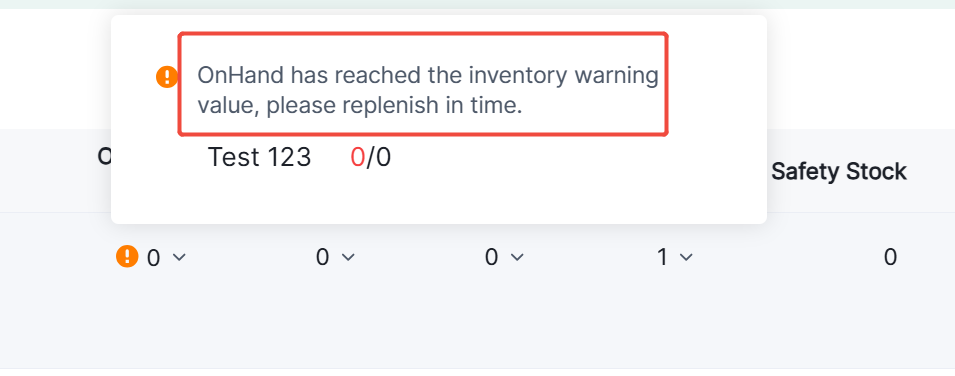
Why this matters: Safety stock alerts help sellers prevent unexpected stockouts by identifying risk early. Instead of discovering shortages only after listings go unavailable, sellers receive advance warnings that support timely restocking, maintain sales continuity, and protect customer trust. This reduces dependence on manual checks and avoids costly last-minute replenishment.
Minimum and Maximum Stock Push Rules
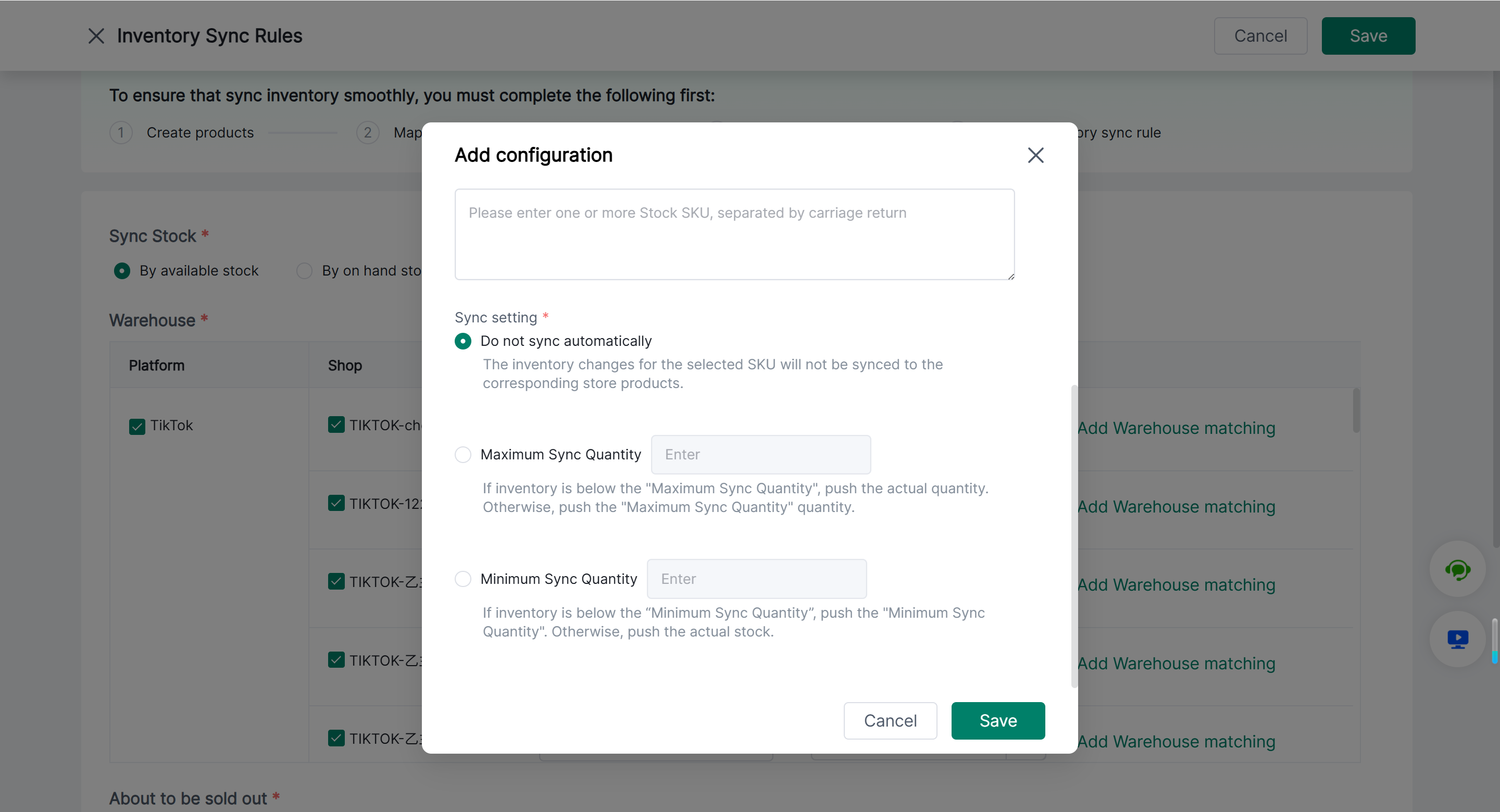
Likewise, if inventory drops below the minimum threshold, the minimum quantity is pushed, while higher stock levels sync normally.
Why this matters: These rules give sellers precise control over inventory visibility across channels. They help limit risk on high-demand SKUs, reserve stock for priority platforms, and prevent platform penalties caused by overselling. Inventory can be allocated strategically without constant manual intervention.
How 4Seller Enables Bidirectional Shopify Inventory Sync?
4Seller is a comprehensive inventory management ecosystem built for Shopify sellers operating across multiple channels. It extends far beyond basic inventory syncing.- Deep Shopify integration ensures all inventory changes, whether from online sales or physical stores, are reflected immediately.
- AI-driven forecasting enables sellers to define revenue targets and generate 12-month inventory plans automatically.
- Intelligent purchase recommendations and automated purchase order creation streamline procurement processes.
- Advanced analytics track retail value, total inventory value, aging stock, top-performing SKUs, and upcoming purchase deadlines.
- Automated daily and weekly inventory alerts inform sellers of low stock, stockouts, and excess inventory, enabling faster decisions.
Want to experience simpler, more controlled inventory management? Start your free trial of 4Seller today and unlock seamless multi-channel inventory synchronization.
Topics
All Topics
- Multi Channel Order Management
- TikTok Shop
- Amazon
- Temu
- About 4Seller
- Shopify
- Multi Channel Inventory Management
- Amazon MCF&FBA
- Seller Tips
- Listing Management
- Marketplace News
- Amazon Shipping
- DHL Express
- UPS
- Amazon MCF
- FedEx
- eBay
- Shein
- Creator Bulk Invite
- Inventory Sync
- GLS
- Multi-channel Store
- Walmart WFS
- Walmart
- Royal Mail
- Shipping Integration
- Kaufland
- DHL Parcel
- Seller Story
- Beginner Tutorial
- 3PL
- Walmart MCS
- Shipping Label
- Deutsche Post
- WooCommerce
- OTTO
- Platform Integration
- PayPal Tracking Sync
- UniUni
- Yodel
- ShipHero
- SPU Catalog
- Stripe Tracking Sync
- USPS
- GOFO
- CIRRO
- Correos
- Correos Express
- DPD
- Etsy
- Evri
- FBM
- Request Review
- Logistics Rule
- CaiNiao
- BRT
- Chronopost
- Poste Italiane
- Cdiscount
- AliExpress
- OMS
- DHL
- ShipBob
- WFS
- Price Sync
Popular Posts
 17 Dec,2024
Table of Content
Popular Posts
- 17 Dec,2024

Back to top