- Multi Channel Order Management
- TikTok Shop
- Amazon
- Temu
- About 4Seller
- Shopify
- Multi Channel Inventory Management
- Amazon MCF&FBA
- Seller Tips
- Listing Management
- Marketplace News
- FedEx
- UPS
- Amazon MCF
- DHL Express
- Amazon Shipping
- eBay
- Shein
- Creator Bulk Invite
- Inventory Sync
- GLS
- Multi-channel Store
- Walmart
- Walmart WFS
- Shipping Integration
- Kaufland
- Royal Mail
- Seller Story
- Beginner Tutorial
- 3PL
- WooCommerce
- DHL Parcel
- Walmart MCS
- Shipping Label
- OTTO
- Deutsche Post
- Platform Integration
- PayPal Tracking Sync
- AliExpress
- Yodel
- ShipHero
- SPU Catalog
- Stripe Tracking Sync
- USPS
- UniUni
- GOFO
- CIRRO
- Correos
- Correos Express
- DPD
- Etsy
- Evri
- FBM
- Request Review
- Logistics Rule
- CaiNiao
- BRT
- Chronopost
- Poste Italiane
- Cdiscount
- OMS
- DHL
- WFS
- ShipBob
- Price Sync
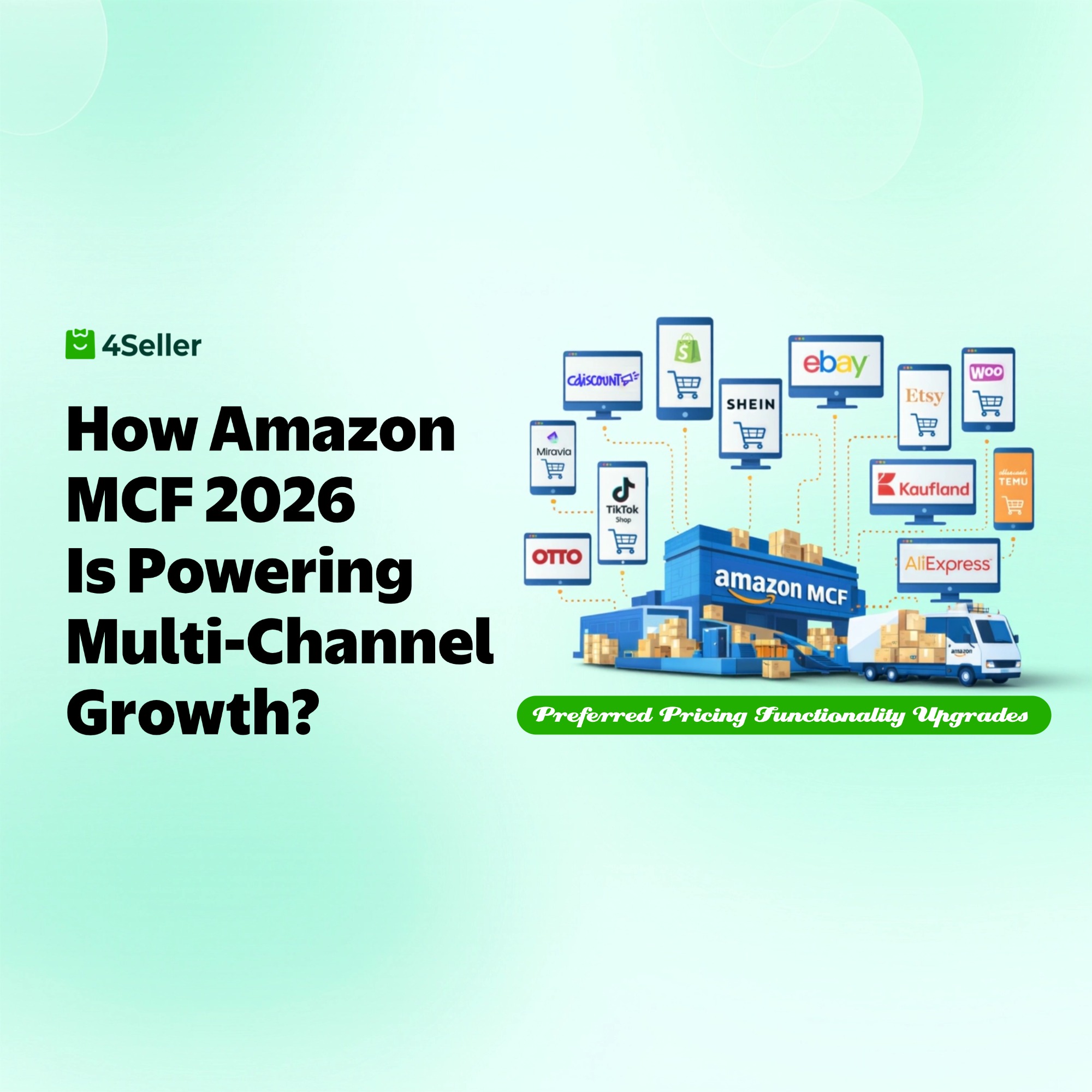
Amazon Multi-Channel Fulfillment 2026: Preferred Pricing and Major Functionality Upgrades for Multi-Channel Sellers
 By Joline20 Jan,2026
Over the past few years, multi-channel selling has evolved from a “growth option” into a survival structure for sellers. Orders now flow in from Amazon, Shopify, TikTok Shop, eBay, and Walmart, while inventory remains fragmented across different warehouses and systems. High fulfillment costs, slow response times, and uncontrollable risks have quietly become the invisible ceiling limiting scalable growth.

In 2026, Amazon’s series of pricing optimizations and functional upgrades to Multi-Channel Fulfillment (MCF) sends a very clear signal: Amazon is upgrading its logistics capabilities from an “on-platform advantage” to cross-channel infrastructure.

No matter where you sell, warehousing, delivery, returns, tracking, and after-sales service can now operate around a single fulfillment network. For multi-channel sellers focused on efficiency, stability, and cash flow, the question is no longer “Can I use MCF?” but rather “Should I redesign my entire fulfillment system around it?”

1. What Is Amazon Multi-Channel Fulfillment (MCF)?

Amazon Multi-Channel Fulfillment (MCF) is not a single shipping feature, but a full-stack fulfillment capability built on Amazon’s logistics network.

Across the entire product journey from origin to customer, Amazon uses:
-
AGL for first-mile and international transportation
-
AWD for inventory buffering and upstream distribution
-
FBA as the core warehousing and fulfillment hub
-
Amazon SEND and MCD for delivery and carrier services
Together, these components connect warehousing, line-haul transportation, last-mile delivery, and multi-channel order fulfillment.
Within this ecosystem, MCF’s role is to extend fulfillment capabilities originally designed for Amazon orders to external sales channels, including Shopify, TikTok Shop, eBay, and independent websites. Sellers can now fulfill orders across platforms using a single inventory pool and logistics network, achieving true cross-channel fulfillment and unified management.
2. Which Countries Support MCF?
United States, Canada, Mexico, Germany, France, Italy, Spain, India, Australia, and Japan.
3. Why Use Amazon Multi-Channel Fulfillment?
-
On-time delivery
Orders can be delivered as fast as two days after shipment, 365 days a year.
-
Transparent pricing
Sorting, packing, and shipping are charged once. You only pay fulfillment and storage fees, with no hidden costs.
-
Unbranded / white-label packaging
Eligible orders can be shipped without Amazon branding.
-
Simplified operations
Inventory management, fulfillment, and delivery operations are automated and optimized.
-
Strong integration capabilities
Connect via pre-built apps or directly through APIs to the official 4Seller ERP all-in-one store management system.
-
End-to-end tracking
Easily share shipment confirmations and tracking details from any carrier.
* Based on internal Amazon MCF data for most marketplaces. Data is for reference only and may vary.
* In the US, UK, Spain, Italy, France, Germany, Canada, and Japan, unbranded packaging is available for eligible sortable items not exceeding 45.72 x 35.56 x 20.32 cm and/or 9 kg.
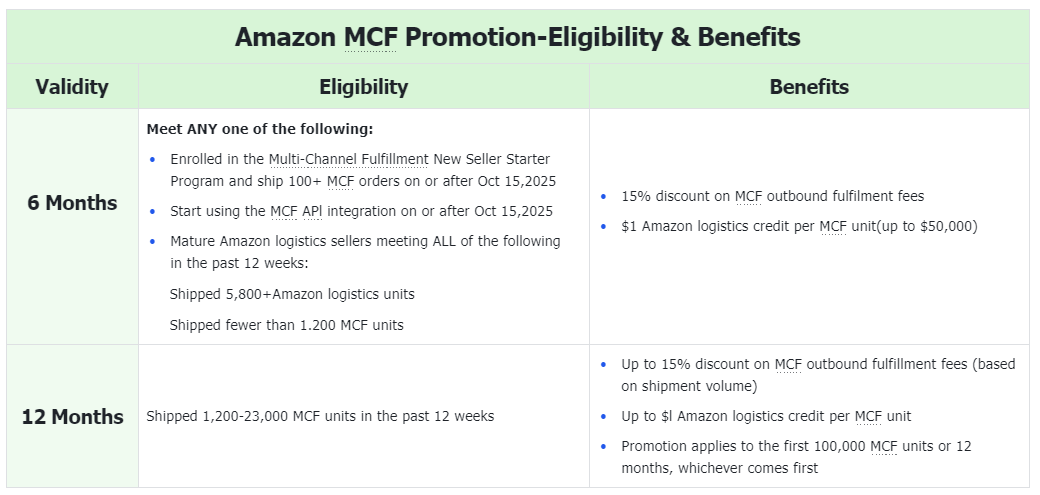
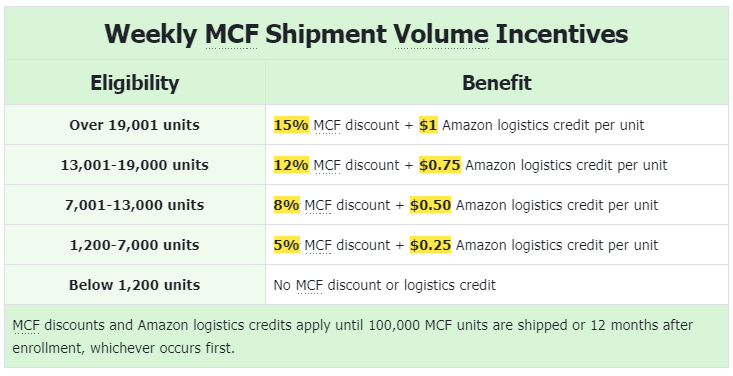
4. New 2026 Pricing Incentive Programs
Reference links:
[1] https://supplychain.amazon.com/pricing
[2] https://sellercentral.amazon.com/gp/help/external/GXNJ5F7NHZNJMTSH
5. A Clear Direction Behind the 2026 Feature Upgrades
Taken together, Amazon’s 2026 upgrades point to one clear direction:
evolving logistics from “basic fulfillment” into a traceable, collaborative, cross-platform infrastructure.
-
Photo Proof of Delivery (POD)
Turning “delivery disputes” into verifiable evidence.
In 2026, Amazon expands POD photo confirmation across more fulfillment scenarios. Each delivery generates a timestamped, geo-tagged photo tied directly to the order record.
The value lies not in the photo itself, but in shifting and fixing accountability earlier in the fulfillment chain.
When customers claim non-delivery, sellers can use Amazon-generated POD records as standardized proof, significantly reducing dispute resolution costs, especially for high-value or high-risk categories.
-
Live Merchant Support
From ticket-based support to real-time resolution.
Previously, sellers relied on cases that could take hours or days.
In 2026, Live Merchant Support enables real-time assistance at critical logistics stages.
When MCF orders encounter exceptions, return delays, or stalled tracking updates, sellers can intervene immediately instead of waiting for automated workflows to complete. For high-volume, multi-channel sellers, real-time support directly amplifies fulfillment stability.
-
Shopify Fulfillment Network (SFN) Integration
Amazon begins to “speak Shopify’s fulfillment language.”
Rather than simply importing Shopify orders, Amazon now collaborates at the fulfillment layer with SFN. Sellers can compare or combine Amazon FBA/MCF and SFN based on inventory location, delivery speed, or cost models.
For example, if Amazon inventory is available while SFN is out of stock in a region, the system can prioritize Amazon fulfillment, and vice versa. Fulfillment decisions shift from manual judgment to rule-based, real-time optimization.
-
Walmart Integration
MCF officially enters the mainstream marketplace ecosystem.
With Walmart integration, MCF expands beyond independent stores and niche platforms. Walmart orders can now be fulfilled directly using Amazon’s warehousing and delivery network, with unified inventory management and automated order routing.
For sellers operating on both Amazon and Walmart, this removes the need for separate inventories and fulfillment teams, dramatically improving inventory turnover and capital efficiency.
-
MCF Returns
Closing the final gap in multi-channel fulfillment.
Historically, MCF excelled at outbound shipping, not returns.
The 2026 launch of MCF Returns enables off-Amazon orders to follow Amazon’s standardized return process, including label generation, warehouse inspection, status updates, and inventory reintegration.
For example, a Shopify customer initiates a return, Amazon generates the return label, the item is received at an FBA warehouse, and inventory is automatically updated and relisted without manual intervention. Multi-channel fulfillment finally becomes closed-loop.
-
Fast Track (1-Hour Logistics Status Updates)
Shrinking logistics blind spots to under one hour.
Fast Track focuses not on faster shipping, but faster logistics visibility. Status changes during outbound, handoff, line-haul, or last-mile delivery are returned to the system within one hour.
For high-volume operations, this enables early risk detection, proactive customer communication, and automated remediation before issues escalate into complaints.
Viewed together, Amazon’s 2026 upgrades represent a systemic redesign rather than isolated improvements:
- Stronger logistics visibility
- Deeper cross-platform collaboration
- Complete reverse logistics
- Significantly improved real-time responsiveness
For multi-channel sellers, fulfillment is no longer just a cost center, but a scalable competitive advantage.
In Conclusion
When pricing incentives and feature upgrades are viewed together, the transformation of MCF becomes unmistakable. It is no longer just a way to ship off-Amazon orders, but a centralized, accountable, cross-platform fulfillment hub.
-
More transparent pricing improves cost predictability
-
Faster feedback and live support move issue handling forward
-
Complete returns and platform integrations enable true multi-channel closure
Ultimately, the real value is not a single discount or feature, but whether your fulfillment foundation is stable and automated enough to support continued platform fragmentation and order growth.
In 2026, MCF is no longer optional experimentation. It is becoming foundational infrastructure for sellers building long-term multi-channel competitiveness.
- Multi Channel Order Management
- TikTok Shop
- Amazon
- Temu
- About 4Seller
- Shopify
- Multi Channel Inventory Management
- Amazon MCF&FBA
- Seller Tips
- Listing Management
- Marketplace News
- FedEx
- UPS
- Amazon MCF
- DHL Express
- Amazon Shipping
- eBay
- Shein
- Creator Bulk Invite
- Inventory Sync
- GLS
- Multi-channel Store
- Walmart
- Walmart WFS
- Shipping Integration
- Kaufland
- Royal Mail
- Seller Story
- Beginner Tutorial
- 3PL
- WooCommerce
- DHL Parcel
- Walmart MCS
- Shipping Label
- OTTO
- Deutsche Post
- Platform Integration
- PayPal Tracking Sync
- AliExpress
- Yodel
- ShipHero
- SPU Catalog
- Stripe Tracking Sync
- USPS
- UniUni
- GOFO
- CIRRO
- Correos
- Correos Express
- DPD
- Etsy
- Evri
- FBM
- Request Review
- Logistics Rule
- CaiNiao
- BRT
- Chronopost
- Poste Italiane
- Cdiscount
- OMS
- DHL
- WFS
- ShipBob
- Price Sync
 17 Dec,2024
- 17 Dec,2024