- Multi Channel Order Management
- TikTok Shop
- Amazon
- Temu
- About 4Seller
- Shopify
- Multi Channel Inventory Management
- Amazon MCF&FBA
- Seller Tips
- Listing Management
- Marketplace News
- FedEx
- Amazon MCF
- DHL Express
- UPS
- Amazon Shipping
- eBay
- Creator Bulk Invite
- Shein
- Inventory Sync
- GLS
- Multi-channel Store
- Walmart
- Walmart WFS
- Seller Story
- Shipping Integration
- Beginner Tutorial
- Kaufland
- Royal Mail
- 3PL
- DHL Parcel
- Shipping Label
- OTTO
- Walmart MCS
- Platform Integration
- Deutsche Post
- WooCommerce
- AliExpress
- UniUni
- Stripe Tracking Sync
- SPU Catalog
- USPS
- ShipHero
- Yodel
- PayPal Tracking Sync
- GOFO
- CIRRO
- Correos
- Correos Express
- DPD
- Etsy
- Evri
- FBM
- Request Review
- Logistics Rule
- CaiNiao
- BRT
- Chronopost
- Poste Italiane
- Cdiscount
- OMS
- DHL
- WFS
- ShipBob
- Price Sync
How Sellers Using ShipStation Should Fulfill Orders Compliantly Under 2026 TikTok Shop New Logistics Services Requirement?
 By Joline06 Feb,2026
As TikTok Shop continues to expand globally, particularly in the U.S. market, the platform is undergoing a structural reshaping of its logistics and fulfillment system. The recently released and gradually implemented new logistics policy has a clear core direction: gradually eliminate seller-controlled shipping methods and strengthen the platform’s unified management of the fulfillment process.
This is not a simple rule tweak, but a significant step in TikTok Shop’s evolution from an “open e-commerce” model to a “platform-based e-commerce” model. For a large number of sellers who rely on third-party order fulfillment tools like ShipStation, this change will directly impact their existing shipping methods and may even determine whether they can continue to operate stably on TikTok Shop.
To understand how sellers using ShipStation for fulfillment should adjust under the new policy, it is first necessary to clarify what this policy actually entails and why TikTok Shop is implementing it.
I. What does this policy entail?
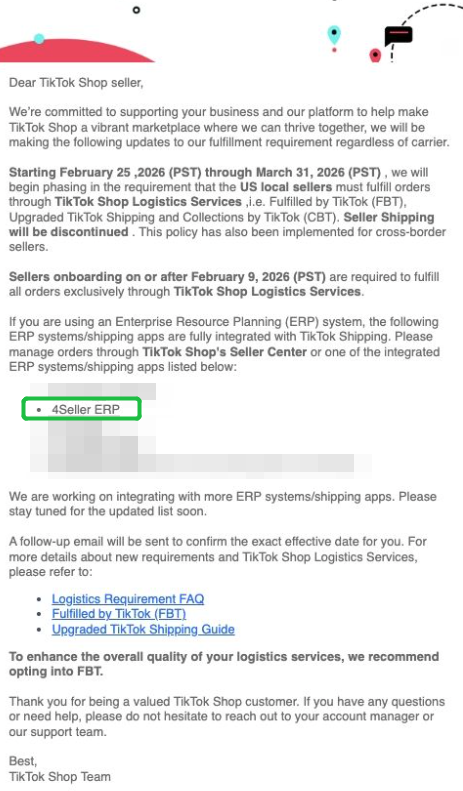
TikTok Shop has issued an official notice to sellers, announcing that starting February 25, 2026 (PST), TikTok Shop will implement the official logistics service (TikTok Shop Logistics Services), gradually replacing and eliminating seller self-fulfillment.
In this official notice, 4Seller ERP is explicitly listed as the first ERP system that has completed integration with TikTok Shop and can be directly used to support sellers in order fulfillment and shipping management through TikTok Shop’s official logistics system.
The core points of this logistics policy adjustment are as follows:
Transition period for existing sellers
From February 25 to March 31, 2026 (PST), U.S.-based sellers will gradually stop using self-fulfillment through third-party tools such as ShipStation and fully integrate into TikTok Shop’s official logistics services, including Fulfilled by TikTok (FBT), Upgraded TikTok Shipping, and Collections by TikTok (CBT).Mandatory compliance for new sellers
All sellers joining on or after February 3, 2026 (PST) must fulfill 100% of their orders through TikTok Shop Logistics Services. Using external order fulfillment systems such as ShipStation to generate shipping labels will no longer be supported.II. What does this policy really mean?
From the policy text itself, TikTok Shop does not use aggressive terms such as “prohibit” or “remove,” but promotes the change by “gradually eliminating” and “requiring the use of official logistics.” However, in terms of execution, the message is very clear: modes of generating labels through third-party tools like ShipStation, using one’s own carrier accounts, will no longer be supported.
Under the new rules, U.S.-based sellers will be required to fulfill orders through TikTok Shop Logistics Services, including Fulfilled by TikTok (FBT), Upgraded TikTok Shipping, and Collections by TikTok (CBT). At the same time, newly joined sellers will not have any transitional space to use third-party tools (such as ShipStation) and must fully use the official logistics system from the start.
Many sellers mistakenly believe this is a “restriction on third-party tools,” but the essence is not the tool itself—it is a change in the fulfillment model.
The most direct reason ShipStation can no longer be used is that all shipping labels purchased and printed via ShipStation are essentially Seller Shipping, and Seller Shipping is being gradually phased out by TikTok Shop.
Under the new policy, shipping labels must come from the TikTok official system or officially certified APIs. The platform requires full control over fulfillment data, and third-party labels will gradually lose system recognition and fulfillment weight.
Therefore, the question is no longer “can ShipStation still be used?” but rather: the Seller Shipping model itself is exiting the TikTok Shop ecosystem.
III. Why is TikTok Shop introducing this policy now?
TikTok Shop recently officially implemented the new logistics policy. From February 25, 2026, U.S.-based sellers will no longer be allowed to use the traditional self-fulfillment model, including third-party systems like ShipStation. Sellers who have relied on ShipStation may be accustomed to convenient operations: one system handling multiple platform orders, batch label printing, and tracking uploads. Under the new policy, these methods are no longer feasible.
ShipStation and other third-party tools cannot generate official TikTok shipping labels, nor can they transmit real-time fulfillment data for each order back to TikTok. Previously, shipping delays, abnormal logistics tracking, and after-sales disputes might have been tolerated, but now the platform requires every order to be trackable, monitorable, and compliant, or it will affect store ratings and platform trust. Simply put, the era of fulfilling TikTok orders via ShipStation is over.
IV. How should sellers who originally used ShipStation adjust their fulfillment under the new policy?
ShipStation has been the primary tool for many sellers to generate shipping labels and connect with carriers such as USPS and FedEx. Previously, sellers could completely handle label printing and logistics services independently, with minimal platform involvement. Under the new rules, continuing to generate labels independently through ShipStation is no longer compliant, as these labels belong to Seller Shipping, which no longer meets TikTok Shop’s fulfillment control requirements.
Continuing to rely on ShipStation to generate labels and wait to see how policies evolve may appear feasible in the short term but actually places sellers in a passive position. The system weight of third-party labels is decreasing, and its impact may not appear as explicit notifications but rather in blocked orders, inability to generate labels, tighter fulfillment metrics, and restricted participation in platform activities. The key issue is not “can ShipStation still be used?” but “how to migrate smoothly.”
For sellers still using ShipStation, the options are clear: either switch quickly to TikTok’s official logistics system or a certified fulfillment ERP solution, or risk restricted orders, store downgrades, or even removal from the platform.
Currently, the feasible directions are mainly:
Continue using ShipStation for other platforms, but switch TikTok orders to TikTok backend fulfillment
In this model, TikTok orders must be switched from ShipStation to the TikTok backend for label purchase and fulfillment, while orders from eBay, Shopify, Shein, Temu, Walmart, and other platforms remain in ShipStation.However, this means multi-platform orders are managed separately. Operations staff must frequently switch systems, increasing process complexity and operational costs. Additionally, scenarios such as multi-store inventory synchronization, cross-TikTok store migration, unified multi-store promotions, cross-platform marketing activities, inventory allocation, order merging and picking, SKU grouping, label printing, and logistics optimization cannot be fully supported. Sellers must frequently switch between systems, increasing workflow complexity, error risk, and making cross-platform data unification and business collaboration difficult.
Migrate to a TikTok Logistics-supported official ERP (such as 4Seller) for unified multi-platform fulfillment management
Sellers can also choose to switch to an ERP system that has completed official TikTok integration, such as 4Seller. Through the official API, compliant TikTok shipping labels can be directly generated, allowing sellers to manage TikTok, Amazon, eBay, Shopify, and other platform orders in one system without switching backends. This ensures platform compliance while maintaining centralized multi-channel order management, making fulfillment under the new policy more streamlined and efficient.Regardless of the choice, the fundamental reality is: shipping is no longer merely a cost and efficiency balance, but a component of platform rules. Sellers who can continue participating in TikTok Shop will be those willing to align their fulfillment operations with the platform.
V. Benefits for ShipStation sellers using the official 4Seller ERP one-stop multi-channel management tool
Compared with ShipStation, 4Seller additionally supports:
TikTok official integration, supporting compliant TikTok shipping label generation
ShipStation users can retain original workflows and quickly switch to 4Seller ERP for order fulfillment
Completely free to use
Moreover, in the context of TikTok Shop gradually phasing out ShipStation fulfillment, sellers need to meet platform official logistics rules while maintaining warehouse operational efficiency. Using the officially certified 4Seller ERP integrated with TikTok Shipping allows sellers to upgrade fulfillment while optimizing overall shipping processes.
Additional benefits include:
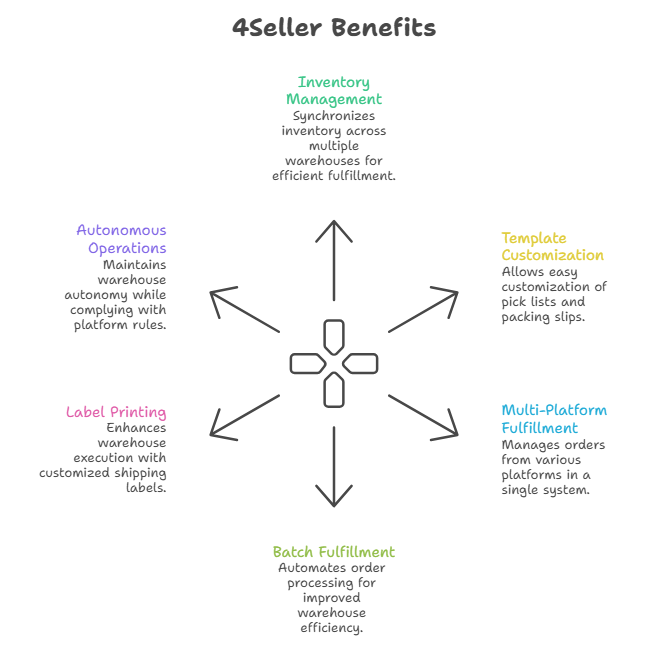
Multi-warehouse inventory linkage for unified multi-channel fulfillment management
Supports synchronization of self-owned and third-party warehouse inventories across multiple stores. Inventory data updates in real-time, reducing overselling risk and maintaining stable fulfillment capacity during peak order periods.Highly customizable Pick lists and Packing slips templates, enhancing warehouse efficiency and brand professionalism
Compared with traditional ERP tools requiring manual HTML or Liquid modifications, 4Seller provides a visual editor. Users can drag and drop SKU info, customer addresses, order notes, brand logos, marketing text, etc., into templates without technical expertise. This lowers the barrier to use, reduces training costs, and minimizes errors.Unified multi-platform fulfillment management supporting TikTok Shipping and Seller Shipping in parallel
Sellers can switch TikTok orders to TikTok Shipping compliance while centrally managing Amazon, Shopify, eBay, and other platform orders that continue to use Seller Shipping. Orders are processed in a single system, enabling parallel fulfillment across platforms without frequent backend switching.One-click batch fulfillment automation, significantly improving small-to-medium warehouse efficiency
4Seller’s one-click fulfillment integrates scanning, weighing, order info entry, label purchase, and printing in one interface. Warehouse staff can use scanners and electronic scales to automatically complete order info, weight, dimensions, and label printing, achieving a seamless workflow from order processing to shipping.Support for printing SKU info, order info, brand logos, and other necessary data on shipping labels, enhancing warehouse execution and brand touchpoints
Sellers can customize printed content on logistics labels according to warehouse operations and brand goals, improving order verification efficiency and reinforcing brand presence and customer support visibility.Maintain autonomous warehouse operations while complying with TikTok official logistics
Compared with printing labels through TikTok backend, 4Seller allows one-click multi-feature fulfillment without fully altering warehouse operations. Sellers can continue using their teams for packing, labeling, and shipping while complying with platform rules.By using the TikTok-certified 4Seller ERP integrated with TikTok Shipping, sellers who previously relied on ShipStation can maintain warehouse autonomy while achieving compliant and efficient fulfillment. For these sellers, it provides a balanced solution between compliance and operational efficiency.
Conclusion
The essence of TikTok Shop’s new logistics policy is not to restrict sellers, but to incorporate fulfillment capabilities into a standardized platform system.
Seller Shipping is being phased out, meaning the traditional fulfillment model of generating labels through ShipStation will gradually exit TikTok Shop.
Sellers who continue operating on TikTok Shop will no longer be those relying on a single label printing tool, but those capable of compliant fulfillment via official systems or certified platforms while maintaining operational efficiency.
By integrating with the TikTok Shipping-enabled 4Seller ERP, sellers can manage multi-channel orders, synchronize multi-warehouse inventories, and automate fulfillment workflows, establishing a stable and sustainable operational model under the new rules.

- Multi Channel Order Management
- TikTok Shop
- Amazon
- Temu
- About 4Seller
- Shopify
- Multi Channel Inventory Management
- Amazon MCF&FBA
- Seller Tips
- Listing Management
- Marketplace News
- FedEx
- Amazon MCF
- DHL Express
- UPS
- Amazon Shipping
- eBay
- Creator Bulk Invite
- Shein
- Inventory Sync
- GLS
- Multi-channel Store
- Walmart
- Walmart WFS
- Seller Story
- Shipping Integration
- Beginner Tutorial
- Kaufland
- Royal Mail
- 3PL
- DHL Parcel
- Shipping Label
- OTTO
- Walmart MCS
- Platform Integration
- Deutsche Post
- WooCommerce
- AliExpress
- UniUni
- Stripe Tracking Sync
- SPU Catalog
- USPS
- ShipHero
- Yodel
- PayPal Tracking Sync
- GOFO
- CIRRO
- Correos
- Correos Express
- DPD
- Etsy
- Evri
- FBM
- Request Review
- Logistics Rule
- CaiNiao
- BRT
- Chronopost
- Poste Italiane
- Cdiscount
- OMS
- DHL
- WFS
- ShipBob
- Price Sync
 17 Dec,2024
- 17 Dec,2024