- Multi Channel Order Management
- TikTok Shop
- Amazon
- Temu
- About 4Seller
- Shopify
- Multi Channel Inventory Management
- Amazon MCF&FBA
- Seller Tips
- Listing Management
- Marketplace News
- FedEx
- Amazon MCF
- DHL Express
- UPS
- Amazon Shipping
- eBay
- Creator Bulk Invite
- Shein
- Inventory Sync
- GLS
- Multi-channel Store
- Walmart
- Walmart WFS
- Seller Story
- Shipping Integration
- Beginner Tutorial
- Kaufland
- Royal Mail
- 3PL
- DHL Parcel
- Shipping Label
- OTTO
- Walmart MCS
- Platform Integration
- Deutsche Post
- WooCommerce
- AliExpress
- UniUni
- Stripe Tracking Sync
- SPU Catalog
- USPS
- ShipHero
- Yodel
- PayPal Tracking Sync
- GOFO
- CIRRO
- Correos
- Correos Express
- DPD
- Etsy
- Evri
- FBM
- Request Review
- Logistics Rule
- CaiNiao
- BRT
- Chronopost
- Poste Italiane
- Cdiscount
- OMS
- DHL
- WFS
- ShipBob
- Price Sync
How Should Sellers Previously Using Seller Shipping Fulfill Orders Compliantly Under 2026 TikTok Shop New Logistics Services Requirement?
 By Joline11 Feb,2026
As TikTok Shop continues to expand globally, especially in the U.S. market, the platform is undergoing a structural overhaul of its logistics and fulfillment system. The newly released and gradually implemented logistics policies make one direction extremely clear: gradually eliminating seller-controlled shipping models while strengthening the platform’s unified control over the fulfillment chain.
This is not merely a minor rule adjustment, but a critical step in TikTok Shop’s evolution from an “open commerce platform” to a “platform-controlled commerce ecosystem.” For a large number of merchants who rely on traditional Seller Shipping models, this change will directly affect their existing fulfillment methods and may even determine whether they can continue operating stably on TikTok Shop.
To understand how Seller Shipping merchants should adjust their fulfillment strategies under the new policy, it is first necessary to clarify how Seller Shipping previously operated, which methods will no longer be supported, and how sellers should transition their fulfillment systems smoothly.
I. What Is This Policy About?
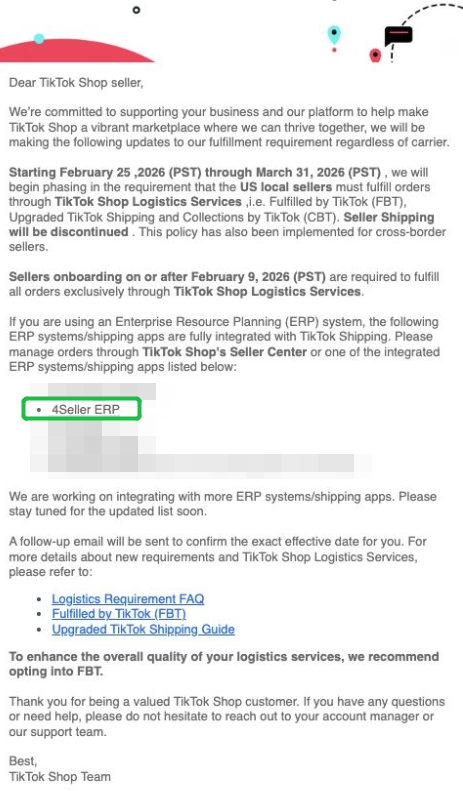
TikTok Shop has officially notified sellers that starting February 25, 2026 (PST), TikTok Shop Logistics Services will be implemented and will gradually replace and eliminate seller-managed shipping models.
In this official announcement, 4Seller ERP was explicitly listed as the first ERP system that has completed integration with TikTok Shop and can be used directly to support sellers in fulfilling orders through the official TikTok Shop logistics system.
The core adjustments of this logistics policy are as follows:
Transition period for existing sellers
From February 25 to March 31, 2026 (PST), U.S. domestic sellers will gradually discontinue Seller Shipping and fully transition to TikTok Shop Logistics Services, including Fulfilled by TikTok (FBT), Upgraded TikTok Shipping, and Collections by TikTok (CBT).Mandatory compliance for new sellers
All sellers who onboard on or after February 3, 2026 (PST) must complete 100% of their order fulfillment through TikTok Shop Logistics Services and will not have Seller Shipping permissions.II. What Does This Policy Actually Mean?
With the official implementation of TikTok Shop’s new logistics policy, the highly autonomous Seller Shipping model will gradually disappear. Starting February 25, 2026 (PST), multiple traditional Seller Shipping workflows will no longer be supported, and sellers will no longer be able to use their own carrier accounts or independent label-generation processes to fulfill orders.
Specifically, the following common operational paths will gradually become invalid:
Dropshipping workflows where suppliers ship directly and provide tracking numbers that sellers manually upload to mark orders as shipped will no longer be allowed.
Using non-official third-party shipping systems (such as ShipStation, WebBee, ByteStand, Pipe17, Rithum, CedCommerce, ChannelEngine, Order Desk, etc.) or WMS systems to generate shipping labels and manually upload tracking numbers will no longer be supported.
Purchasing shipping labels through personal USPS, UPS, FedEx carrier accounts and uploading tracking numbers manually will no longer be supported.
POD suppliers independently handling label creation, packaging, and shipping while sellers only upload tracking numbers to complete fulfillment will gradually be phased out.
Purchasing labels within Shopify through Shopify Connector tools and syncing tracking numbers back to TikTok to mark orders as shipped will also no longer be supported.
Under the new rules, U.S. domestic sellers must fulfill orders through TikTok Shop Logistics Services, including Fulfilled by TikTok (FBT), Upgraded TikTok Shipping, and Collections by TikTok (CBT). New sellers will not have any Seller Shipping transition period and must fully adopt the official logistics system from the start.
This means logistics fulfillment is no longer a flexible operational module controlled by sellers but will become a standardized and platform-controlled component. Control over logistics capabilities is shifting from merchants to the platform.
III. Why Did TikTok Shop Release This New Logistics Policy?
This change is not a temporary adjustment but an inevitable result of TikTok Shop’s development stage. In its early phase, Seller Shipping reduced entry barriers and enabled rapid supply expansion and transaction growth. However, as order volume increased, fulfillment issues such as delayed shipments, abnormal tracking, and growing after-sales disputes began to affect overall conversion rates and consumer trust. From the customer’s perspective, fulfillment failures are often attributed to the platform rather than individual sellers.
Therefore, TikTok Shop must bring fulfillment capabilities under unified management through an official logistics system that is predictable, monitorable, and scalable. Unified logistics standards and official label generation mechanisms allow the platform to track key order milestones in real time and incorporate fulfillment performance into a standardized evaluation system. The platform is transitioning from reliance on individual seller capabilities to a system-driven fulfillment infrastructure, which is the core logic behind the new logistics policy.
IV. How Should Sellers Previously Using Seller Shipping Ship Under the New Policy?
Seller Shipping is the most directly affected fulfillment model. Previously, sellers could rely entirely on their own warehouses, preferred carriers, and self-generated shipping labels. Under the new rules, this model no longer meets the platform’s requirements for fulfillment controllability.
Continuing traditional self-shipping workflows may appear sustainable in the short term but may lead to serious consequences such as inability to generate compliant shipping labels, orders failing to ship, tightening fulfillment performance metrics, reduced access to campaigns and traffic, and increased platform risk controls.
For Seller Shipping sellers, the fulfillment path is now very clear, with two primary compliant directions:
First, directly switch to TikTok’s official fulfillment services, including Fulfilled by TikTok (FBT), Upgraded TikTok Shipping, and Collections by TikTok (CBT), where the platform manages warehousing and distribution. However, this option is mainly suitable for small sellers with low order volumes operating on a single channel.
Second, use the officially integrated 4Seller ERP that connects directly with TikTok Shipping to batch purchase official shipping labels and achieve compliant fulfillment while maintaining existing warehouse operations. Sellers can continue shipping from their own warehouses or third-party facilities, but labels must be generated through the official TikTok logistics API via 4Seller ERP.
V. What Are the Benefits of Switching to the Officially Certified 4Seller ERP?
Against the backdrop of TikTok Shop gradually phasing out Seller Shipping, sellers need to maintain their existing warehouse operational efficiency as much as possible while complying with the platform’s official logistics requirements. By using the officially certified 4Seller ERP integrated with TikTok Shipping, sellers can complete fulfillment upgrades under compliant conditions while optimizing their overall shipping workflows.
1. Unified Management of Multi-Platform Differentiated Fulfillment, Supporting Flexible Parallel Operations of TikTok Shipping and Seller Shipping Across Other Channels
Within the 4Seller system, sellers can switch TikTok orders to TikTok Shipping in compliance with new TikTok policies while simultaneously connecting and centrally managing orders from Amazon, Shopify, eBay, and other platforms using Seller Shipping self-fulfillment.
All orders can be processed within a single unified system interface, enabling flexible parallel fulfillment rules across different platforms under centralized management without frequently switching between backends, effectively improving multi-channel operational efficiency and overall fulfillment stability.2. Automatically Match Logistics Rules to Configure Carriers, Services, Package Dimensions, and Weight, Reducing Manual Selection and Error Rates
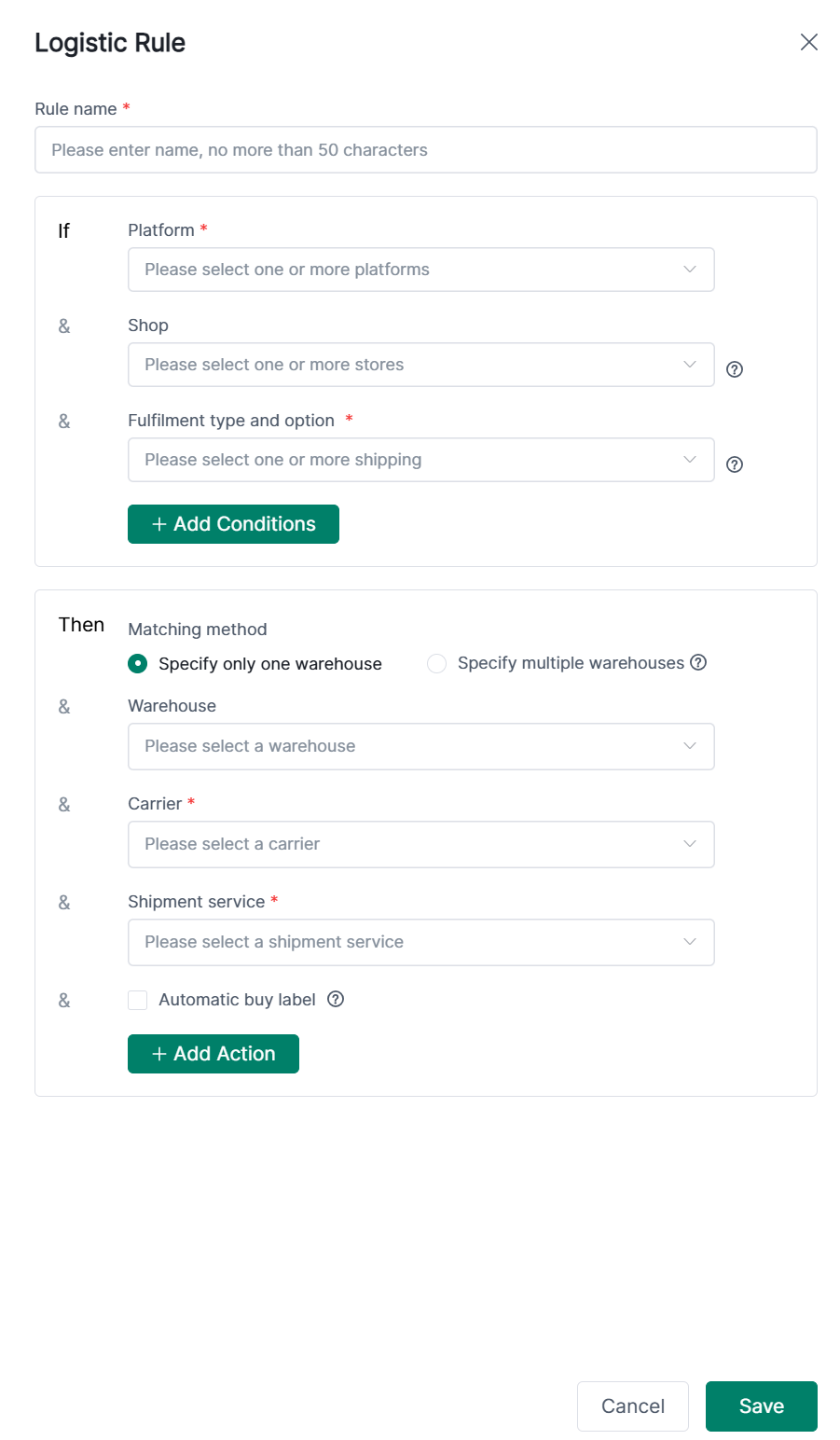
The system can automatically match TikTok Shipping logistics services based on preset logistics rules and order conditions, eliminating the need for manual per-order carrier selection or manual entry of package weight and dimensions, thereby reducing operational complexity and the risk of errors.
3. One-Click Automatic Selection of More Cost-Effective Shipping Solutions to Optimize Fulfillment Cost Structure
4Seller supports pre-configured logistics rules to automatically select the lowest-cost shipping options, reducing manual price comparisons and verification time while improving overall shipping efficiency.
4. Automated One-Click Label Printing and Order Fulfillment Workflow to Significantly Improve Small and Medium Warehouse Shipping Efficiency
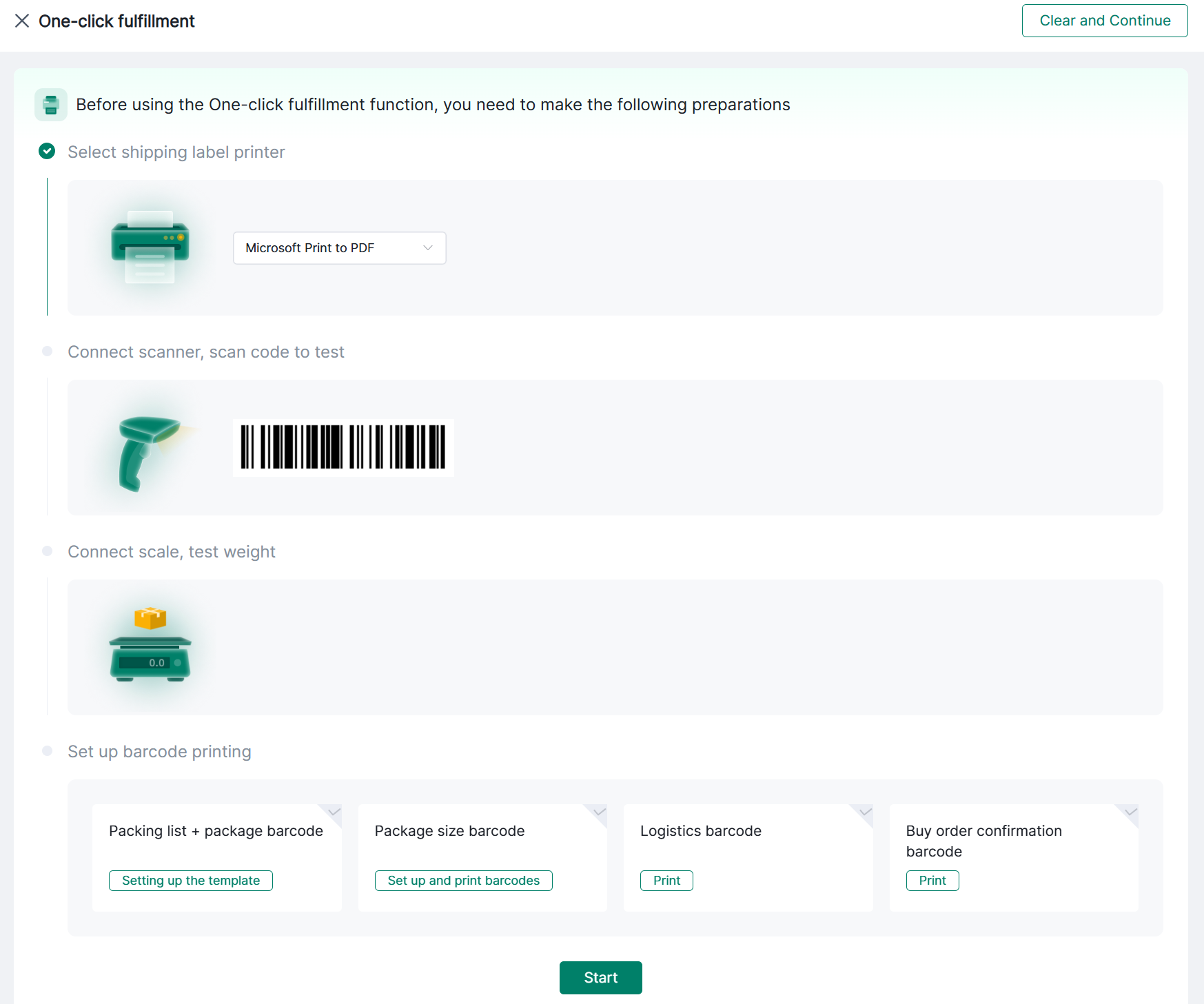
4Seller’s one-click label printing feature integrates barcode scanning, weighing, order information entry, label purchasing, and printing into a single operational interface. Warehouse staff can use barcode scanners and electronic scales to automatically capture order details, weight, and dimensions, and complete label purchasing and printing in one streamlined process, achieving an integrated workflow from order processing to shipment.
Compared to traditional methods that require manually entering information for each order, one-click printing significantly reduces manual input and operational steps. It is especially suitable for sellers with moderate order volumes and smaller warehouse teams who want to achieve efficient and standardized shipping processes without complex systems or additional manpower.5. Support for Printing SKU Information, Order Details, Brand Logos, and Other Essential Content on Shipping Labels to Strengthen Warehouse Execution and Brand Touchpoints
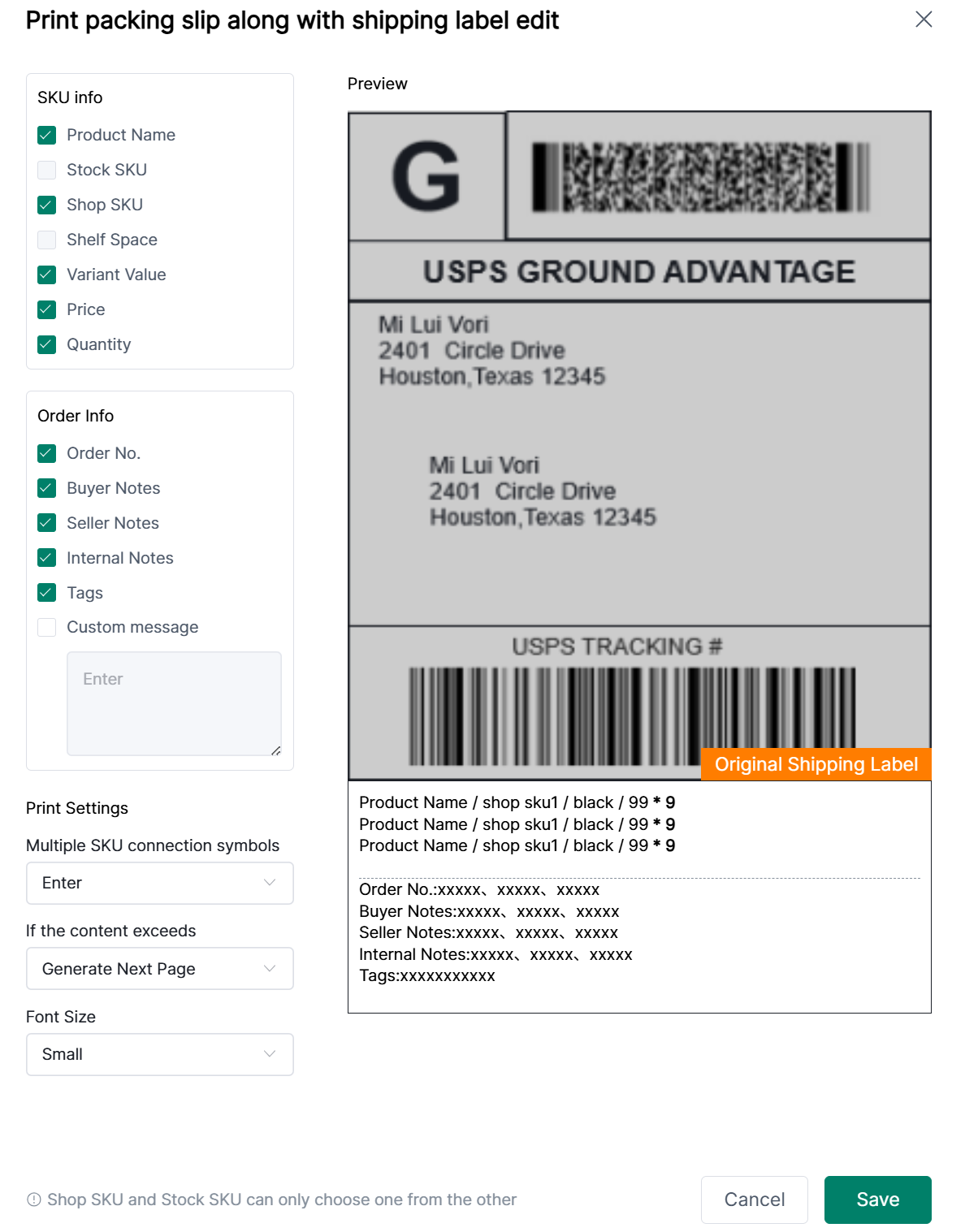
4Seller allows sellers to flexibly print SKU details, order information, brand logos, customer service contacts, and other custom fields directly on shipping labels.
Compared to standard labels that only contain basic logistics information, sellers can customize printed content based on warehouse operational needs and brand objectives. This helps warehouse staff quickly identify orders during sorting, verification, and shipping processes, reducing manual verification costs. At the same time, labels can serve as brand touchpoints, delivering brand information and after-sales support channels to end customers, enhancing professionalism and user experience.6. Highly Customizable Pick List and Packing Slip Templates to Improve Warehouse Execution Efficiency and Brand Professionalism
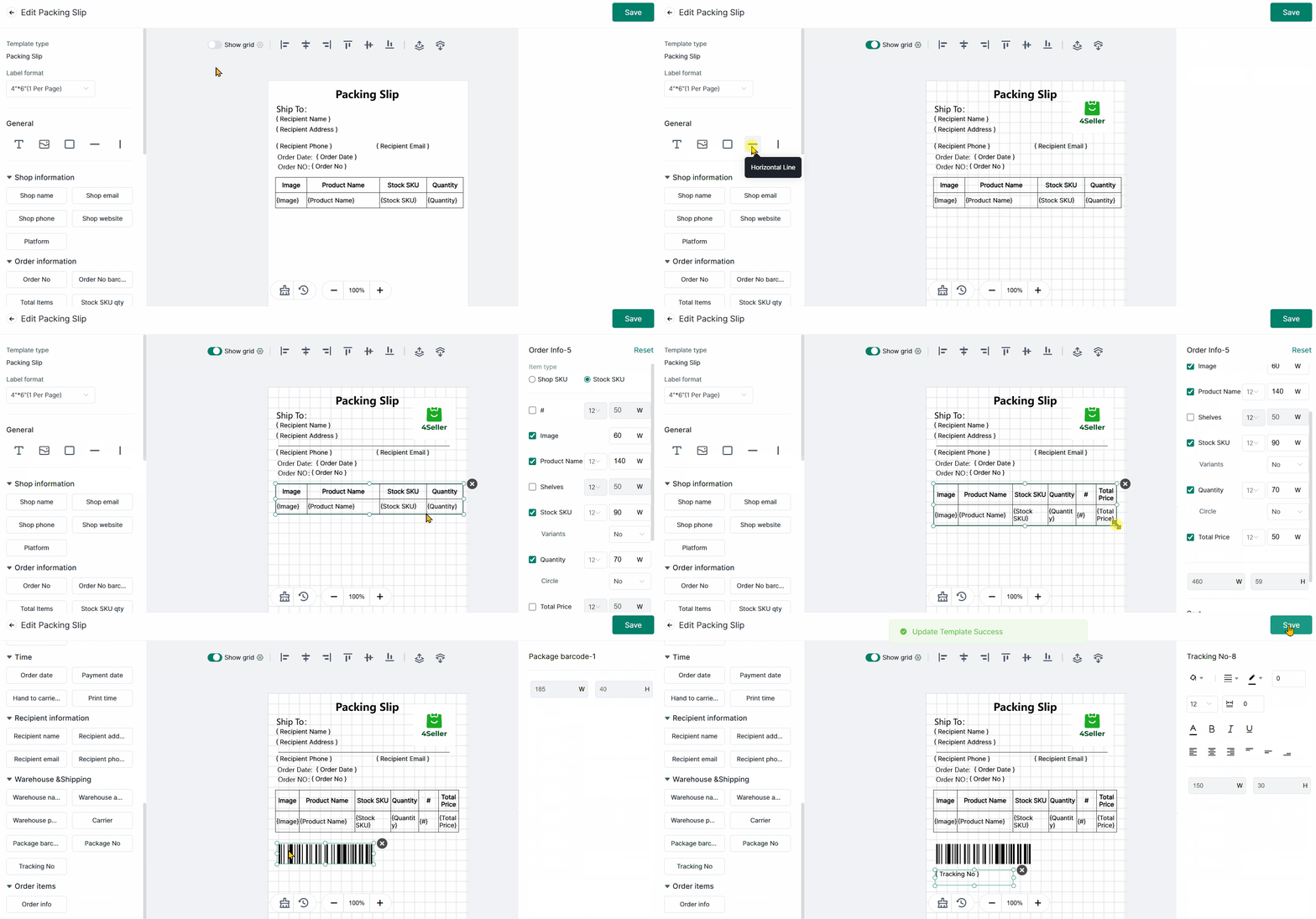
Compared to traditional ERP tools like ShipStation that require manual modification of HTML or Liquid code for customization, 4Seller provides a visual editor that allows users to design shipping labels, packing slips, pick lists, and other templates through simple drag-and-drop components. For example, users can directly drag fields such as SKU information, customer addresses, order notes, brand logos, and marketing messages into the print layout. No technical background is required for easy configuration. This significantly lowers the usage barrier, enabling small and medium sellers to access advanced customization features while saving training costs and reducing troubleshooting time.
7. Support for SKU Grouped Printing of Labels, Packing Slips, and Pick Lists to Improve Warehouse Picking and Shipping Efficiency
Warehouse staff can pick products directly based on aggregated SKU quantities displayed on the page, and pre-printed labels can be directly attached to corresponding goods without manually matching orders one by one.
For example, in traditional workflows, you might pick one item from Zone A, then go to Zone B for another item, and even return to Zone A later for similar products. This not only wastes time but also disrupts workflow rhythm. With SKU grouped printing enabled, you can pick all identical SKUs from Zone A at once before moving to Zone B, significantly reducing repeated walking and maximizing picking efficiency.8. Automatically Mark Orders as Shipped After Printing Labels or Retrieving Logistics Information to Reduce Repetitive Operational Steps
After obtaining logistics information and completing label printing, the system can automatically synchronize order shipping status, reducing the time cost of manually updating tracking numbers.
9. Maintain Independent Warehouse Operations While Compliantly Using TikTok Official Logistics
Compared to printing labels directly within the TikTok backend, sellers using the 4Seller ERP integrated with TikTok Shipping can utilize one-click printing with multiple advanced features without completely changing existing warehouse operational models. Sellers can continue using their own teams to handle packing, labeling, and dispatch while maintaining operational flexibility under the new platform requirements.
10. Multi-Warehouse Inventory Synchronization for Unified Multi-Channel Fulfillment Management
Supports syncing inventory from self-operated warehouses and third-party warehouses across multiple stores. Inventory data can be updated in real time, helping sellers reduce overselling risks while maintaining stable fulfillment capabilities during peak order periods.
By using the TikTok-official-certified 4Seller ERP integrated with TikTok Shipping, sellers who previously relied on Seller Shipping can continue maintaining independent warehouse operations while improving fulfillment efficiency under compliant conditions. For merchants who originally depended on Seller Shipping, this provides a balanced solution between compliance requirements and operational efficiency.
Conclusion
The changes to Seller Shipping do not mean sellers lose fulfillment capabilities. Instead, fulfillment rules are shifting from seller-defined processes to platform-standardized systems. Traditional workflows relying on independent label generation, custom carriers, and separate warehouse processes are being replaced by official logistics and certified systems.
Under the new fulfillment framework, sellers must shift their mindset from “how to keep shipping independently” to “how to maintain shipping efficiency under compliance.” Under TikTok Shop’s new logistics policy, sellers can no longer generate tracking numbers through non-official channels and manually upload them. Instead, they must generate official shipping labels through TikTok Logistics or certified ERP systems such as 4Seller and then hand those labels to their warehouse or supply chain for fulfillment, ensuring tracking compliance and real-time monitoring by the platform.

- Multi Channel Order Management
- TikTok Shop
- Amazon
- Temu
- About 4Seller
- Shopify
- Multi Channel Inventory Management
- Amazon MCF&FBA
- Seller Tips
- Listing Management
- Marketplace News
- FedEx
- Amazon MCF
- DHL Express
- UPS
- Amazon Shipping
- eBay
- Creator Bulk Invite
- Shein
- Inventory Sync
- GLS
- Multi-channel Store
- Walmart
- Walmart WFS
- Seller Story
- Shipping Integration
- Beginner Tutorial
- Kaufland
- Royal Mail
- 3PL
- DHL Parcel
- Shipping Label
- OTTO
- Walmart MCS
- Platform Integration
- Deutsche Post
- WooCommerce
- AliExpress
- UniUni
- Stripe Tracking Sync
- SPU Catalog
- USPS
- ShipHero
- Yodel
- PayPal Tracking Sync
- GOFO
- CIRRO
- Correos
- Correos Express
- DPD
- Etsy
- Evri
- FBM
- Request Review
- Logistics Rule
- CaiNiao
- BRT
- Chronopost
- Poste Italiane
- Cdiscount
- OMS
- DHL
- WFS
- ShipBob
- Price Sync
 17 Dec,2024
- 17 Dec,2024