- Multi Channel Order Management
- TikTok Shop
- Amazon
- Temu
- About 4Seller
- Shopify
- Multi Channel Inventory Management
- Amazon MCF&FBA
- Seller Tips
- Listing Management
- Marketplace News
- FedEx
- Amazon MCF
- DHL Express
- UPS
- Amazon Shipping
- eBay
- Creator Bulk Invite
- Shein
- Inventory Sync
- GLS
- Multi-channel Store
- Walmart
- Walmart WFS
- Seller Story
- Shipping Integration
- Beginner Tutorial
- Kaufland
- Royal Mail
- 3PL
- DHL Parcel
- Shipping Label
- OTTO
- Walmart MCS
- Platform Integration
- Deutsche Post
- WooCommerce
- AliExpress
- UniUni
- Stripe Tracking Sync
- SPU Catalog
- USPS
- ShipHero
- Yodel
- PayPal Tracking Sync
- GOFO
- CIRRO
- Correos
- Correos Express
- DPD
- Etsy
- Evri
- FBM
- Request Review
- Logistics Rule
- CaiNiao
- BRT
- Chronopost
- Poste Italiane
- Cdiscount
- OMS
- DHL
- WFS
- ShipBob
- Price Sync
How Should Shopify Connector Sellers Ship Orders Compliantly Under 2026 TikTok Shop New Logistics Services Requirement?
 By Joline11 Feb,2026
As TikTok Shop continues to expand globally, especially in the U.S. market, the platform is undergoing a structural transformation of its logistics fulfillment system. The newly released and gradually implemented logistics policy has a very clear core direction: gradually eliminate non-official fulfillment pathways and strengthen the platform’s unified control over the entire order shipping process.
This is not a simple rule adjustment, but rather marks TikTok Shop’s official transition from an “open phase dominated by seller-controlled fulfillment” into a new stage of “platform-standardized fulfillment.” For a large number of merchants who installed Shopify Connector through the TikTok App Marketplace and are accustomed to syncing TikTok orders back to Shopify for centralized processing, this change will directly impact their existing shipping model.
For a long time, these merchants have used Shopify as their operational hub, responsible for product listing, order management, inventory synchronization, and logistics fulfillment. However, under TikTok’s new logistics policy, the workflow of purchasing third-party shipping labels in Shopify and syncing tracking numbers back to TikTok will gradually lose its compliance foundation.
To understand how merchants using Shopify Connector should adjust their shipping methods under the new policy, it is first necessary to clarify: how this model worked in the past, why it is no longer viable, and how sellers should transition their fulfillment systems.
I. What Does This Policy Say?
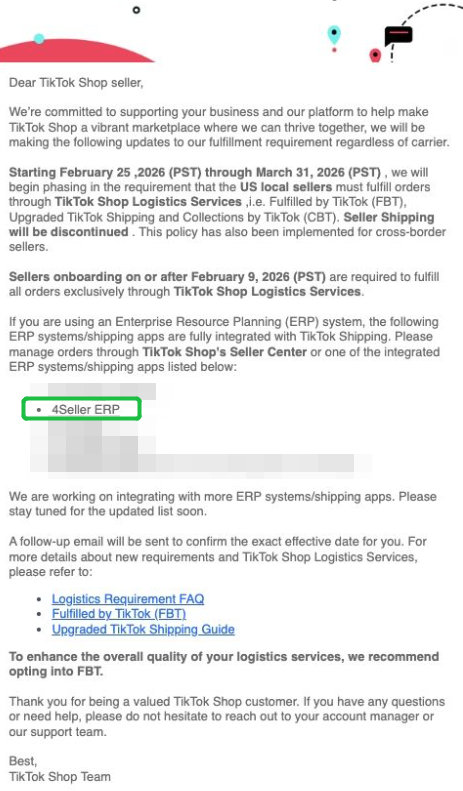
TikTok Shop has issued an official notice announcing that starting February 25, 2026 (PST), TikTok Shop will implement TikTok Shop Logistics Services. Under the new fulfillment framework, shipping labels must be generated through TikTok’s official system or officially certified APIs. All non-official label sources, including labels generated through Shopify Connector installed via the TikTok App Marketplace, will no longer be recognized as compliant fulfillment methods by the platform. This means TikTok orders will no longer be allowed to bypass the official fulfillment system by generating shipping labels within Shopify and syncing them back afterward.
In this official announcement, 4Seller ERP has been explicitly listed as the first ERP system fully integrated with TikTok Shop and ready for direct use. It enables sellers to fulfill and manage shipments through TikTok Shop’s official logistics system.
The core adjustments of this logistics policy include:
Transition period for existing sellers
From February 25 to March 31, 2026 (PST), U.S. sellers will gradually stop using the Seller Shipping model that generates labels externally and syncs tracking afterward. They must fully transition to TikTok Shop Logistics Services, including Fulfilled by TikTok (FBT), Upgraded TikTok Shipping, and Collections by TikTok (CBT).Mandatory compliance for new sellers
All sellers who join on or after February 3, 2026 (PST) must complete 100% of order fulfillment through TikTok Shop Logistics Services. Existing U.S. sellers will also gradually stop using non-official shipping labels during the transition period.II. What Does This Policy Really Mean?
Under the new TikTok policy, the model of using Shopify Connector to sync TikTok orders back to Shopify and generate shipping labels is no longer allowed. All labels generated through Shopify connectors (such as SKU IQ, Silk Commerce, CedCommerce, ShipStation, EasyShip, Shippo, etc.) are considered Seller Shipping labels and therefore cannot be used to complete compliant TikTok order fulfillment.
In other words, the workflow of shipping TikTok orders through Shopify Connector has completely become invalid. Sellers must use TikTok’s official logistics services or officially certified ERPs (such as 4Seller) to generate TikTok Shipping labels to ensure orders remain compliant, trackable, and monitorable.
III. Under the New Policy, How Should Sellers Who Previously Used Shopify Connector Ship Orders?
For these merchants, the biggest change is not order management itself, but rather the required change in how shipping labels are generated.
Continuing to purchase third-party labels within Shopify and syncing tracking numbers back may temporarily sustain some orders, but in reality this approach is already high-risk. Potential consequences include inability to mark orders as shipped, unrecognized labels, declining fulfillment metrics, or even store restrictions.
Under the new policy framework, sellers only have two viable options.
The first method is to generate official shipping labels directly within the TikTok backend and fulfill orders through their own warehouses or third-party warehouses. However, this requires sellers to operate across multiple systems, which significantly disrupts workflows for merchants accustomed to Shopify-centric operations.
The second method is to use an officially integrated ERP such as 4Seller that has completed TikTok Shipping integration. Sellers can maintain a Shopify-like centralized management structure, handling multi-channel orders, inventory, and fulfillment workflows within a single system while generating official TikTok logistics labels through certified APIs in bulk.
Under this model, shipping execution can still be completed within existing warehouses, but the shipping label source must come from official interfaces to meet compliance requirements.
IV. What Are the Benefits for Shopify Connector Sellers Using Officially Certified 4Seller ERP Under the New Policy?
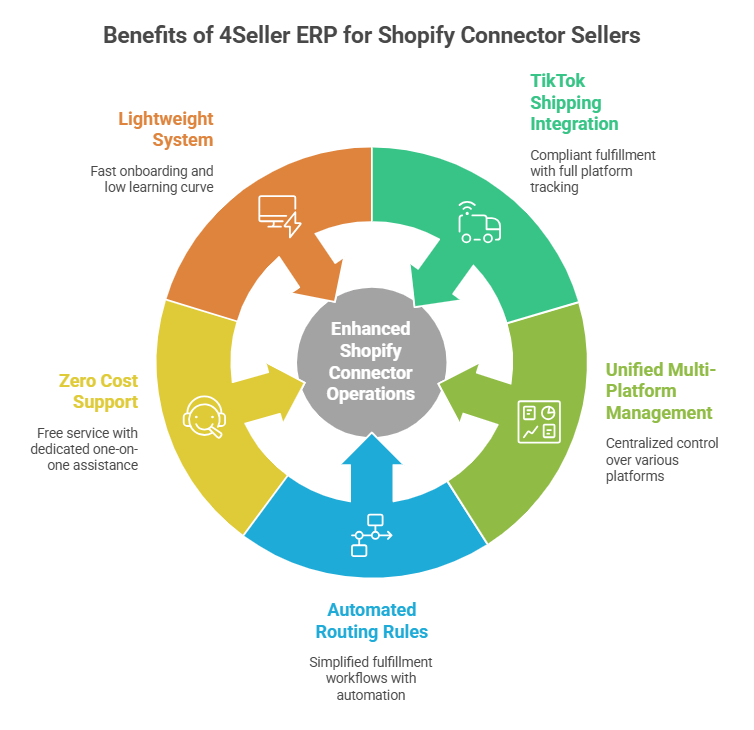
With the implementation of TikTok’s new policy, relying solely on Shopify Connector to process TikTok orders is no longer feasible, while officially certified 4Seller ERP offers significant advantages:
4Seller integrates TikTok Shipping for compliant fulfillment with full platform tracking
Shopify Connector cannot directly use TikTok Shipping or generate compliant labels, and cannot access platform shipping discounts or tracking exemptions.
4Seller is officially certified and integrated with TikTok Shipping APIs. Labels generated are fully compliant and enter TikTok’s official monitoring system from the moment of creation, eliminating compliance risks.Unified multi-platform management for efficient operations and reduced order loss risk
Shopify Connector workflows involve multiple systems, increasing the risk of missing orders or data inconsistencies.
4Seller supports centralized multi-platform order management and works with self-operated warehouses, MCF, and 3PL fulfillment models, allowing sellers to manage products, inventory, and orders within one interface.Automated routing rules simplify fulfillment workflows
Compared to Shopify Connector’s multi-system coordination, troubleshooting complexity is significantly reduced.
4Seller supports automated logistics rules, batch label generation, automatic shipment confirmation, order splitting and merging, and multi-warehouse inventory synchronization.Zero cost + dedicated 1-on-1 remote support
Shopify Connector solutions often require multiple paid tools, increasing per-order costs by around $0.10.
4Seller is completely free and provides multilingual one-on-one remote support, enabling faster problem resolution without coordinating multiple vendors.Lightweight system with fast onboarding and low learning curve
Sellers familiar with Shopify can transition to 4Seller without relearning complex workflows.
The system design is similar to Shopify but more powerful, ensuring sellers can operate TikTok orders efficiently and compliantly under the new policy while maintaining existing operational efficiency.Under TikTok’s new policy, relying on Shopify Connector not only creates compliance risks but also increases operational costs and complexity. By choosing 4Seller, merchants can manage multi-channel operations for free while benefiting from officially certified TikTok Shipping integration for efficient and reliable fulfillment.
In Conclusion
The changes to the Shopify Connector model do not mean Shopify itself has lost value, but rather indicate that TikTok Shop’s fulfillment system is shifting from “externally driven systems” toward “platform-standardized logistics.”
The previous workflow of syncing TikTok orders into Shopify, generating third-party labels, and syncing tracking back is being replaced by official logistics and certified systems. Under the new fulfillment rules, sellers do not need to abandon centralized management, but instead should adopt a system that combines Shopify-style multi-channel management capabilities with official TikTok Shipping API integration.
Through 4Seller ERP, which has completed official TikTok Shipping integration, merchants can maintain their existing operational workflows and warehouse structures while generating official shipping labels, automating fulfillment, and managing multi-channel operations within a unified system, enabling a smooth transition into TikTok’s platform-driven fulfillment ecosystem.
- Multi Channel Order Management
- TikTok Shop
- Amazon
- Temu
- About 4Seller
- Shopify
- Multi Channel Inventory Management
- Amazon MCF&FBA
- Seller Tips
- Listing Management
- Marketplace News
- FedEx
- Amazon MCF
- DHL Express
- UPS
- Amazon Shipping
- eBay
- Creator Bulk Invite
- Shein
- Inventory Sync
- GLS
- Multi-channel Store
- Walmart
- Walmart WFS
- Seller Story
- Shipping Integration
- Beginner Tutorial
- Kaufland
- Royal Mail
- 3PL
- DHL Parcel
- Shipping Label
- OTTO
- Walmart MCS
- Platform Integration
- Deutsche Post
- WooCommerce
- AliExpress
- UniUni
- Stripe Tracking Sync
- SPU Catalog
- USPS
- ShipHero
- Yodel
- PayPal Tracking Sync
- GOFO
- CIRRO
- Correos
- Correos Express
- DPD
- Etsy
- Evri
- FBM
- Request Review
- Logistics Rule
- CaiNiao
- BRT
- Chronopost
- Poste Italiane
- Cdiscount
- OMS
- DHL
- WFS
- ShipBob
- Price Sync
 17 Dec,2024
- 17 Dec,2024