How Should POD Sellers Ship Orders Compliantly Under the New TikTok Shop Logistics Services Requirement?
 By Joline Chan丨10k Ecommerce Fans11 Feb,2026
As TikTok Shop continues to expand globally, particularly in the U.S. market, the platform is undergoing a structural transformation of its logistics fulfillment system. The newly released and gradually implemented logistics policy has a very clear core direction: to strengthen the platform’s unified management over the logistics fulfillment chain and require that orders must be shipped through the official logistics system.

For a large number of merchants who rely on POD (Print on Demand) supply chains to complete production and shipping, this change will directly affect their existing fulfillment workflows and may even determine whether they can continue operating stably on the TikTok Shop channel.

Under the new TikTok Shop logistics policy, POD merchants will no longer generate shipping labels through suppliers and manually upload tracking numbers to complete fulfillment. Instead, they must first generate official logistics labels through TikTok Logistics or officially certified ERP systems (such as 4Seller), and then provide these labels to POD suppliers for production and shipment. This ensures that tracking sources remain compliant and can be monitored by the platform in real time.

To understand how POD merchants should adjust their shipping methods under the new policy, it is first necessary to clarify how POD previously operated, which shipping methods will no longer be supported, and how sellers can complete a compliant transition without changing their existing supply chain structure.

I. What Does This Policy Mean?

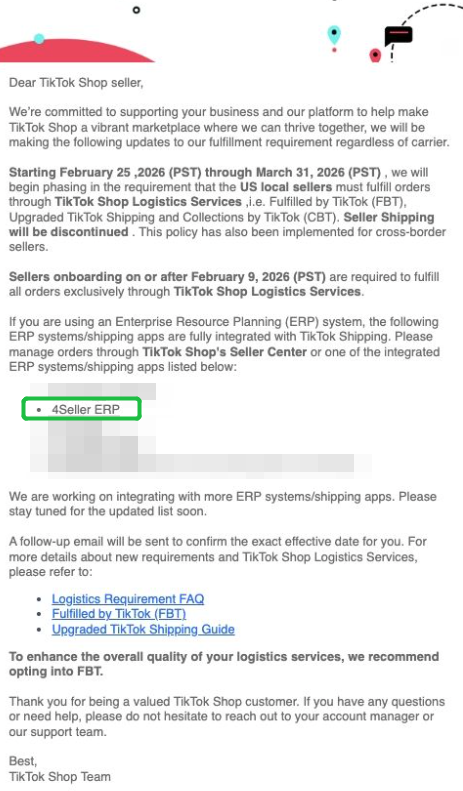
TikTok Shop has issued an official announcement stating that starting February 25, 2026 (PST), TikTok Shop will implement official logistics services (TikTok Shop Logistics Services) and gradually require order fulfillment to be completed through the official logistics system.

In the official announcement, 4Seller ERP has been explicitly listed as the first ERP system that has completed integration with TikTok Shop and can be directly used. It supports sellers in fulfilling and managing orders through TikTok Shop’s official logistics system.

The core points of this logistics policy adjustment are as follows:

1. Transition Period for Existing Sellers

From February 25 to March 31, 2026 (PST), U.S. domestic sellers will gradually stop using non-official logistics labels and fully transition to TikTok Shop official logistics services, including Fulfilled by TikTok (FBT), Upgraded TikTok Shipping, and Collections by TikTok (CBT).

2. Mandatory Compliance for New Sellers

All sellers who join on or after February 3, 2026 (PST) must complete 100% of order fulfillment through TikTok Shop Logistics Services. Traditional POD self-generated logistics label shipping will no longer be supported.

II. What Does This Policy Truly Mean?

With the official rollout of TikTok Shop’s new logistics policy, the fulfillment model previously dominated by POD supply chain providers will undergo fundamental changes. Starting February 25, 2026 (PST), U.S. domestic sellers must complete order fulfillment through TikTok Shop Logistics Services, including Fulfilled by TikTok (FBT), Upgraded TikTok Shipping, and Collections by TikTok (CBT).

The platform will unify logistics label generation and fulfillment data feedback mechanisms. Sellers will no longer be allowed to use non-official logistics labels or complete order fulfillment through manual tracking uploads.

Under this framework, traditional supply-chain-centered POD fulfillment processes will gradually exit. Specifically, the following common workflows will no longer be supported:


	Syncing orders to POD platforms such as Printify, Printful, Inkedjoy, or Gelato, allowing suppliers to complete production and shipping, and then manually uploading tracking numbers to TikTok.


	POD factories or fulfillment warehouses independently generating logistics labels and shipping directly without TikTok participating in label generation.


	Automated fulfillment through Shopify plus POD plugins, where Shopify retrieves tracking numbers and sends them back to TikTok for order marking.


	Shipping through POD warehouse carrier accounts or local logistics channels and manually filling in tracking numbers afterward to complete fulfillment.


This means POD fulfillment will no longer be entirely led by supply chain service providers but must be incorporated into TikTok’s official logistics system, where the platform controls label generation and fulfillment data management. Control over logistics capabilities is shifting from the supply chain side to the platform side, transforming from “supply chain capability” into “platform capability.”

III. Why Is TikTok Shop Launching This New Logistics Policy Now?

This change is not sudden but an inevitable result of the platform’s development stage. In the early stages, the POD model helped many sellers quickly enter the market, lowering inventory and fulfillment barriers and bringing product diversity and growth to TikTok Shop.

However, as order volumes increased, issues became more concentrated. Different POD suppliers used different logistics channels, tracking updates were inconsistent, shipping times varied significantly, and after-sales disputes gradually increased. These problems did not only affect individual sellers but directly impacted the platform’s conversion rates and user trust.

From a consumer’s perspective, fulfillment failures are not seen as problems with POD factories but are attributed to TikTok Shop itself. Therefore, the platform must establish a unified, trackable, and predictable fulfillment system.

The official logistics system can standardize delivery standards, tracking milestones, and service quality while requiring that logistics labels be generated through TikTok Logistics Services to ensure that the entire order process is fully trackable and monitorable.

Under this model, the platform no longer depends on different POD supply chains’ fulfillment capabilities but instead achieves scalable fulfillment through system standardization.

IV. Under the New Policy, How Should POD Sellers Ship Orders?

POD is one of the fulfillment models most directly affected by TikTok Shop’s new logistics policy. Previously, most POD sellers fully relied on suppliers to complete production, label creation, and shipping, while sellers only needed to manually upload tracking numbers after shipment to mark orders as fulfilled.

However, under the new fulfillment rules, supplier-generated logistics labels followed by tracking feedback will no longer meet the platform’s requirements for logistics controllability and data compliance.

It must be clearly stated that currently no POD supplier can directly purchase official TikTok Logistics Services shipping labels. This means that POD sellers who wish to continue compliant shipping on TikTok Shop must generate logistics labels from the seller side rather than through suppliers.

Under the new policy framework, POD sellers essentially have only two compliant shipping paths:

1. Purchase Official Logistics Labels Directly in TikTok Shop Backend

Sellers must generate official logistics labels within the TikTok Shop backend and provide the label information to POD suppliers. Suppliers then complete production and shipping according to the logistics channels and delivery information on the labels. Throughout the fulfillment process, labels must originate from TikTok’s official system. This method is suitable mainly for small and medium sellers with lower order volumes and single-channel operations.

2. Use the Officially Integrated 4Seller ERP to Batch Generate Official Logistics Labels

Sellers can use 4Seller ERP to batch purchase official TikTok logistics labels with one click, complete order marking and label printing, and then provide the labels to POD suppliers for shipment. It should be noted that 4Seller does not directly integrate with POD suppliers or production systems. Suppliers remain responsible for production and execution and only ship according to the official labels provided by sellers.


Under both models, the POD production process itself does not need to change. However, control over logistics label generation must shift back to the seller side or official system to meet platform requirements for fulfillment traceability and monitoring.

V. What Are the Benefits of Using the Officially Certified 4Seller ERP for POD Sellers Under the New Policy?

For POD sellers with large order volumes, generating labels individually through the TikTok Shop backend will significantly increase operational costs and manual workload. In such cases, using the officially integrated 4Seller ERP can enable more efficient compliant fulfillment while maintaining existing POD supply chain structures.

First, the system supports one-click batch purchasing of official TikTok logistics labels and automatic order marking, avoiding inefficiencies caused by individual processing. Sellers can centrally print labels within the system and provide them to POD suppliers in batches.

Second, the system can automatically match available TikTok Shipping services based on logistics rules, reducing manual selection errors and ensuring label compliance.

Meanwhile, 4Seller supports multi-warehouse inventory management, including third-party warehouses and self-operated warehouses, helping sellers reduce overselling and fulfillment exceptions in multi-channel scenarios.

It should be emphasized that as an officially certified ERP, 4Seller only handles official logistics label generation, order marking, and fulfillment management. It does not directly connect to POD supplier systems or automatically trigger production processes. Sellers must still provide official labels to suppliers for production and shipment.

For merchants who previously relied on automated POD fulfillment, this provides a feasible path to achieve compliant shipping and improved fulfillment efficiency on TikTok Shop without changing their existing production models.

Conclusion

Changes to the POD shipping model do not mean POD businesses can no longer operate. Instead, they indicate that fulfillment rules are shifting from “supply chain customization” to “platform standardization.”

Workflows that relied on POD suppliers independently generating labels, shipping independently, and manually uploading tracking numbers are being replaced by official logistics labels and certified systems.

Under the new fulfillment framework, sellers should no longer focus on enabling POD suppliers to ship independently but instead on maintaining POD production models while achieving official logistics label generation and compliant fulfillment.

Through the officially integrated and recommended 4Seller ERP, POD sellers can continue using their existing supply chains for production and shipping while enabling official logistics label generation, batch label purchasing, and automatic tracking feedback, thereby smoothly transitioning into the platform-based fulfillment system.
 17 Dec,2024
- 17 Dec,2024