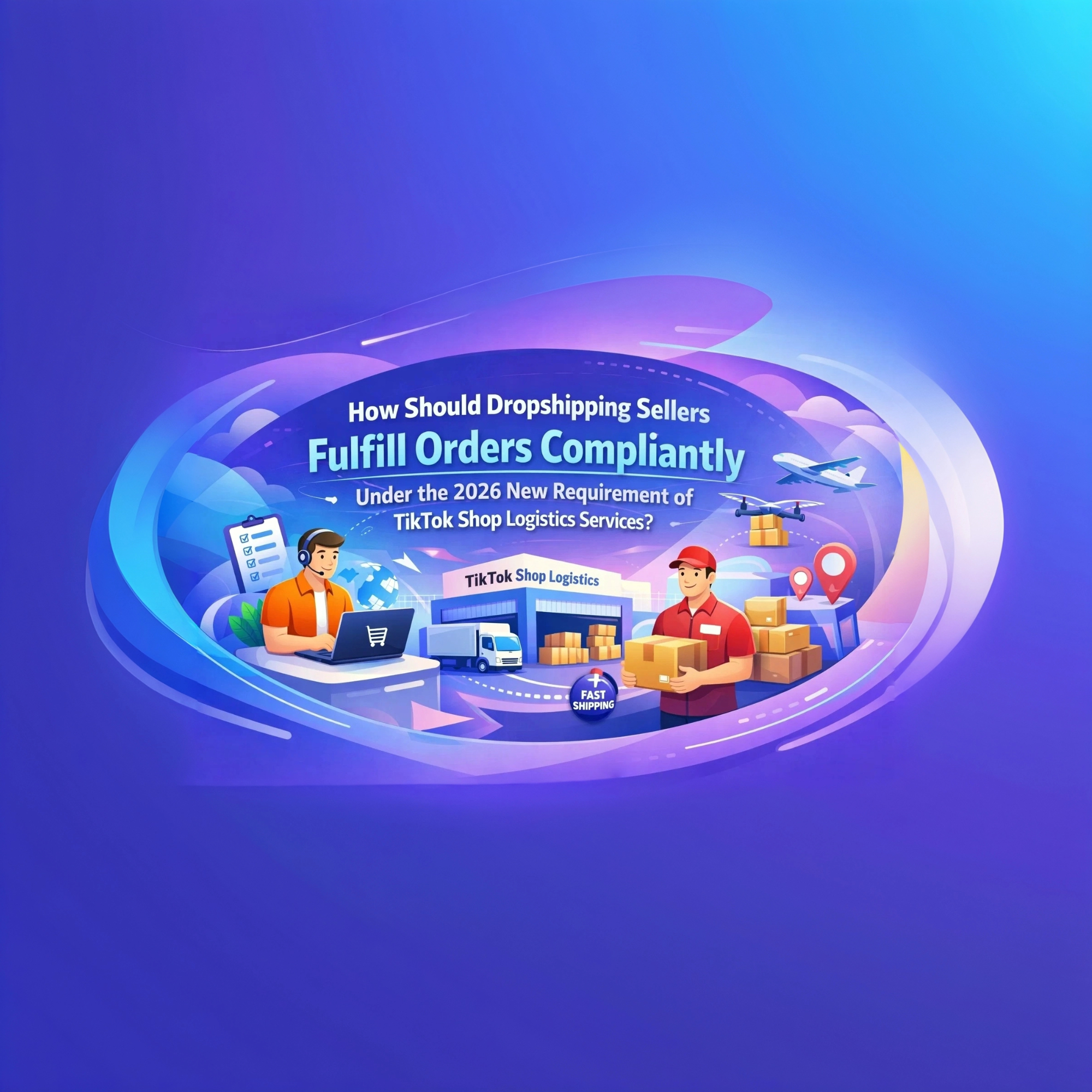
How Should Dropshipping Sellers Fulfill Orders Compliantly Under the 2026 New Requirement of TikTok Shop Logistics Services?

As TikTok Shop continues expanding across the U.S. and global markets, the platform is undergoing a structural upgrade of its logistics fulfillment system. The newly introduced TikTok Shop Logistics Services policy has a very clear core objective: to standardize logistics operations and strengthen the platform’s controllability and traceability across the entire order fulfillment lifecycle.

For a large number of sellers who rely on Dropshipping suppliers to ship orders directly, this is not merely a workflow adjustment but a transformation of the fulfillment model itself.

Under the new rules, shipping labels must be generated through TikTok’s official logistics system or officially integrated ERP solutions (such as 4Seller). The traditional workflow where suppliers independently generate shipping labels and sellers upload tracking information afterward will gradually fail to meet platform compliance requirements.

To understand how Dropshipping sellers should adjust their fulfillment methods under the new policy, it is first necessary to clarify what this policy actually means and why TikTok Shop is implementing it.

I. What Does This Policy Actually State?

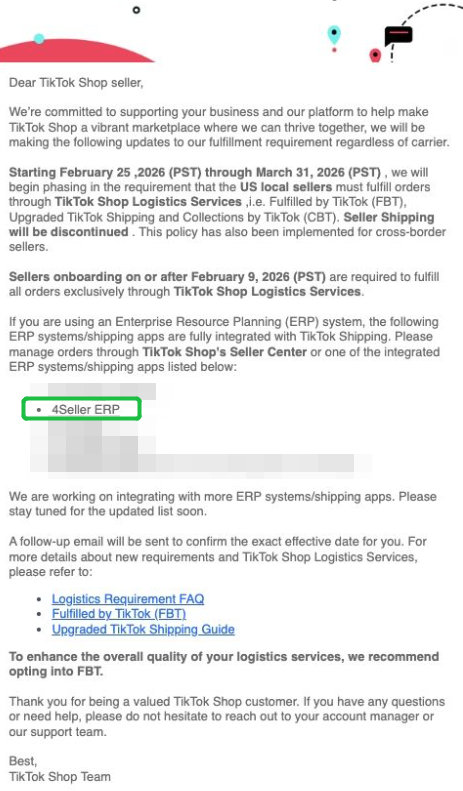
TikTok Shop has issued an official notice to sellers announcing that starting February 25, 2026 (PST), TikTok Shop Logistics Services will be implemented, gradually replacing and eliminating seller self-fulfilled shipping models.

In this official notice, 4Seller ERP is explicitly listed as the first ERP system that has completed official integration with TikTok Shop and can be directly used by sellers to fulfill and manage orders through TikTok Shop’s official logistics system.

The core adjustments of this logistics policy include:

1. Transition Period for Existing Sellers

From February 25 to March 31, 2026 (PST), U.S. domestic sellers will gradually stop using the Seller Shipping model, where logistics labels are independently generated through Dropshipping platforms and tracking numbers are uploaded afterward. Instead, they must fully integrate with TikTok Shop’s official logistics services, including Fulfilled by TikTok (FBT), Upgraded TikTok Shipping, and Collections by TikTok (CBT).

2. Mandatory Compliance for New Sellers

All sellers who join on or after February 3, 2026 (PST) must fulfill 100% of their orders through TikTok Shop Logistics Services. Existing U.S. sellers will also gradually discontinue the use of non-official shipping labels during the transition period.

II. What Does This Policy Truly Mean?

Under traditional Dropshipping models, fulfillment processes were typically dominated by suppliers. After receiving orders on TikTok, sellers often synced orders through Shopify or ERP systems to Dropshipping suppliers such as CJdropshipping, Zendrop, DSers (AliExpress), Spocket, AutoDS, Eprolo, Trendsi, or HyperSKU. Suppliers then handled production, label creation, and shipping, sending tracking information back to sellers, who uploaded it to TikTok to mark orders as shipped.

Throughout this process, logistics label generation was neither controlled by sellers nor by the platform but by suppliers who independently selected logistics channels. TikTok only received tracking information after shipment completion, making real-time monitoring and standardized delivery performance difficult.

Based on the logic of the new policy, this “ship first, upload tracking later” model will gradually be replaced. In the future, logistics labels must be generated through official systems, ensuring that orders are integrated into the platform’s data ecosystem from the moment of shipment. Logistics will no longer be merely a supply chain function but a standardized platform-managed fulfillment capability.

III. Why Is TikTok Shop Introducing This New Logistics Policy Now?

In the platform’s early stages, the Dropshipping model significantly lowered entry barriers for sellers, allowing rapid expansion of product supply and platform scale. However, as order volume grew, instability in fulfillment began to surface. Different suppliers used different logistics channels, tracking update frequencies varied, delivery times were inconsistent, and after-sales disputes increased.

From a consumer perspective, fulfillment issues are not seen as supplier problems but as problems with TikTok Shop itself. As fulfillment risks continued to spill over, the platform needed to reclaim logistics control and establish predictable fulfillment through unified logistics standards and closed-loop data systems.

Official logistics labels ensure that every stage of fulfillment, from shipment to delivery, is tracked in real time and incorporated into the platform’s unified performance model. This system reduces dependence on individual Dropshipping supply chains and instead achieves scalable replication through standardized processes.

IV. How Should Dropshipping Sellers Fulfill Orders Under the New Policy?

With the implementation of TikTok Shop’s new logistics policy, traditional Dropshipping workflows are no longer viable. Previously, sellers could simply push orders to suppliers, who generated shipping labels and fulfilled orders before sellers uploaded tracking numbers. Starting February 25, 2026 (PST), this workflow relying on independently generated non-official shipping labels will no longer be supported. Sellers must establish their own warehouses or use third-party warehouses to generate official shipping labels through approved channels, ensuring fulfillment data can be returned to TikTok systems.

Currently, there are three main compliant fulfillment pathways for sellers who previously relied on Dropshipping:

1. Use FBT (Fulfilled by TikTok)

Sellers can send inventory to TikTok’s official warehouses, where the platform handles storage, packing, and shipping. Logistics labels are generated by TikTok. Sellers no longer manage logistics execution but must prepare inventory in advance. This method is suitable for sellers with high order volumes, stable SKUs, and a preference for fully platform-managed fulfillment.

2. Build Self-Warehousing and Use CBT (Collections by TikTok)

Sellers can pack orders in their own warehouses while TikTok’s official logistics services handle pickup and delivery. Labels are generated through official systems, but sellers retain operational control of warehouse activities. This model suits small to medium sellers with self-operated warehouses.

3. Use Official ERP Systems Integrated with TikTok Shipping (e.g., 4Seller) for Self-Fulfillment via Self-Owned or Third-Party Warehouses

Through officially integrated ERP systems such as 4Seller, sellers can batch-generate compliant official shipping labels and provide them to their own warehouses or third-party warehouses for packing and shipping. This approach preserves multi-channel inventory flexibility while ensuring compliance with TikTok’s official requirements.


V. Benefits of Using Officially Certified 4Seller ERP Under the New Policy for Former Dropshipping Sellers

1. Official TikTok Shipping Integration for Compliance

4Seller integrates directly with TikTok Shipping APIs. Labels are generated directly through platform interfaces, ensuring fulfillment data enters TikTok’s monitoring system immediately. This helps maintain tracking validity and delivery performance metrics, reducing risks of penalties, traffic restrictions, or store suspensions.

2. Unified Multi-Channel Order Management

4Seller allows sellers to manage TikTok, Amazon, Shopify, eBay, and other platform orders within one system, enabling centralized operations and inventory synchronization across warehouses.

3. Low Operational Complexity with High Automation
-
Visual label design, batch printing, and SKU-based picking workflows require no technical background.
-
Automated logistics rule matching selects the most cost-effective TikTok Shipping channels and enables batch label generation with automatic tracking synchronization.
-
Multi-store inventory synchronization ensures listings remain in stock without manual updates.
Order volume can double without doubling manpower.
4. Flexible Switching Between Self-Owned and Third-Party Warehouses
Official labels generated through 4Seller can be provided directly to warehouses for fulfillment, balancing operational flexibility with compliance requirements.
5. Reduced Errors and Lost Orders
Traditional Dropshipping workflows often involve exporting and importing order data through spreadsheets or connectors, increasing risks of missing orders, mismatched SKUs, lost address data, and delayed synchronization. Authorizing TikTok stores directly into 4Seller eliminates many manual steps and reduces fulfillment incidents.
6. Lower Fulfillment Costs and Higher Profit Margins
Dropshipping often carries hidden costs such as multiple software subscriptions, per-order fees, and manual troubleshooting expenses.
4Seller offers a free system, potential platform shipping benefits, and reduced labor costs, resulting in tangible profit improvements.
7. Official Certification and Dedicated Support
As an officially certified system, 4Seller receives faster platform updates and provides multilingual 1V1 support. Sellers avoid the common issue of being passed between multiple tools when problems occur.
For high-volume Dropshipping sellers, generating labels one by one in TikTok’s backend significantly increases operational workload. With 4Seller’s official integration, sellers can batch purchase official labels, automate order marking, and apply logistics rules while maintaining existing supply chain structures.
It should be noted that 4Seller does not directly integrate with Dropshipping suppliers’ production systems. Suppliers remain execution partners responsible only for production and shipping according to official labels provided by sellers.
Conclusion
Changes to Dropshipping fulfillment do not mean Dropshipping itself can no longer continue. Instead, they indicate a shift from supplier-defined logistics processes toward platform-standardized fulfillment rules.
Traditional workflows where suppliers independently generated labels and sellers manually uploaded tracking are being replaced by official logistics labels and certified systems. The key for sellers is not to change their supply chain but to change how shipping labels are generated.
By integrating officially certified ERP systems such as 4Seller with TikTok Shipping, Dropshipping sellers can maintain existing supply chains while generating official logistics labels, managing batch shipments, and automating tracking synchronization, enabling a smooth transition into a platform-managed fulfillment ecosystem.
 17 Dec,2024
- 17 Dec,2024