- Multi Channel Order Management
- TikTok Shop
- Amazon
- Temu
- About 4Seller
- Shopify
- Multi Channel Inventory Management
- Amazon MCF&FBA
- Seller Tips
- Listing Management
- Marketplace News
- FedEx
- Amazon MCF
- DHL Express
- UPS
- Amazon Shipping
- eBay
- Creator Bulk Invite
- Shein
- Inventory Sync
- GLS
- Multi-channel Store
- Walmart
- Walmart WFS
- Seller Story
- Shipping Integration
- Beginner Tutorial
- Kaufland
- Royal Mail
- 3PL
- DHL Parcel
- Shipping Label
- OTTO
- Walmart MCS
- Platform Integration
- Deutsche Post
- WooCommerce
- AliExpress
- UniUni
- Stripe Tracking Sync
- SPU Catalog
- USPS
- ShipHero
- Yodel
- PayPal Tracking Sync
- GOFO
- CIRRO
- Correos
- Correos Express
- DPD
- Etsy
- Evri
- FBM
- Request Review
- Logistics Rule
- CaiNiao
- BRT
- Chronopost
- Poste Italiane
- Cdiscount
- OMS
- DHL
- WFS
- ShipBob
- Price Sync
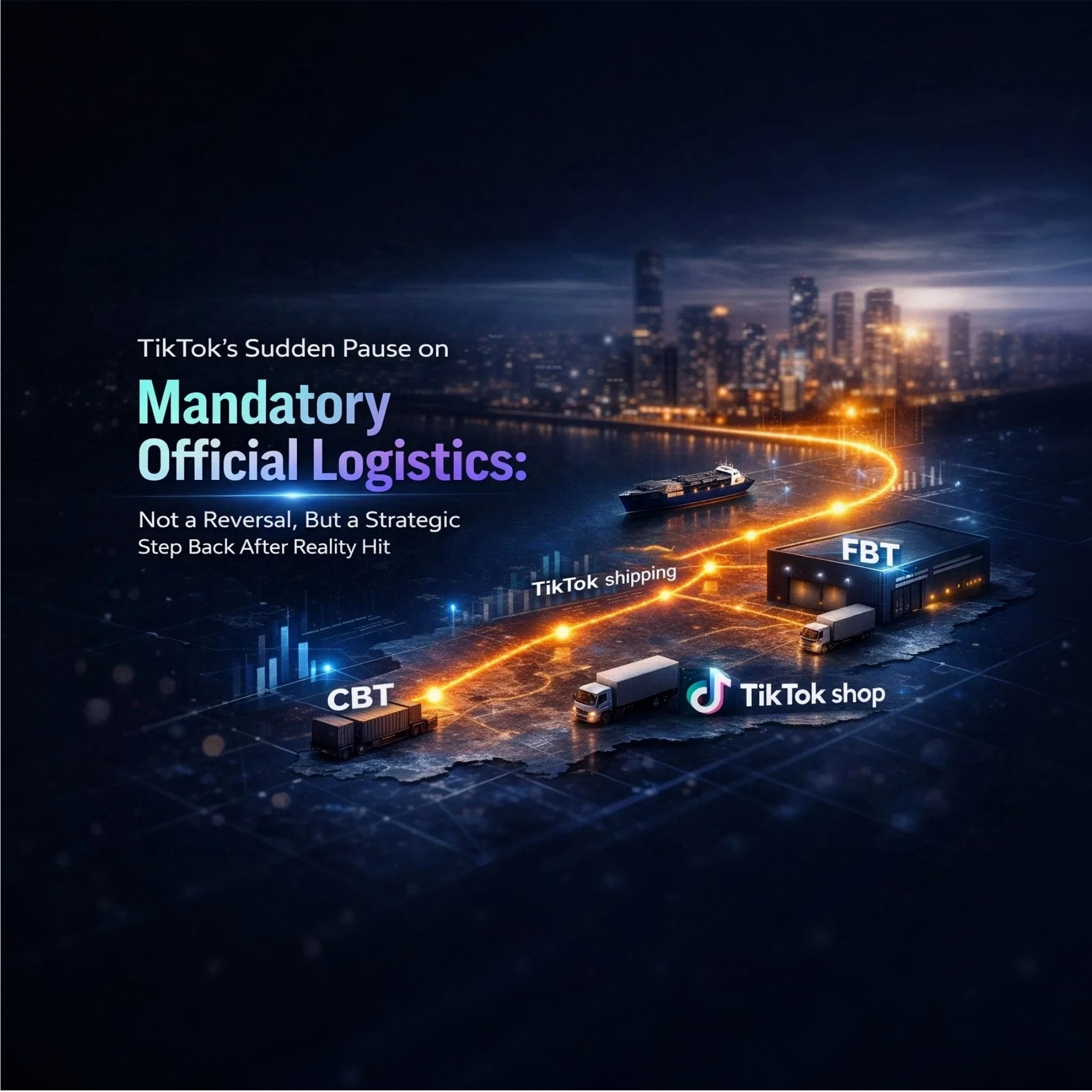
TikTok’s Sudden Pause on Mandatory Official Logistics: Not a Reversal, But a Strategic Step Back After Reality Hit
 By Joline03 Mar,2026
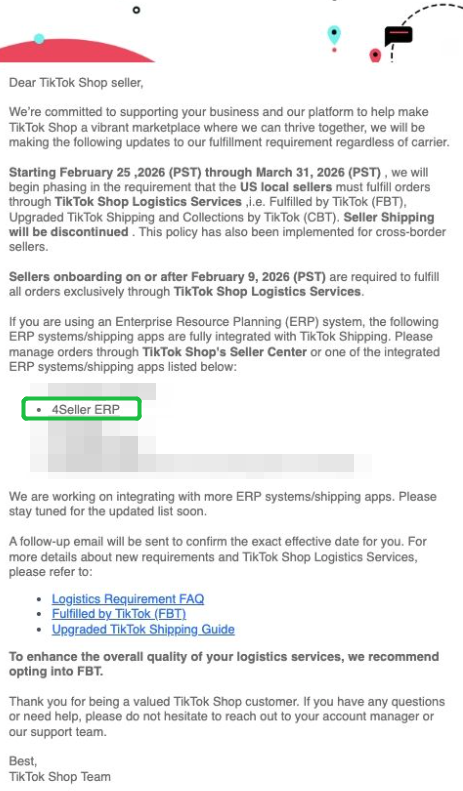
On January 21, 2026, TikTok Shop announced that it would gradually discontinue Seller Shipping in the United States and require sellers to transition to TikTok-controlled logistics services or fully integrated approved logistics tools.

According to the plan released at that time, the transition would begin in late February and complete full migration by the end of March. Sellers who failed to migrate might lose access to 170 million U.S. users.

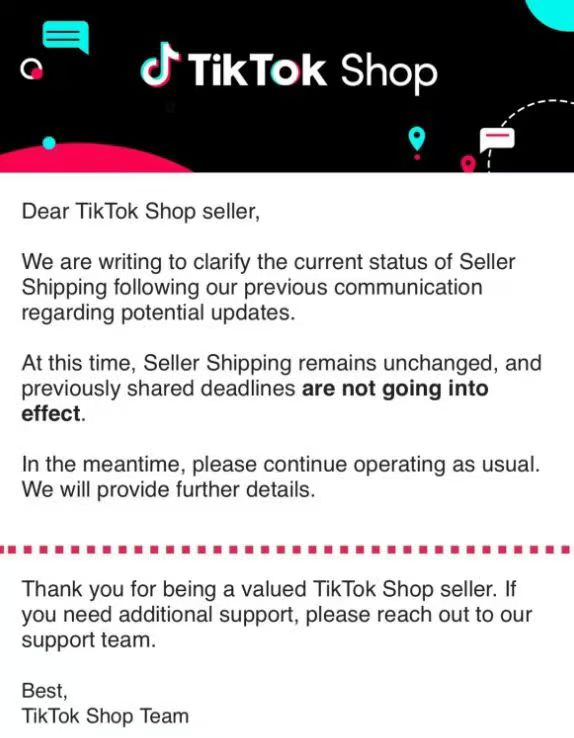
However, less than one month later, on February 18, TikTok officially issued another clarification notice: the previously mentioned timeline would not take effect, and Seller Shipping would continue to be retained.


Within just one month, the policy shifted from “comprehensive mandatory takeover of logistics” to “maintaining the status quo.” This was not a simple adjustment, but a strategic-level retreat.

So what exactly happened behind the scenes?

I. The Real Reaction from Sellers: Profits Compressed, Inventory Locked, Risk Amplified

After the policy was released, the market reaction was far more intense than expected.

Previously, Modern Retail magazine reported last month that some brands withdrew from TikTok Shop due to dissatisfaction with the proposed reforms. Merchants and agency executives stated that the reform would increase fulfillment costs, compress profit margins, and make it harder for merchants to offer the deep discounts expected by TikTok users. Some brands indicated that if the reform plan were implemented, they would reduce product assortments, scale back promotional activities, or even exit the platform entirely.

At the time, major brands widely expressed operational and financial concerns. On one hand, some brands pointed out that TikTok’s in-house logistics services were still in the early stages of development, with practical issues such as shipping delays and inventory errors. Forcing a switch while the logistics system was not yet fully mature would undoubtedly transfer fulfillment risk directly to sellers. On the other hand, the deeper challenge came from the inventory structure itself. If required to send inventory to TikTok warehouses in advance, brands would need to forecast demand specifically for the TikTok platform. For a platform known for viral spread and instant bestseller explosions, demand is highly uncertain and extremely difficult to predict.

The issue lies in the fact that TikTok’s traffic logic itself relies on high-frequency promotions and explosive bestsellers. Once content goes viral, orders may surge dramatically within a short period of time. However, the official logistics model requires inventory to be allocated to designated warehouses in advance, increasing warehousing costs, potentially raising fulfillment fees, and extending cash flow cycles. For brands that rely on centralized inventory management or shared multi-platform inventory systems, this is not merely a logistics migration, but a reconstruction of supply chain structure. This structural impact is the true core reason behind the large-scale concern.

Modern Retail interviewed Jerry Wu, Chief Marketing Officer of Grande Cosmetics: “One of our best-selling products has to be shipped from China by sea, which basically takes five to six months to arrive. If we specifically allocate inventory to send to TikTok warehouses and it immediately sells out, then we have to wait even longer. This is just another step in the process, and I’m not happy about it.”

This statement actually reveals the core contradiction. TikTok is fundamentally a content-driven sales platform where bestsellers often generate concentrated volume within a short period, with demand that fluctuates greatly and is difficult to predict. Sales may double within days or drop rapidly within a week. Under such a traffic structure, requiring sellers to prepare inventory separately in official warehouses means bearing inventory risk for a highly uncertain sales rhythm. Once misjudged, either stockouts will affect conversion rates, or excess inventory will tie up cash flow.

There is an inherent tension between such uncertainty and mandatory centralized warehousing. From a supply chain logic perspective, this is fundamentally a conflict.

II. The Problem Is Not Just Emotion, but Whether Execution Is Truly Ready

Some brands stated that TikTok’s in-house logistics services were still in early development, with issues such as shipping delays and inventory errors. Forcing a comprehensive switch within a logistics system still under refinement inherently carries significant risk.

A platform can control logistics, but if logistics stability has not yet matured, forcing a switch transfers operational risk directly to sellers. When sellers begin to worry about delays, mis-shipments, and inventory management issues, trust begins to decline. Once trust declines, the ecosystem begins to shake.

III. Without Operational Autonomy, Why Would Large Sellers Enter?

Over the past year, TikTok has actively sought to attract enterprise sellers and introduced multiple initiatives to expand product categories and price ranges on its platform. Eliminating seller-controlled shipping would make it more difficult for brands that rely on centralized inventory systems or existing third-party logistics partnerships to enter.

Travis Johnson, Global CEO of Amazon marketing agency Podean, previously stated: “For large brands with complex and highly mature systems, trying to integrate something new will be very complicated. No matter what, this will impact profit margins.”

This touches on another strategic contradiction for TikTok: it wants to enhance logistics control while also attracting mature brands. However, mature brands have complex supply chains, mature systems, and high levels of shared inventory. Mandatory official logistics would significantly increase their entry costs.

When merchant acquisition strategy conflicts with logistics policy, the platform must make a choice.

IV. A Deeper Challenge: The Platform’s Own Stability Is Still Under Examination

It is worth noting that this adjustment to TikTok’s logistics policy occurred at a critical point shortly after the restructuring of its U.S. business.

After months of uncertainty, the equity restructuring plan for TikTok’s U.S. business was officially finalized. According to disclosed information, Oracle, Silverlake, and Abu Dhabi’s MGX will each hold 15% equity, ByteDance will retain 19.9%, and another 30.1% will be held by affiliated entities of existing ByteDance investors. More importantly, operational control and algorithm management will transfer to a U.S. entity. This structural adjustment fundamentally alleviated prior regulatory concerns surrounding national security, significantly reduced policy uncertainty, and once again made TikTok a platform where U.S. brands, advertisers, and e-commerce sellers could make long-term plans.

However, the implementation of structural restructuring does not mean the platform is already fully stable in the short term.

As previously reported by Modern Retail, TikTok’s new joint ownership structure did not start smoothly earlier this year. Extended system outages affected shop sales, advertising performance, and creator activities, and some brands reported significant revenue declines during this period. At a stage where ownership structure has just been reorganized and systems are still in transition, platform operational stability itself becomes a focal point of market attention.

Against this backdrop, when combined with the previous policy adjustment regarding mandatory order fulfillment switching, merchants’ risk perception was further amplified. Supply chain adjustments already involve inventory restructuring, rising costs, and cash flow pressure. If further combined with uncertainties in platform technical stability and rule changes, decision-making difficulty naturally increases substantially.

Nadya Okamoto, founder of period care brand August, once stated bluntly: “People generally have low trust in TikTok. We’re not going to treat this like other platforms where we say, ‘Okay, this is our big opportunity, let’s seize this transformation.’ Our thinking is, ‘Let’s evaluate the profit margins, explore different options, and then decide.’”

This statement reflects not emotion, but rational judgment. When platform governance structure has just been reorganized and technical and operational systems are still in transition, merchants will naturally assess their level of dependency more cautiously. Especially in the U.S. market, brands have extremely high requirements for policy stability and platform continuity.

Therefore, from a macro perspective, TikTok’s decision to pause mandatory official logistics is not merely a response to seller pressure, but a rebalancing of overall ecosystem stability. At a time when equity restructuring has just been completed and market trust is still being repaired, the platform needs to prioritize growth and confidence rather than trigger greater turbulence at the supply chain level.

In other words, this rhythm adjustment is essentially the platform’s re-management of risk during a period of structural restructuring.

V. What Signal Does This “Pause” Actually Release?

This is not strategic abandonment, but a pacing retreat.

TikTok’s desire to strengthen logistics control has not changed. But the platform has realized that ecosystem capacity, logistics maturity, seller trust, and merchant acquisition strategy, at the current stage, are not sufficient to support a hard switch.

Therefore, the policy pause is essentially a reassessment of risk.

VI. In the Constantly Changing 2026 TikTok Policy Environment, What Should Sellers Do Now?


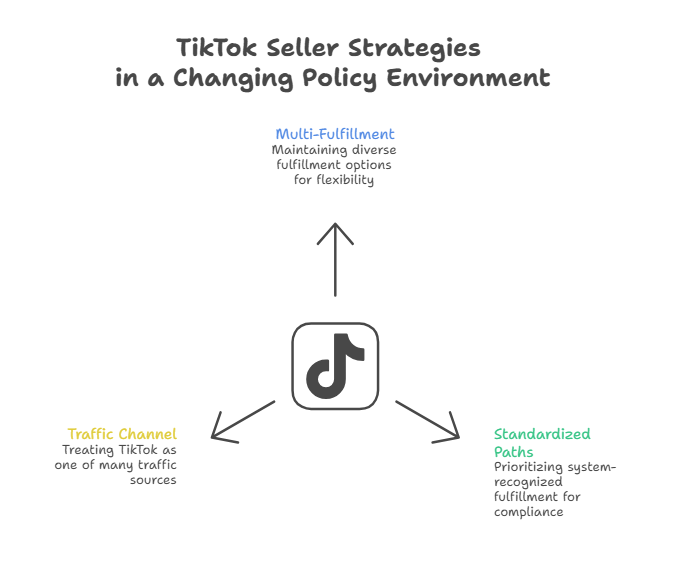
In such a repeatedly fluctuating environment, what sellers truly need to do is not to bet on “whether the policy will return,” but to build a flexible structure.

First, maintain multi-fulfillment capability.

Do not lock inventory entirely into a single system. Retain FBA, third-party warehouses, and official logistics testing capabilities. The core is not that you must switch now, but that you must always have the ability to switch. When platform rhythm changes, you can adjust rather than passively endure.

Second, prioritize standardized paths that can be system-recognized.

Although Seller Shipping remains, platform requirements for fulfillment authenticity have clearly increased. The previous cancellation of USPS offline shipping was essentially aimed at rectifying postage fraud such as “fake label schemes,” addressing uncontrollable tracking routes, delivery delays, and fraudulent labels. Dispute rates for such non-compliant orders are far higher than compliant ones, seriously affecting consumer experience and platform reputation. At the same time, under seller shipping models, warehousing, labeling, and delivery standards vary widely, leading to inconsistent delivery times, higher return rates, and even vicious low-price competition.

Therefore, the platform is gradually compressing gray-area operations by strengthening tracking source verification, logistics route recognition, and system integration. The future risk may not be “whether seller shipping is allowed,” but “whether it is authentically verifiable.” Compared to manual tracking input or opaque routes, using TikTok officially recommended integrated MCF auto-label fulfillment application 4Seller-Easy MCF to achieve authentic source verification and complete fulfillment chain integrity is more aligned with platform compliance direction and safer.

Third, treat the platform as a traffic channel, not your only battlefield.

Policies will change. Rules will adjust. But enterprise structure must remain stable. Do not let a single platform determine your supply chain structure. Real security comes from structural independence, not from temporary policy relaxation.

In Conclusion

Policy changes within one month indicate that the platform is testing boundaries.

Sellers are not passive parties, but part of the ecosystem. When a large number of brands express cost pressure, supply chain risk, and trust anxiety, the platform chose to retreat. Seller Shipping is temporarily retained, but the long-term contest over logistics control is not over.

In the platform era, what is truly safe is not any specific policy, but whether you can continue operating steadily amid policy changes. This is the real capability TikTok e-commerce sellers must cultivate in 2026.
- Multi Channel Order Management
- TikTok Shop
- Amazon
- Temu
- About 4Seller
- Shopify
- Multi Channel Inventory Management
- Amazon MCF&FBA
- Seller Tips
- Listing Management
- Marketplace News
- FedEx
- Amazon MCF
- DHL Express
- UPS
- Amazon Shipping
- eBay
- Creator Bulk Invite
- Shein
- Inventory Sync
- GLS
- Multi-channel Store
- Walmart
- Walmart WFS
- Seller Story
- Shipping Integration
- Beginner Tutorial
- Kaufland
- Royal Mail
- 3PL
- DHL Parcel
- Shipping Label
- OTTO
- Walmart MCS
- Platform Integration
- Deutsche Post
- WooCommerce
- AliExpress
- UniUni
- Stripe Tracking Sync
- SPU Catalog
- USPS
- ShipHero
- Yodel
- PayPal Tracking Sync
- GOFO
- CIRRO
- Correos
- Correos Express
- DPD
- Etsy
- Evri
- FBM
- Request Review
- Logistics Rule
- CaiNiao
- BRT
- Chronopost
- Poste Italiane
- Cdiscount
- OMS
- DHL
- WFS
- ShipBob
- Price Sync
 17 Dec,2024
- 17 Dec,2024