Amazon Featured Offer Update 2026: Why Sellers Still Lose the Buy Box and How to Win It

For Amazon sellers, winning the Buy Box — officially called the Featured Offer — directly dictates daily sales performance. When multiple merchants offer the exact same product under a single ASIN, Amazon does not distribute buyer traffic equally. Instead, the algorithm selects one standout seller to occupy the Featured Offer slot, granting them exclusive display next to the prominent “Add to Cart” and “Buy Now” buttons. Because most shoppers do not manually compare alternative offers, this top position naturally captures the vast majority of customer purchases.
However, heading into July 2026, many merchants are facing a confusing situation. Even with excellent account health, fully stocked FBA inventory, and zero product restrictions, their Featured Offer has suddenly vanished.
This mystery stems from a massive update Amazon rolled out in July 2026, which completely eliminated the initial eligibility step that used to determine who could compete. While this change allows more sellers to enter the arena directly, it does not guarantee an automatic win.
Instead, Amazon has shifted its focus from asking “Can this seller compete?” to asking “Which specific offer provides the best customer experience?” As a result, maintaining competitive pricing, fast fulfillment, stable inventory, and operational accuracy has become more critical than ever before.What Is the Amazon Featured Offer (Buy Box)?
When several merchants share the same ASIN, Amazon highlights the best available deal in the main purchase section of the product page. Winning this Featured Offer position allows a seller to maximize product visibility, streamline the checkout process for shoppers, generate significantly higher sales volume, and maintain eligible, high-performing advertising campaigns.
Crucially, Amazon does not simply award this spot to the lowest-priced offer. The algorithm evaluates the total value of the deal by balancing competitive pricing, delivery speed, inventory availability, fulfillment reliability, and overall seller performance metrics. For example, a merchant offering a slightly higher price with Prime next-day delivery will frequently outperform a cheaper competitor who offers slower shipping. Ultimately, the system is designed to answer one key question: “Which offer gives customers the absolute best buying experience?”
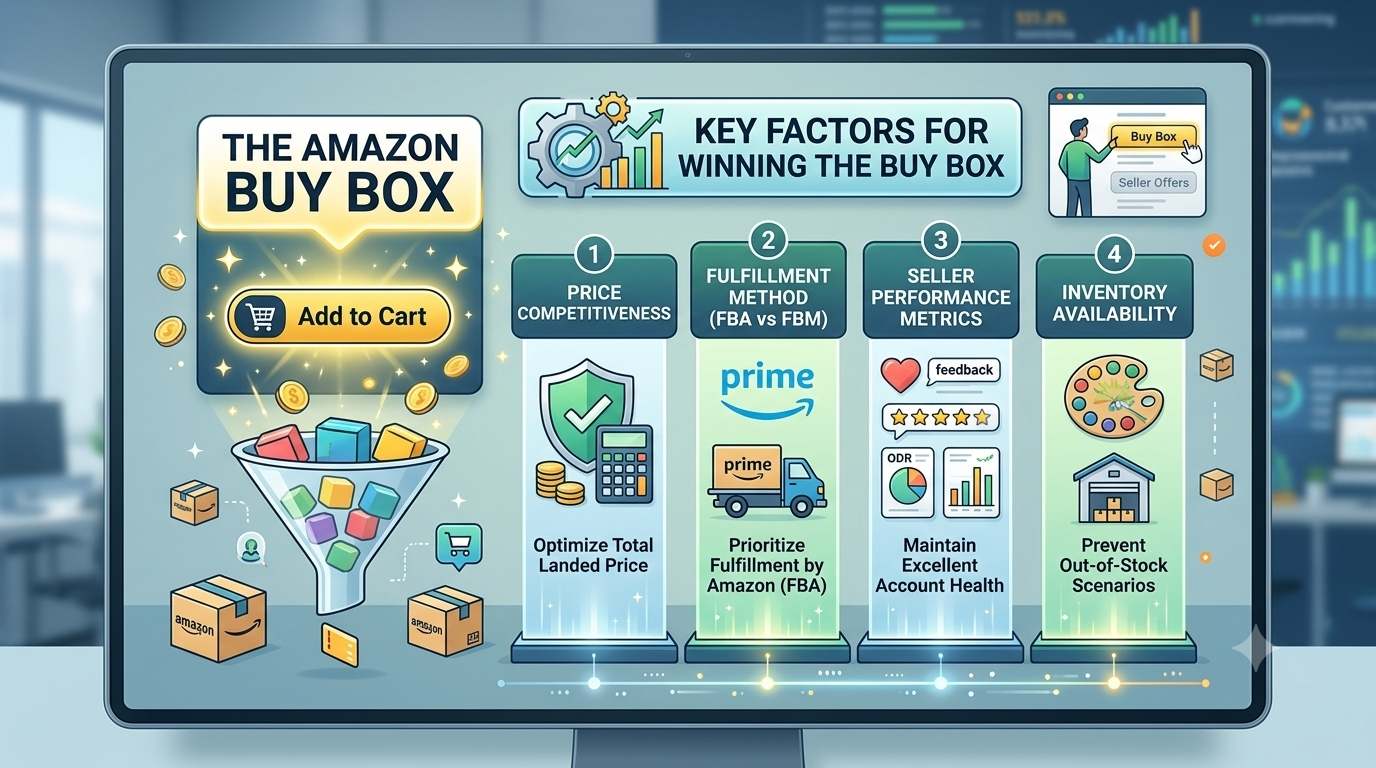
What Changed in Amazon Featured Offer Rules in July 2026?
To understand how the market has intensified, it helps to look at how the algorithm evolved from a rigid two-step process into a dynamic, real-time arena.
- The Previous System: First, Amazon ran a baseline audit on Featured Offer Eligibility to verify account health, order defect rates, shipping performance, and selling history. If a seller failed this initial gate, they were blocked from competing entirely. Only the sellers who passed proceeded to the Offer Competition phase, where they went head-to-head on immediate metrics like price and delivery options.
- The New 2026 System: Amazon has completely removed the separate eligibility filter. Now, almost any merchant with active stock enters the final competition pool automatically.
- Is the price competitive?
- Can the order arrive quickly?
- Is inventory available?
- Will customers have a reliable experience?
“Am I qualified?”to:“Why should Amazon choose my offer over others?”
Why Sellers Still Lose the Buy Box After the Update
-
"My account is healthy and I use FBA. Why don't I have the Featured Offer?"
This dynamic happens because the algorithm relies heavily on trust signals. Even though the old eligibility wall is gone, Amazon still needs performance history to evaluate an offer. For brand-new products, the system lacks historical data regarding conversion rates, customer satisfaction, and fulfillment consistency. Consequently, an established seller with solid historical data will naturally win the Buy Box over a new offer, even if their current metrics look identical on paper.
Actionable Blueprint for Sellers: Instead of waiting passively for the algorithm to trust you, you must proactively build early performance signals. Merchants should leverage the Amazon Vine program to secure early verified reviews, drive external traffic from social media or email lists to spark initial conversions, keep launch pricing highly aggressive, and ensure flawless fulfillment from day one. Feeding the algorithm positive customer experience data is the only way to unlock the Buy Box for a new listing.
-
“Does the Lowest Price Always Win the Buy Box?”
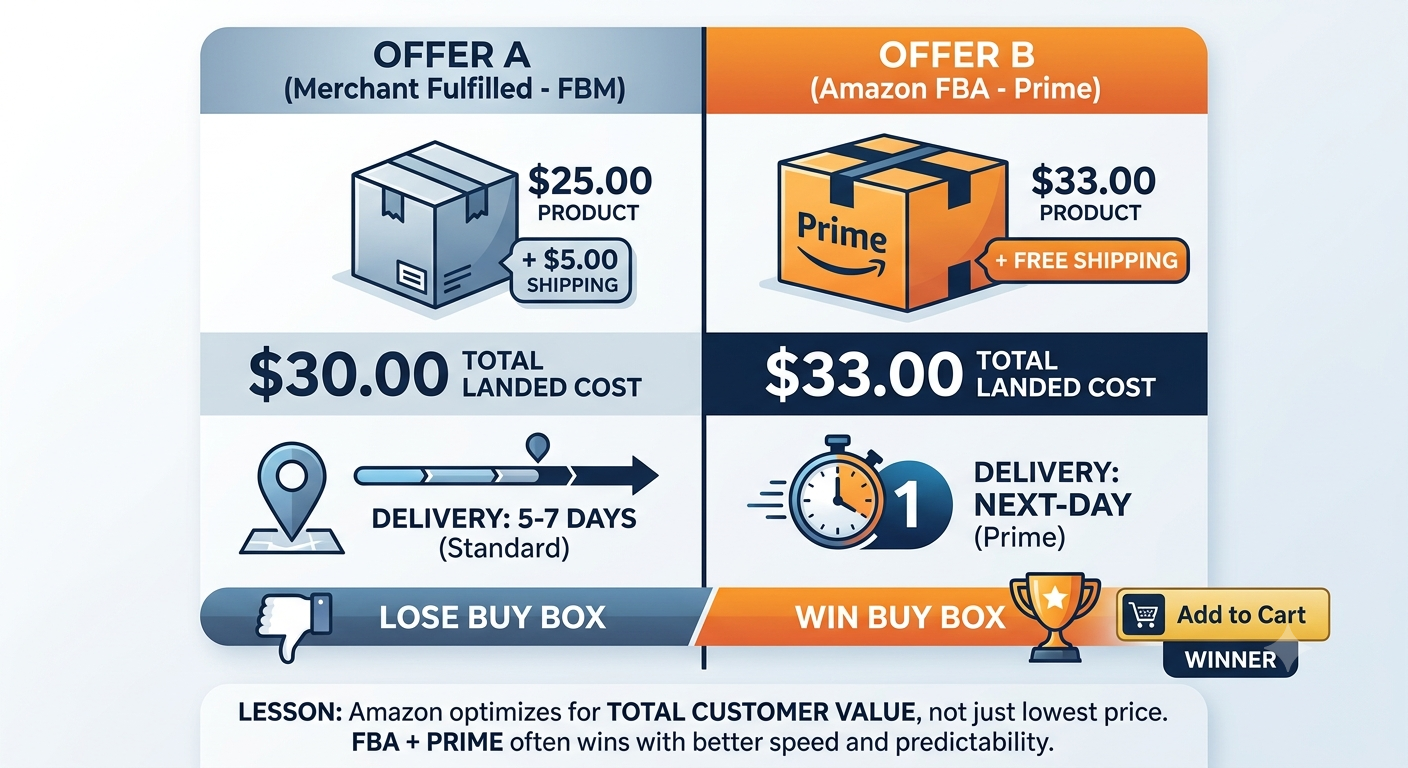
Consider a scenario where Offer A is a merchant-fulfilled (FBM) listing with a lower product price but a 5–7 day delivery window. Meanwhile, Offer B features a slightly higher price but utilizes Amazon FBA to provide Prime next-day delivery. Even though Offer A costs less, Amazon will routinely award the Featured Offer to Offer B because faster delivery, predictable shipping, and Prime protections offer a superior customer experience. Ultimately, price matters, but the total landed value matters more. Sellers must optimize their total cost, shipping fees, and fulfillment methods in tandem.
-
“What Should Sellers Focus on After the Featured Offer Update?”
- Intelligent Pricing: Sellers must continuously monitor market trends, competitor movements, and shipping expenses. Implementing automated repricing tools is essential to reacting instantly to market changes without eroding profit margins.
- Fulfillment Speed: Delivery speed remains a heavy algorithmic weight. Utilizing Amazon FBA, leveraging Amazon Multi-Channel Fulfillment (MCF), or partnering with reliable local 3PL warehouses ensures your package arrives when promised.
- Stable Stock Levels: Running out of stock instantly kills listing momentum. Sellers must eliminate FBA stockouts, cross-channel overselling, and replenishment delays to maintain continuous Buy Box ownership.
How 4Seller Helps Multi-Channel Sellers Maintain Competitive Operations
Modern e-commerce brands rarely limit themselves to Amazon; they simultaneously scale across Shopify, Walmart, TikTok Shop, and eBay. However, managing fragmented operations across multiple storefronts can create back-end friction that indirectly damages your Amazon performance metrics. 4Seller provides a centralized solution to these multi-channel challenges.- Preventing Inventory Disruption: When a product sells out rapidly on one marketplace, it can trigger unexpected stock shortages on others. Without real-time synchronization, sellers face cross-platform overselling, forced order cancellations, and late shipments—all of which destroy Amazon seller metrics. 4Seller solves this by instantly synchronizing inventory levels across all active channels.
- Streamlining Multi-Channel Fulfillment: Disconnected order workflows often lead to human error and shipping delays. 4Seller centralizes your order management, allowing you to seamlessly route fulfillment from Amazon FBA, Multi-Channel Fulfillment (MCF), or third-party warehouses from a single dashboard.
- Enhancing Operational Visibility: Managing multiple stores requires absolute clarity. By unifying orders, inventory balances, product listings, and shipping statuses into a single view, 4Seller helps merchants catch operational bottlenecks before they impact the customer. While no software can magically guarantee a Buy Box, maintaining flawless operations protects the exact variables Amazon values most: constant product availability, reliable delivery, and a positive customer experience.
Conclusion: Winning the Buy Box Is About Offer Quality
Amazon's 2026 Featured Offer update has permanently leveled the playing field, shifting the conversation away from legacy qualifications. The defining question is no longer whether your store is old enough to compete, but why your specific offer is the absolute best choice for the consumer at this exact second.The sellers who thrive in this dynamic environment will be those who consistently deliver competitive prices, lightning-fast shipping, and uninterrupted inventory stability. For multi-channel brands, upgrading your backend operational accuracy and efficiency is no longer optional. It is the baseline requirement to stay competitive and win on Amazon.
Topics
All Topics
Popular Posts
 17 Dec,2024
Table of Content
Popular Posts
- 17 Dec,2024


Back to top