- Multi Channel Order Management
- TikTok Shop
- Amazon
- Temu
- About 4Seller
- Shopify
- Multi Channel Inventory Management
- Amazon MCF&FBA
- Seller Tips
- Listing Management
- Marketplace News
- Amazon Shipping
- DHL Express
- Amazon MCF
- UPS
- FedEx
- eBay
- Shein
- Creator Bulk Invite
- Multi-channel Store
- Inventory Sync
- GLS
- Walmart WFS
- Walmart
- Seller Story
- Beginner Tutorial
- Royal Mail
- Kaufland
- Shipping Integration
- DHL Parcel
- 3PL
- WooCommerce
- Walmart MCS
- Deutsche Post
- Shipping Label
- OTTO
- Platform Integration
- PayPal Tracking Sync
- UniUni
- Yodel
- ShipHero
- SPU Catalog
- Stripe Tracking Sync
- USPS
- AliExpress
- GOFO
- CIRRO
- Correos
- Correos Express
- DPD
- Etsy
- Evri
- FBM
- Request Review
- Logistics Rule
- CaiNiao
- BRT
- Chronopost
- Poste Italiane
- Cdiscount
- OMS
- DHL
- WFS
- ShipBob
- Price Sync
How Sellers Automate Multi-Channel Fulfillment in 2026 with Amazon MCF and 4Seller?
 By Joline21 Jan,2026
As multi-platform, cross-channel operations increasingly become the norm for US and EU sellers, order fulfillment is evolving from a stage heavily dependent on manual operations to one centered on system-driven automation.
Against this backdrop, the deep integration between 4Seller, an Amazon-officially certified third-party ecommerce management tool, and Amazon Multi-Channel Fulfillment (MCF) provides multi-channel sellers with a compliant, stable, and highly efficient fulfillment solution. It is rapidly becoming a key choice for improving fulfillment efficiency and inventory turnover in 2026.
What Is 4Seller?
4Seller is a free, all-in-one, multi-platform and multi-store ecommerce management tool designed for local US and EU sellers, serving over 60,000 sellers across Western markets.
4Seller fully integrates with major ecommerce platforms including Amazon, Shopify, Walmart, eBay, Shein, Etsy, WooCommerce, Temu, TikTok, OTTO, Kaufland, Miravia, AliExpress, and Cdiscount. It also supports major fulfillment solutions such as FBA, ShipBob, WFS, and ShipHero, and integrates with a wide range of carriers and shipping platforms, including USPS, UPS, FedEx, DHL, DPD, Royal Mail, Correos, Deutsche Post, GLS, Evri, Yodel, Chronopost, Poste Italiane, BRT, Australia Post, Canada Post, UniUni, Cainiao, Cirro, GOFO, Stamps, Shippo, ShipSaving, and PostPony.
4Seller covers the entire ecommerce operating workflow, from product management and order fulfillment to inventory synchronization, logistics tracking, and data reporting. Its core objective is simple: make cross-platform selling more efficient.
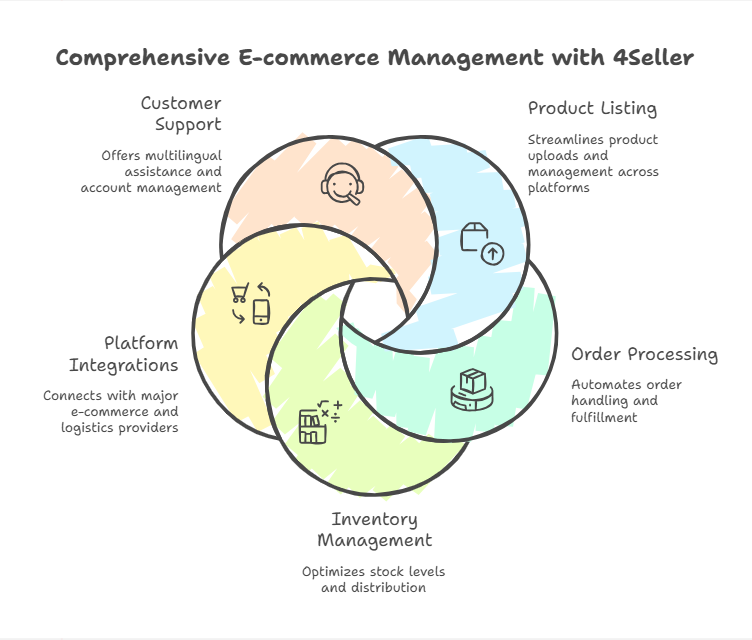
What Are the Core Features of 4Seller?
1. Product Listing
4Seller supports cross-platform bulk listing and one-click product migration, significantly reducing the cost of launching new products and expanding to new platforms. The system integrates multi-model AI capabilities, including ChatGPT and DeepSeek, enabling AI-generated product titles and descriptions, intelligent attribute completion, and one-click image optimization.
In addition, listings across multiple stores can be bound to a single SPU, allowing unified price and inventory adjustments with synchronized updates, improving operational efficiency and listing consistency.2. Order Processing
4Seller centralizes orders from more than 12 ecommerce platforms into a single interface with real-time synchronization and unified management. Sellers can use predefined rules to automate shipping method selection, order routing, and fulfillment, significantly reducing manual steps.
The system supports one-click label printing, scan-to-ship workflows, grouped fulfillment, and Amazon automated review requests, upgrading order processing from experience-driven manual operations to a rule-based automated system.3. Inventory and Procurement Management
4Seller enables second-level synchronization of inventory across multiple stores and warehouses, unifying self-operated warehouses, third-party overseas warehouses, and Amazon FBA / MCF inventory into one management system.
Through inventory linkage rules and maximum/minimum allocation settings, sellers can dynamically distribute inventory across channels, avoiding stockouts, overselling, and long-term inventory buildup. This significantly improves inventory turnover and capital efficiency.4. Ecommerce and Logistics Platform Integrations
4Seller has completed deep integrations with major platforms including Amazon, Shopify, Walmart, eBay, Shein, Etsy, WooCommerce, Temu, TikTok, OTTO, Kaufland, Miravia, AliExpress, and Cdiscount, as well as more than 30 carriers and shipping platforms.
Order status and logistics information are automatically synced and tracked in real time, ensuring high consistency between platforms, warehouses, and customers. This reduces after-sales disputes and communication costs, creating a stable and reliable fulfillment foundation.5. Multilingual Customer Support
4Seller provides multilingual customer support in English, French, German, Italian, and Spanish, with dedicated one-on-one account managers. Sellers receive hands-on assistance with system setup, workflow configuration, and issue troubleshooting, ensuring the platform is fully implemented in real operational scenarios rather than remaining a set of unused features.
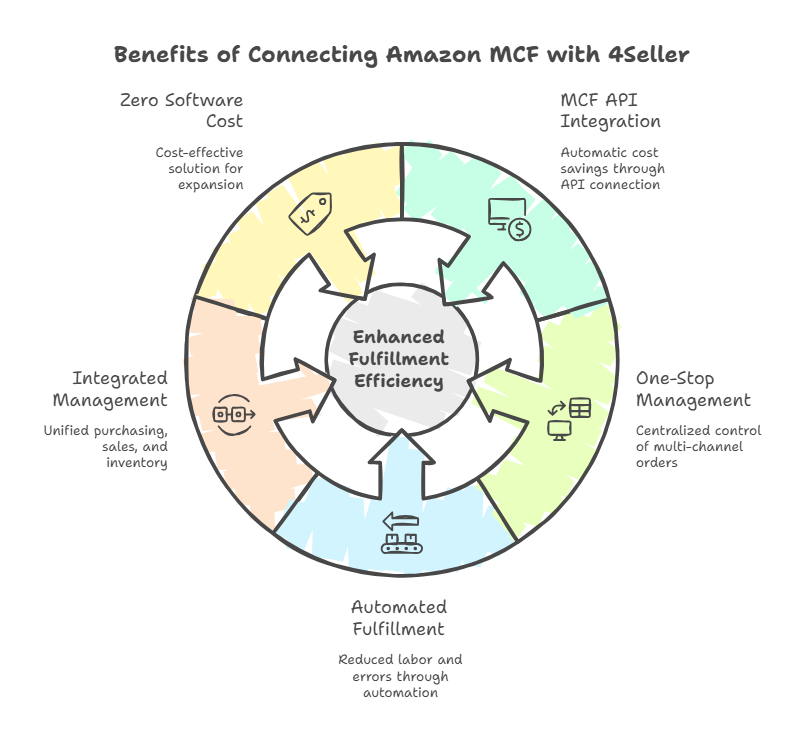
What Are the Benefits of Connecting Amazon MCF with 4Seller?
1. MCF API Fulfillment Integration: System-Level Cost Reduction
For sellers who have adopted or plan to adopt Amazon MCF API integration on or after October 15, 2025, this is not merely a technical connection but a clearly quantifiable cost-optimization opportunity.
When MCF outbound fulfillment is triggered through an official API-integrated system such as 4Seller ERP, eligible orders are automatically included in Amazon’s incentive program. Sellers can receive a direct 15% discount on multi-channel fulfillment fees, along with a $1 Amazon logistics credit per successfully delivered MCF order, capped at $50,000.These benefits do not require manual applications or limited-time promotions. They are structurally tied to system-based fulfillment. The more stable the order volume and the more automated the fulfillment workflow, the greater the cumulative cost advantage. For sellers operating multiple platforms and stores simultaneously, this type of system-driven incentive is often more sustainable and predictable than one-off discounts.
2. One-Stop, End-to-End Management of Multi-Channel Orders
For sellers operating across Amazon, Shopify, TikTok Shop, eBay, and other platforms, the biggest challenge is rarely order volume, but fragmentation. Orders are scattered across different backends, inventory is split across multiple warehouses, and daily operations rely heavily on manual switching.
By connecting Amazon MCF with 4Seller, sellers can centrally manage self-operated warehouses, third-party warehouses, and Amazon FBA inventory within a single system, with full visibility into inventory status and order flows.Sellers no longer need to repeatedly confirm which warehouse should fulfill each order or whether inventory is sufficient. The system handles these decisions automatically, significantly reducing operational workload.
3. Highly Automated Fulfillment to Reduce Labor and Error Costs
4Seller synchronizes order data from multiple platforms in real time and automatically routes eligible orders to Amazon MCF based on predefined logistics and fulfillment rules. Shipping status updates and tracking information are returned automatically.
Sellers only need to maintain accurate fulfillment rules rather than intervene order by order. Even during peak seasons or promotional surges, fulfillment remains stable, which is a critical capability as businesses scale.4. Integrated Purchasing, Sales, and Inventory Management
4Seller goes beyond simple inventory synchronization and is built around the core objective of improving inventory turnover. Purchasing, sales, and inventory status are unified into a single logic system.
Through inventory linkage rules, self-operated warehouses, third-party warehouses, and Amazon FBA / MCF inventory are managed together. Sellers can define channel-specific inventory allocation strategies, ensuring inventory flows toward higher-conversion, faster-cash-return channels.In practice, inventory is no longer a static number but a dynamic, allocatable asset. Faster-moving channels receive priority supply, while slower channels naturally scale back, preventing capital from being tied up inefficiently. Compared with tools that focus only on quantity alignment, 4Seller emphasizes dynamic cross-channel coordination, helping sellers accelerate turnover and improve capital efficiency without increasing total inventory.
5. Zero Software Cost, Lower Long-Term Expansion Pressure
Most mainstream multi-channel management and fulfillment tools, such as WebBee, Linnworks, AfterShip, and ShipStation, charge substantial monthly subscription fees, often with key features locked behind higher pricing tiers.
4Seller delivers full multi-platform management, order automation, inventory coordination, and Amazon MCF integration while remaining completely free. This allows sellers to achieve automated multi-channel fulfillment without increasing fixed operating costs, a critical advantage for businesses in expansion phases that need to tightly control expenses.How to Use 4Seller with Amazon MCF to Efficiently Process Orders in 2026?
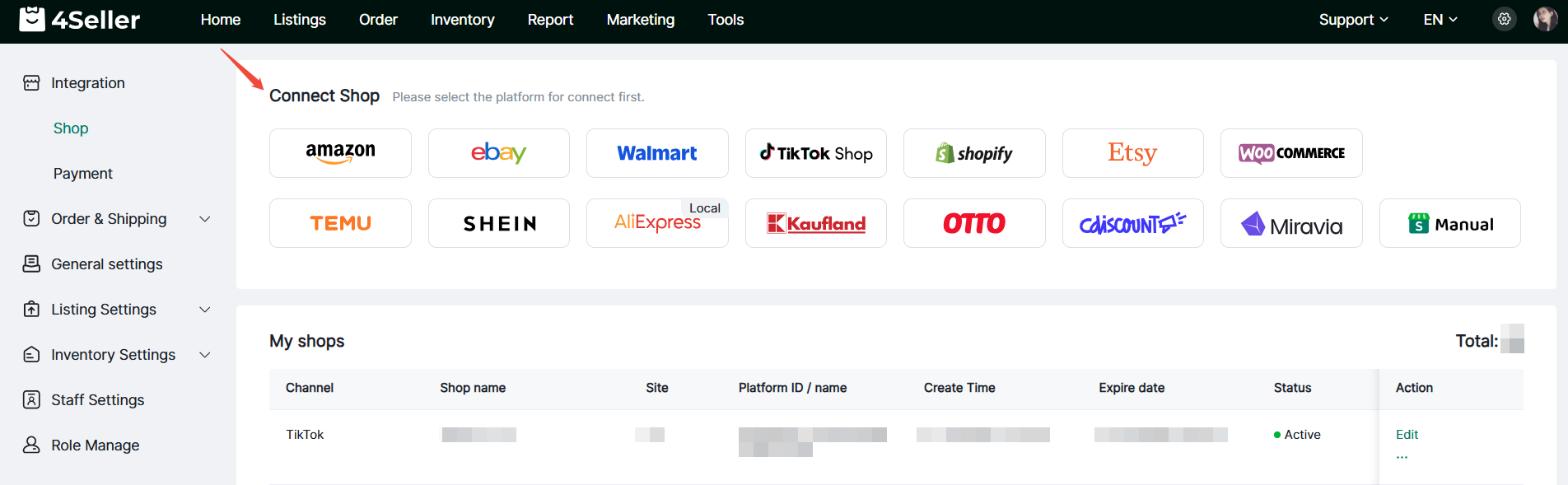
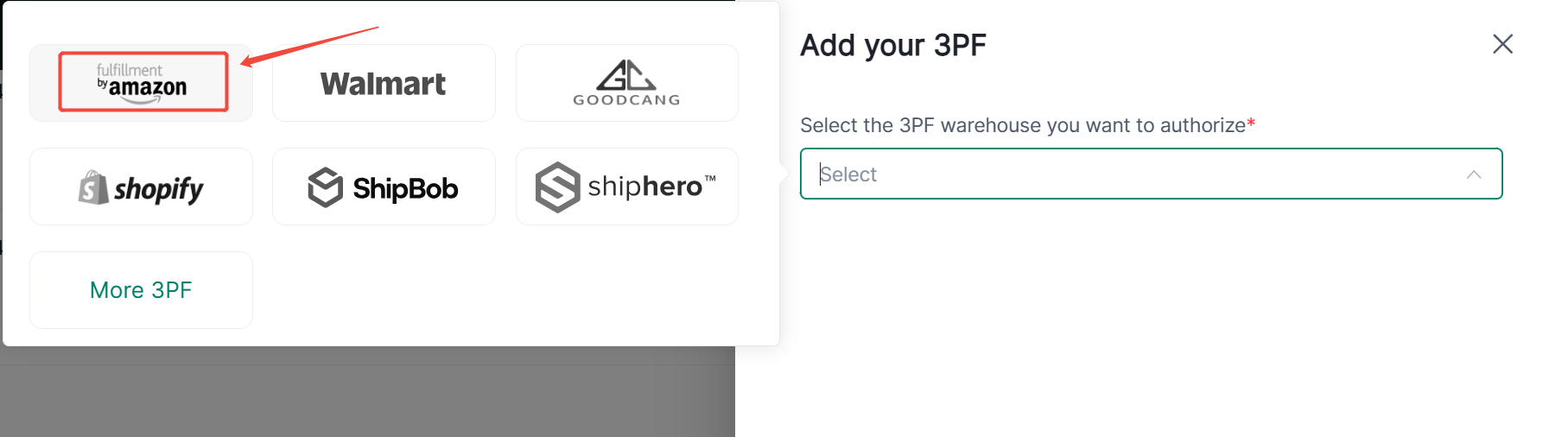
1. Connect Amazon, TikTok, and other multi-channel stores to 4Seller
How to Authorize TikTok Shop with 4Seller ?
https://www.4seller.com/help/en/doc-article/2046-How-to-Authorize-TikTok-Shop-with-4Seller
How to Authorize Shopify Shop with 4Seller?
https://www.4seller.com/help/en/doc-article/165-How-to-Authorize-Shopify-Shop-with-4Seller
How to Authorize Temu Shop to 4Seller?
https://www.4seller.com/help/en/doc-article/212-How-to-Authorize-Temu-Shop-to-4Seller
How to Authorize Shein Shop with 4Seller ?
https://www.4seller.com/help/en/doc-article/431-How-to-Authorize-Shein-Shop-with-4Seller
How to Authorize Walmart Shop to 4Seller?
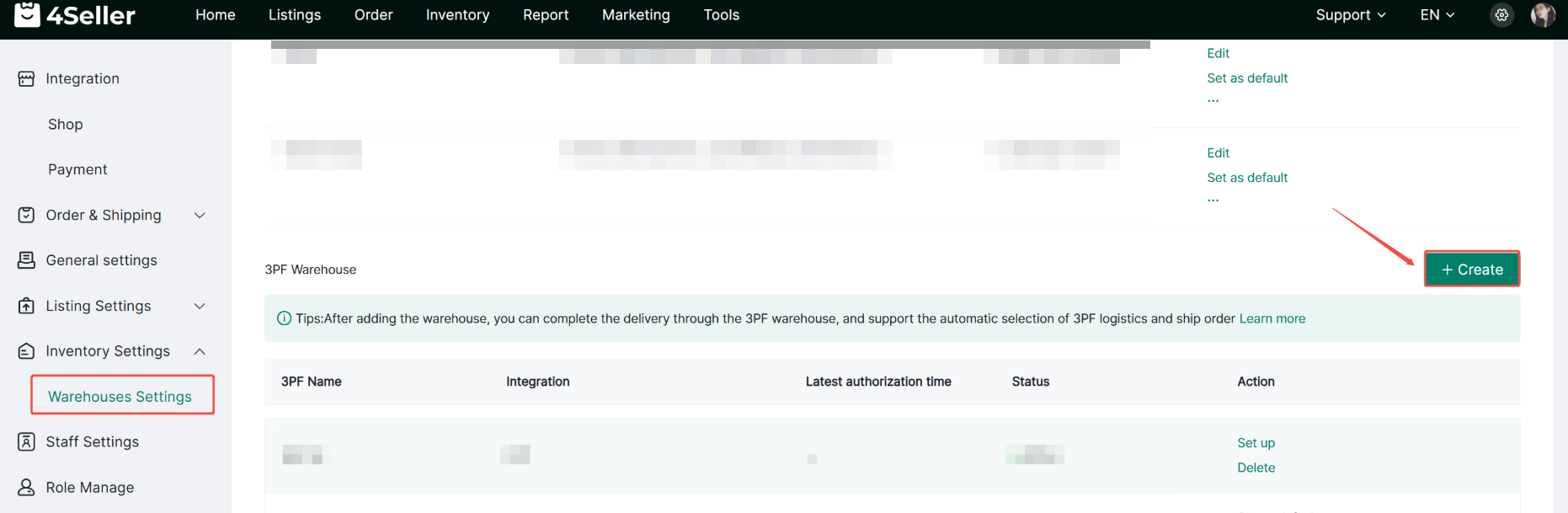
https://www.4seller.com/help/en/doc-article/205-How-to-Authorize-Walmart-Shop-to-4Seller2. Connect Amazon FBA to 4Seller
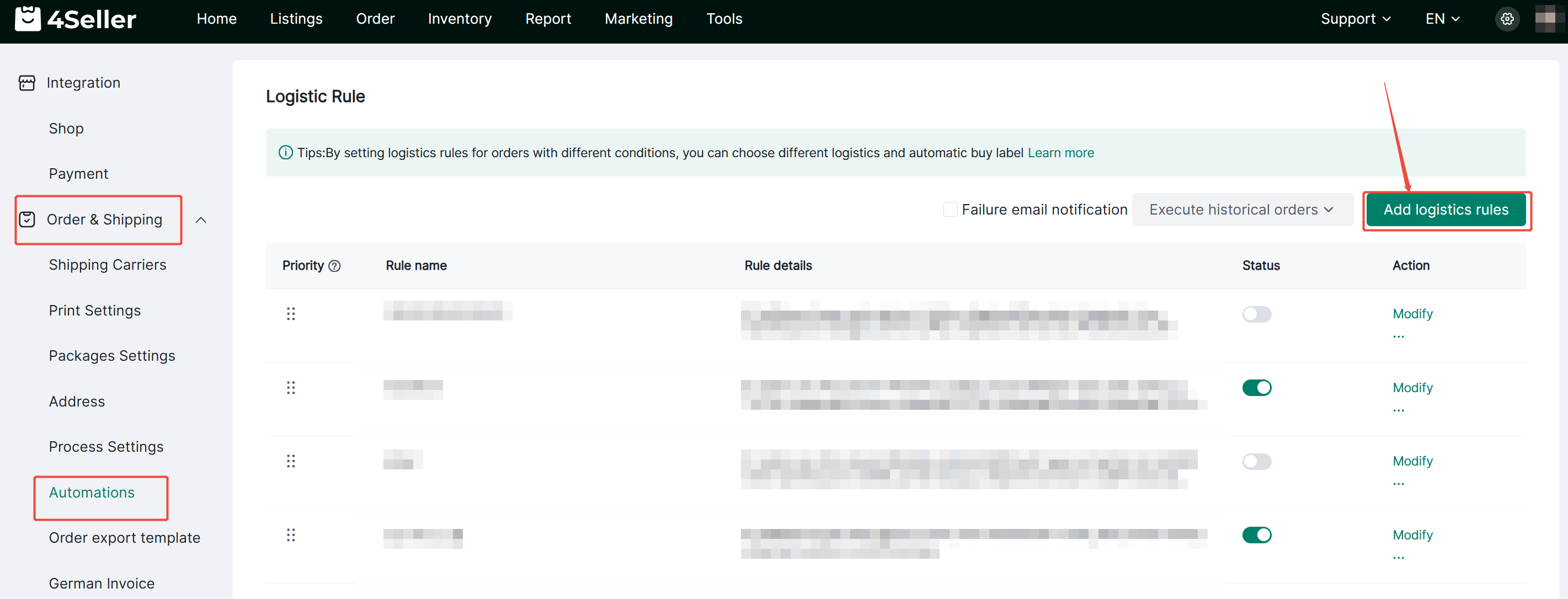
3. Configure logistics rules for automated fulfillment
How to Set the Logistics Rules?
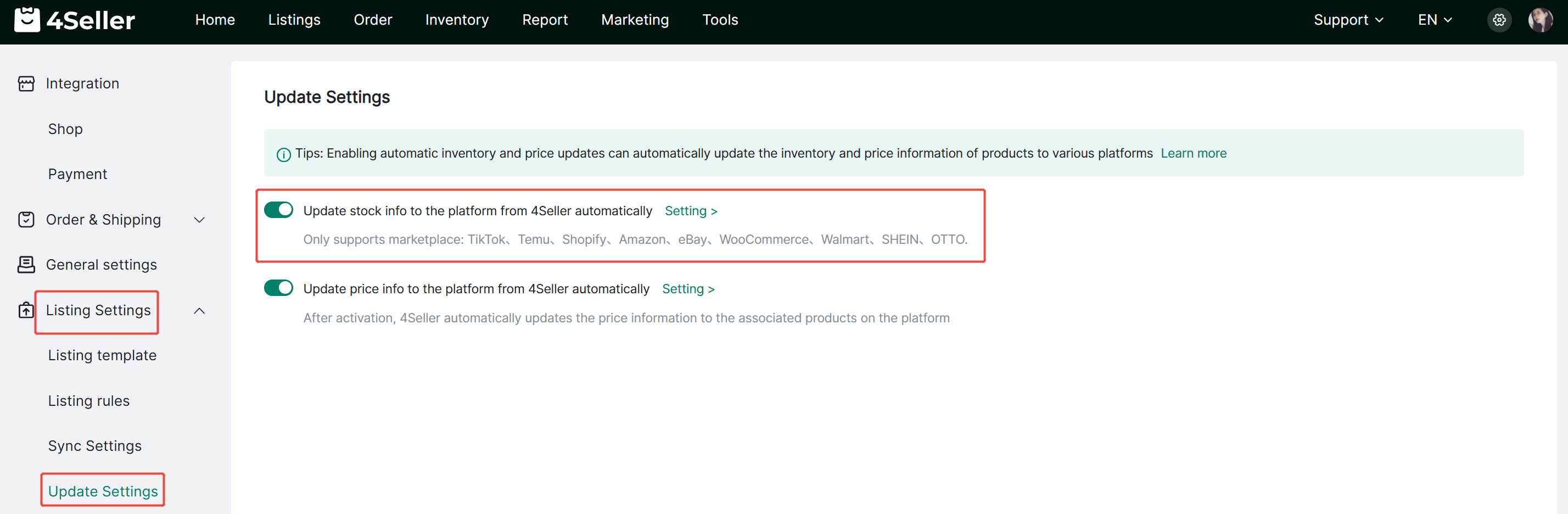
https://www.4seller.com/help/en/doc-article/102-How-to-Set-the-Logistics-Rules4. Enable inventory linkage across multiple stores
How to Enable Inventory Sync (Inventory Linkage)?
https://www.4seller.com/help/en/doc-article/129-How-to-enable-Inventory-Sync-Inventory-LinkageConclusion
As multi-channel selling becomes the default operating model for US and EU sellers, fulfillment efficiency is increasingly defined by system integration rather than manual execution.
By combining Amazon MCF’s compliant, scalable fulfillment with 4Seller’s centralized automation and inventory coordination, sellers can reduce costs, simplify operations, and improve inventory turnover without increasing software expenses.
In 2026, the advantage will belong to sellers who build system-driven fulfillment from day one, and the 4Seller + Amazon MCF integration offers a clear path to that future.
- Multi Channel Order Management
- TikTok Shop
- Amazon
- Temu
- About 4Seller
- Shopify
- Multi Channel Inventory Management
- Amazon MCF&FBA
- Seller Tips
- Listing Management
- Marketplace News
- Amazon Shipping
- DHL Express
- Amazon MCF
- UPS
- FedEx
- eBay
- Shein
- Creator Bulk Invite
- Multi-channel Store
- Inventory Sync
- GLS
- Walmart WFS
- Walmart
- Seller Story
- Beginner Tutorial
- Royal Mail
- Kaufland
- Shipping Integration
- DHL Parcel
- 3PL
- WooCommerce
- Walmart MCS
- Deutsche Post
- Shipping Label
- OTTO
- Platform Integration
- PayPal Tracking Sync
- UniUni
- Yodel
- ShipHero
- SPU Catalog
- Stripe Tracking Sync
- USPS
- AliExpress
- GOFO
- CIRRO
- Correos
- Correos Express
- DPD
- Etsy
- Evri
- FBM
- Request Review
- Logistics Rule
- CaiNiao
- BRT
- Chronopost
- Poste Italiane
- Cdiscount
- OMS
- DHL
- WFS
- ShipBob
- Price Sync

 17 Dec,2024
- 17 Dec,2024