- Multi Channel Order Management
- TikTok Shop
- Amazon
- Temu
- About 4Seller
- Shopify
- Multi Channel Inventory Management
- Amazon MCF&FBA
- Seller Tips
- Listing Management
- Marketplace News
- Amazon Shipping
- DHL Express
- Amazon MCF
- UPS
- FedEx
- eBay
- Shein
- Creator Bulk Invite
- Multi-channel Store
- Inventory Sync
- GLS
- Walmart WFS
- Walmart
- Seller Story
- Beginner Tutorial
- Royal Mail
- Kaufland
- Shipping Integration
- DHL Parcel
- 3PL
- WooCommerce
- Walmart MCS
- Deutsche Post
- Shipping Label
- OTTO
- Platform Integration
- PayPal Tracking Sync
- UniUni
- Yodel
- ShipHero
- SPU Catalog
- Stripe Tracking Sync
- USPS
- AliExpress
- GOFO
- CIRRO
- Correos
- Correos Express
- DPD
- Etsy
- Evri
- FBM
- Request Review
- Logistics Rule
- CaiNiao
- BRT
- Chronopost
- Poste Italiane
- Cdiscount
- OMS
- DHL
- WFS
- ShipBob
- Price Sync
Pipe17 vs. 4Seller: Which Amazon MCF Software is Best for Multichannel Sellers?
 By Joline30 Mar,2026
Many sellers expanding from Amazon FBA to TikTok Shop, Shopify, and Temu eventually hit the same "invisible wall": front-end sales are skyrocketing, but the back-end fulfillment process is a total mess.
Just processing orders across different platforms, syncing inventory, and calculating profit margins can drain an operations team's energy every single day. At this stage, leveraging Amazon MCF (Multi-Channel Fulfillment) to unify shipping becomes the default choice for almost everyone. However, after learning the hard way, many sellers realize that what truly determines whether this model runs smoothly or holds you back isn't MCF itself—it's the tool you use to "drive" it.
Addressing this core pain point, Pipe17 and 4Seller offer solutions from two entirely different dimensions. This isn't just a simple feature comparison; it's a fundamental difference in underlying business logic.
1. Multi-System Switching Slows Down MCF Fulfillment
Pipe17 is fundamentally positioned as a connector. What it excels at is routing orders from one system to another and bringing the results back. You can think of it as a highly efficient pipeline that connects Shopify, Amazon MCF, WMS, accounting software, listing tools, return management systems, and even more complex enterprise-grade components.
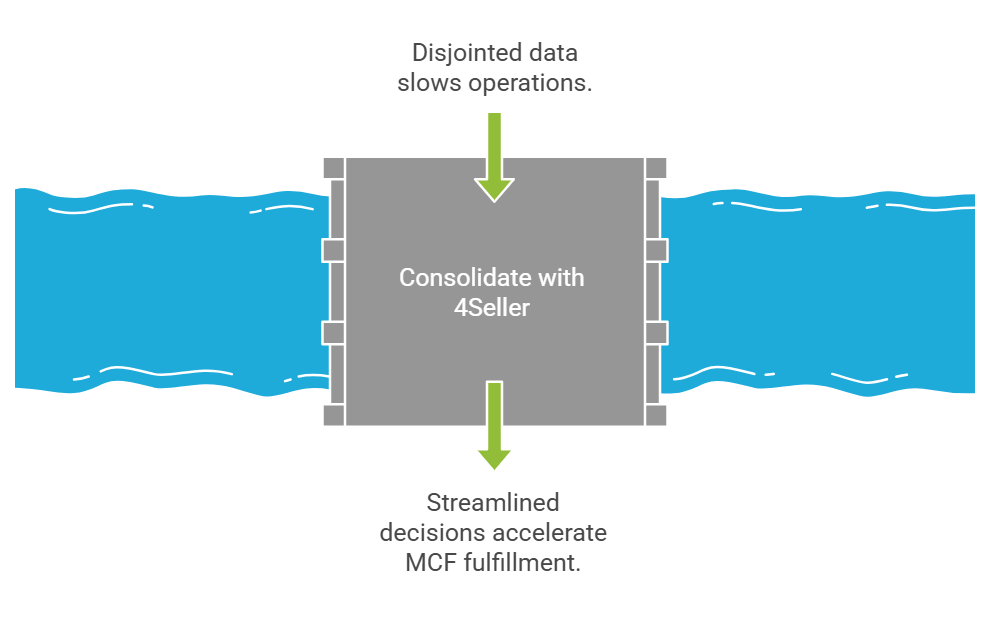
This architecture is incredibly valuable for large organizations because it allows different systems to focus on what they do best, stitched together by Pipe17. But precisely because of this, your business operations are inherently fragmented across multiple platforms. Product management, inventory tracking, fulfillment execution, and profit analysis are often scattered across different tools. Completing a single workflow requires bouncing back and forth between multiple dashboards.
Let's look at a very real scenario: One day, a SKU starts blowing up on TikTok Shop, but you realize the profit margin is too thin and want to adjust the price immediately. You have to go to your listing system (like Feedonomics) to change the price ➔ confirm if it synced ➔ check Pipe17 to ensure orders are still flowing ➔ go to your inventory system to verify stock levels ➔ and finally log into your 3PL (Amazon MCF) to ensure no orders were mis-shipped.
There’s nothing technically "wrong" with this process, but it is completed in disjointed stages. Each system does its part perfectly, but there is no single place to get a "big picture" view. While Pipe17 has incredibly strong connective capabilities suitable for multi-system synergy, this constant "context switching" constantly disrupts your operational rhythm in day-to-day management.
4Seller's logic is the exact opposite. Instead of trying to be a connector, it consolidates these capabilities into a single, unified system. Products, inventory, orders, fulfillment, and even profit data all operate within the same ecosystem. This brings a critical shift: when making MCF fulfillment decisions, you are no longer relying on pieced-together data from various sources, but on a real-time, unified data view. This all-in-one structure fundamentally shortens the path from decision to execution.
2. Overly Complex Rules Can Easily Jam Peak Season Orders
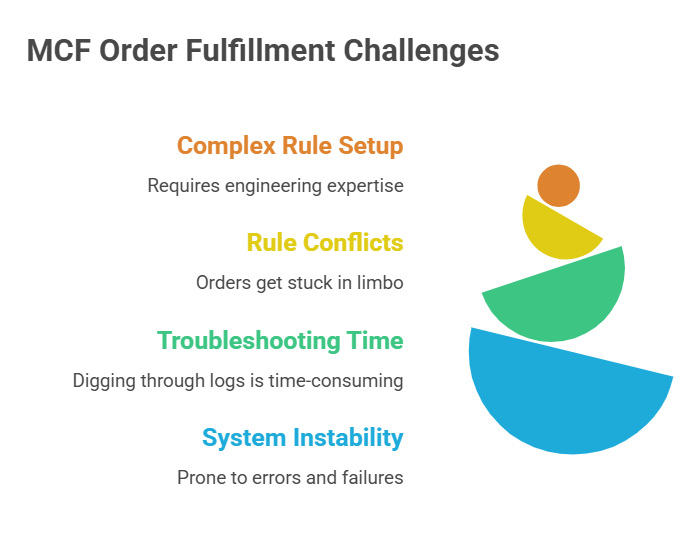
When using MCF, Pipe17’s setup feels more like it was built for engineers. You have to build a rigorous set of rules yourself: what conditions trigger MCF, which warehouse to route from, and how to split shipments. In day-to-day operations, this absolute flexibility often turns into a disaster. Once peak season hits with a massive surge of concurrent orders, or if two of your custom rules conflict, orders get stuck in limbo. Troubleshooting this is incredibly time-consuming; you have to dig through system logs and check API statuses, all while front-end customers are already demanding their tracking numbers.
In contrast, a seller's true pain point isn't "the inability to customize rules," but rather "system instability and proneness to errors." 4Seller hits the nail on the head here by hardwiring numerous complex edge cases into default "best practices." You only need to complete the simplest authorization and SKU matching, then flip the switch for auto-fulfillment. From there, the system automatically closes the loop in the background—pushing orders to MCF, syncing tracking numbers, and updating order statuses. Sellers don't need to be IT experts; they just need a stable system that won't throw errors and quietly gets the job done.
3. Slow Amazon MCF AFTN Sync: Order Delays Can Ruin Store Ratings
For sales channels like TikTok Shop, the speed of tracking sync is practically a lifeline. Whether an order uploads its tracking information on time directly impacts your store performance metrics.
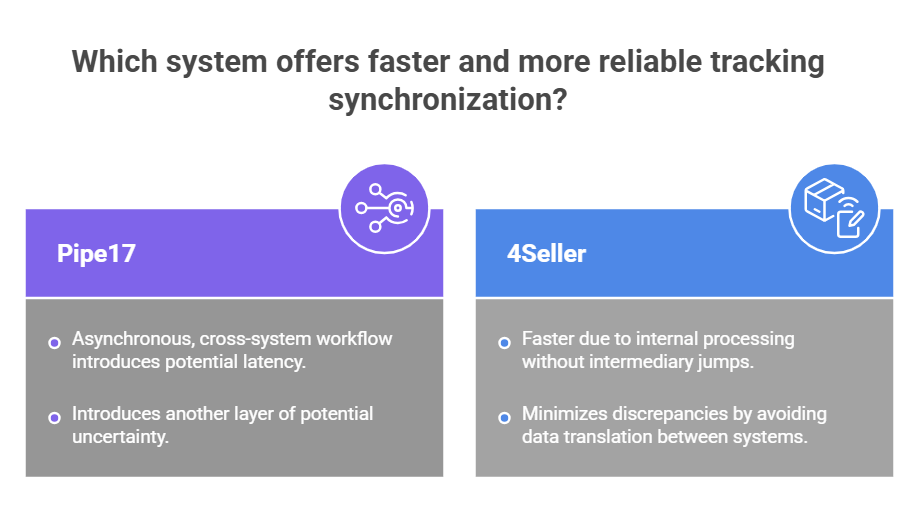
Pipe17 can definitely get the job done here. After an order is pushed to Amazon MCF, the tracking info is routed back to the original platform via Pipe17. The entire process is connected, but it is fundamentally an asynchronous, cross-system workflow. This means data has to flow through multiple nodes, and every additional node introduces another layer of potential latency and uncertainty.
4Seller’s approach is much closer to a closed-loop system. Order fetching, MCF pushing, and tracking syncing all happen within the same platform without extra intermediary jumps. This structure isn't just "faster"; more importantly, it minimizes the discrepancies that can occur when data is translated between different systems.
Especially when dealing with Amazon's unique AFTN (Amazon Fulfillment Tracking Number) format, this closed-loop path effectively mitigates the risks associated with formatting mismatches or sync delays.
4. Lagging Inventory Sync Leads to Instant Overselling During Sales Spikes
For sellers truly running multi-channel operations, inventory is never just a "number to glance at"—it's the core variable that dictates whether an order can be successfully shipped.
When using Pipe17, inventory is often scattered across multiple systems: Amazon FBA holds one set of data, your local warehouse/WMS holds another, and your ERP might hold a third. During daily operations, you have to bounce between these systems to confirm if inventory matches, if there's sufficient stock left, or if you need to switch fulfillment methods.
The problem is that this "fragmented management" might barely hold up during normal, low-volume periods, but it spirals out of control the moment you experience a sales spike.
A classic scenario: A SKU suddenly takes off on TikTok, and orders flood in over a short period. However, your inventory sync is still stuck in the previous cycle. You think you have stock, and the system keeps accepting orders, but FBA is actually on the verge of stockout. Your local warehouse fails to step in on time, and just like that, you've oversold.
Under a multi-system architecture like Pipe17's, this issue is incredibly hard to catch in real time. Inventory changes must first sync across various systems, after which rules must evaluate whether to reroute fulfillment. Every step in this chain has latency. Once the data pipeline gets even slightly extended, the risk of overselling is magnified.
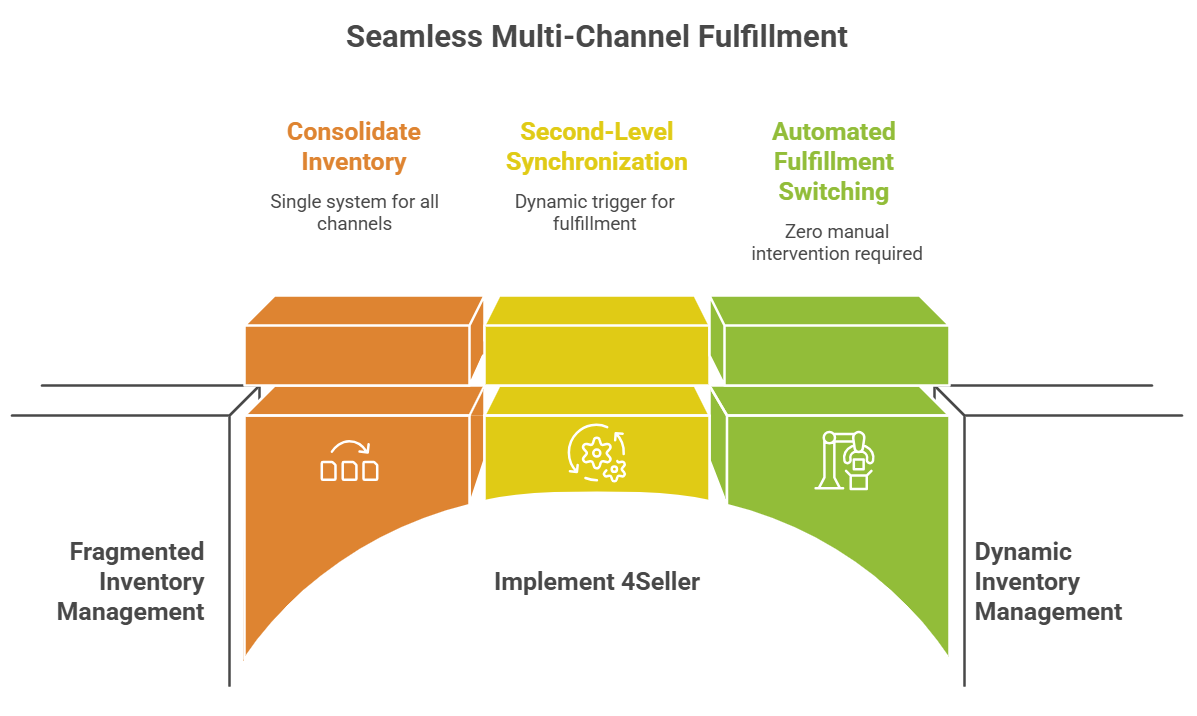
4Seller handles this completely differently. It consolidates inventory from Amazon, TikTok, Shopify, Temu, and other channels into a single system, achieving second-level synchronization. Inventory is no longer just a passive data display; it becomes a dynamic trigger that directly drives fulfillment actions.
For instance, when your local warehouse stock drops to a set threshold, the system can automatically switch to Amazon MCF. When FBA inventory is replenished, it can automatically revert to the original fulfillment path. The entire process requires zero manual intervention and no cross-system validation.
The fundamental shift here is that you no longer need to "babysit your inventory"—you let the inventory drive the decision-making itself. When multiple platforms blow up simultaneously, this capability is often the key to avoiding stockouts and ensuring seamless fulfillment.
5. Enterprise-Grade Tools Give Lean Teams a Headache
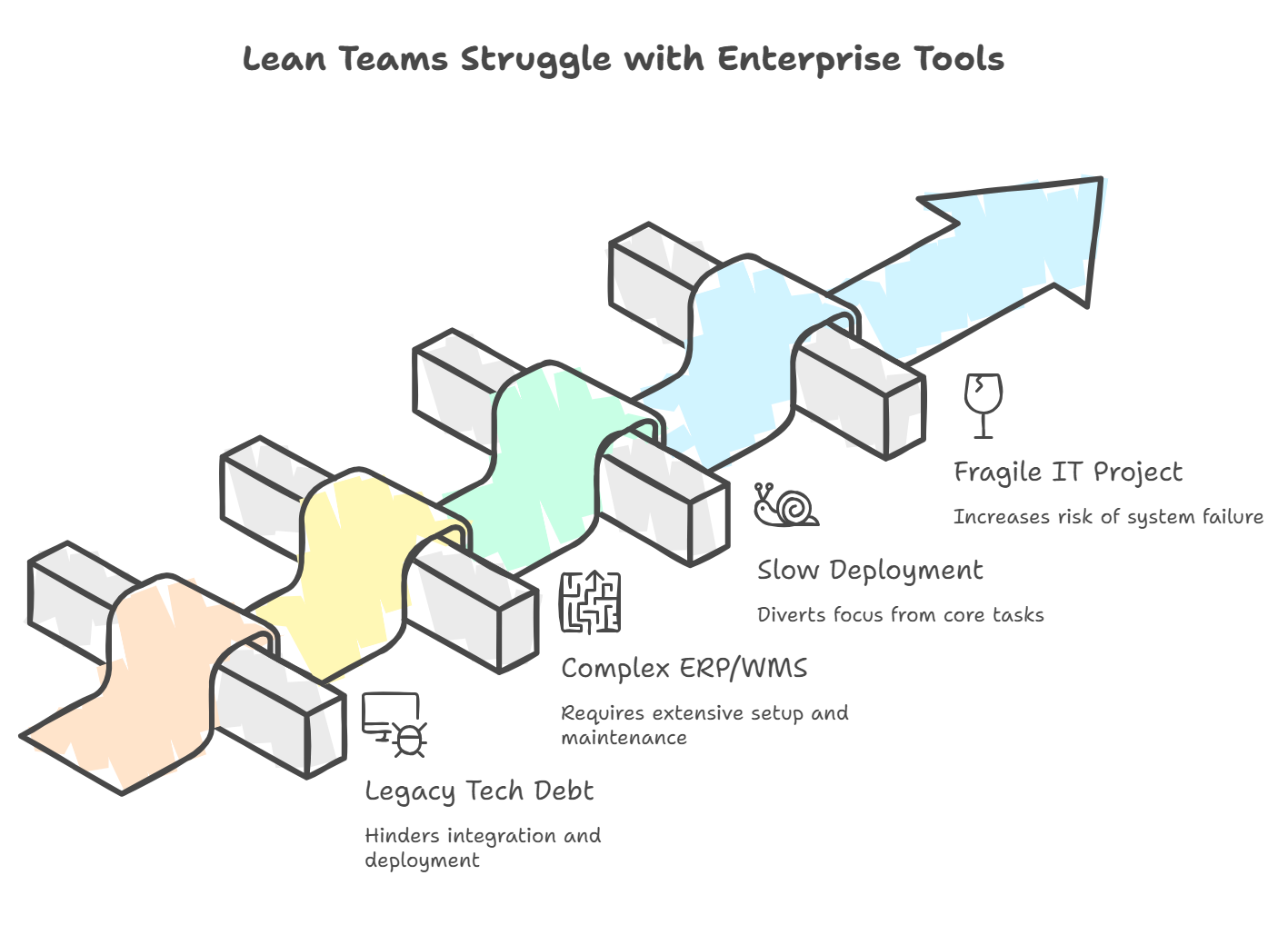
Pipe17 is more like a cure for "large enterprise syndrome." It is perfectly suited for massive, traditional companies burdened with legacy tech debt and highly complex ERP and WMS setups, who simply need a tool to stitch it all together.
But for sellers currently fighting on the front lines of TikTok, Shopify, and Temu, the team's core focus must remain on product selection and driving traffic. You need an out-of-the-box weapon that quickly maximizes the leverage of FBA—not a massive, fragile IT project that takes months to deploy. 4Seller is tailor-made for these agile operation teams that need to "travel light and deliver results fast."
6. How Much Time and Trial-and-Error Have You Wasted Trying to Figure Out MCF?
Finally, we have to talk about the elephant in the room that many reviews avoid: pricing and customer support.
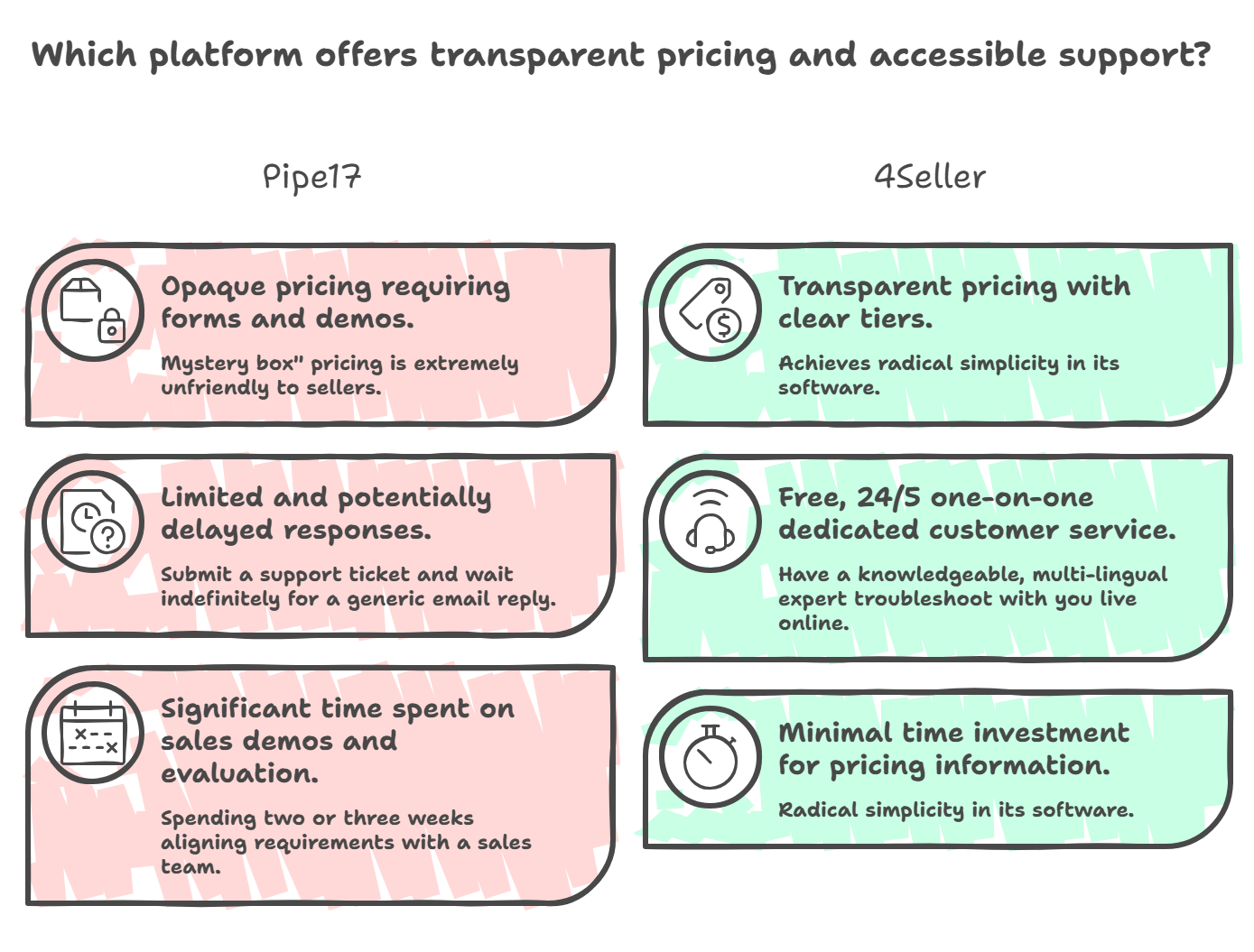
If you go to Pipe17's website, you won't find transparent pricing. You have to fill out forms, book meetings, sit through sales demos, and only after a systematic evaluation of your order volume will they give you a quote. This "mystery box" pricing is extremely unfriendly to sellers. Imagine spending two or three weeks aligning requirements with a sales team, only to discover the base monthly fee is outrageously high, or the tiered pricing based on API calls is incredibly harsh. For teams urgently needing to validate their profit models, this isn't just a financial bottomless pit; it's a fatal waste of time.
Looking at 4Seller, it not only achieves radical simplicity in its software but also offers a level of service that simply outclasses the competition. Multi-language support breaks down communication barriers, and more importantly, they provide free, 24/5 one-on-one dedicated customer service. They will even jump on remote screen-share calls to walk you through roadblocks step-by-step. When you hit an order sync error in the middle of the night, would you rather submit a support ticket and wait indefinitely for a generic email reply, or have a knowledgeable, multi-lingual expert troubleshoot with you live online? The answer is obvious.
Conclusion
If we had to summarize the difference in one sentence, it would be this: Pipe17 solves "how to connect systems," while 4Seller solves "how to execute business faster." The former makes complex architectures manageable, while the latter shortens the path of execution.
While Pipe17 remains incredibly powerful in terms of enterprise-level capabilities and system scalability, for the vast majority of sellers looking to fulfill multi-channel orders via Amazon MCF, 4Seller Easy MCF is the better fit. Through its all-in-one structure and automated closed-loop system, it compresses actions that normally require cross-system hopping into a single, intuitive dashboard.
In an increasingly fast-paced e-commerce environment, this "shorter pipeline" is often the true key to determining whether you can sustainably scale your order volume.
Free multilingual 24/5 remote 1-on-1 meeting booking [Link]
For reference: [Easy MCF user guide] 【4Seller X Amazon MCF Introduction】
Contact us: [WhatsApp] / [LinkedIn] / [Instagram] / [Facebook] / [E-mail: support@4seller.com]
- Multi Channel Order Management
- TikTok Shop
- Amazon
- Temu
- About 4Seller
- Shopify
- Multi Channel Inventory Management
- Amazon MCF&FBA
- Seller Tips
- Listing Management
- Marketplace News
- Amazon Shipping
- DHL Express
- Amazon MCF
- UPS
- FedEx
- eBay
- Shein
- Creator Bulk Invite
- Multi-channel Store
- Inventory Sync
- GLS
- Walmart WFS
- Walmart
- Seller Story
- Beginner Tutorial
- Royal Mail
- Kaufland
- Shipping Integration
- DHL Parcel
- 3PL
- WooCommerce
- Walmart MCS
- Deutsche Post
- Shipping Label
- OTTO
- Platform Integration
- PayPal Tracking Sync
- UniUni
- Yodel
- ShipHero
- SPU Catalog
- Stripe Tracking Sync
- USPS
- AliExpress
- GOFO
- CIRRO
- Correos
- Correos Express
- DPD
- Etsy
- Evri
- FBM
- Request Review
- Logistics Rule
- CaiNiao
- BRT
- Chronopost
- Poste Italiane
- Cdiscount
- OMS
- DHL
- WFS
- ShipBob
- Price Sync

 17 Dec,2024
- 17 Dec,2024